
The short answer
To repair commercial roof problems in the right order, find out first whether the water is a leak or condensation. A leak goes to a roofing contractor, because spray foam is not waterproofing. Condensation dripping from a sound metal roof is underside insulation work, which is what HOLVEM does.
HOLVEM carries out coating, encapsulation, sealing and insulation refurbishment. We are not a general roofing contractor. The useful question is what can safely stay, what needs another trade, and how the work fits the people and equipment underneath.
01Sort the symptom before choosing the contractor
Sort the symptom before choosing the contractor
Before choosing a contractor, look at when the floor gets wet. Is it during rain, after a cold night or while production is running? Photograph the patch from a safe position inside and note the timing. Stay off the sheets and rooflights; a roof inspection needs planned access.
The following table is a starting point for assessment. A symptom can have more than one cause, and a survey may change the initial route.
| What you notice | Possible cause to investigate | Who assesses or fixes it | Disruption to plan | Can the premises remain in use? |
|---|---|---|---|---|
| Wetting at a fixing, lap or penetration during rain | A failed weathering detail or local sheet defect | Roofer first; coating contractor where a suitable refurbishment is specified | Access and protection around the affected area | Possibly, with agreed exclusion zones |
| Widespread droplets on the underside | Condensation on a cold surface; rain entry must also be checked | Check the roof and moisture first; use the findings to choose the insulation treatment | Access beneath the roof and protection of contents | Possibly, through phased work |
| Worn external finish on otherwise serviceable roofing | Deterioration of the existing weathering finish | Roofer checks repairs; coating contractor assesses preparation and compatibility | External access, preparation and weather-dependent working | Often possible in an agreed programme; never assumed |
| Damaged sheets or suspect supporting structure | Physical failure requiring investigation | Roofer and, where needed, structural engineer | Local closures or a wider shutdown may be necessary | Decided by the responsible specialists |
| Air movement through the roof assembly | Gaps or incomplete sealing, potentially alongside other defects | Roofer for defective components; sealing or insulation contractor for an agreed treatment | Work around junctions, services and access routes | Depends on the treatment and working area |
A treatment follows the diagnosis. It should not be selected simply because it can cover the visible stain. Read roof leak or condensation for the distinction between rain entry and moisture forming inside the building.
A treatment follows the diagnosis. It should not be selected simply because it can cover the visible stain.
Leak or condensation?
- Likely a leak: water appears during or soon after rain at the same lap, fixing, rooflight or gutter. Call a roofer.
- Likely condensation: droplets form across the underside after a cold night or during production, even in dry weather. Ask us to check the roof.
- Both: get the roof watertight first, then insulate the underside.
These patterns point to the next check; the survey confirms the cause. Read leak or condensation.
02What must a roofer put right first?
What must a roofer put right first?
Agree the handover between roofer and treatment team
- 01RooferBroken sheets, defective fixings, drainage and failed junctions.
- 02Structural engineerWhere supports are damaged or movement raises a concern.
- 03Asbestos surveyorWhere asbestos-containing roofing is present or suspected.
- 04TreatmentFinish the agreed repairs, then coat, seal or insulate the prepared roof.
Once you know the cause, agree the repairs. A roofer checks broken sheets, fixings, drainage and leaking junctions. If the supports are damaged or the frame has moved, bring in a structural engineer too. Your treatment quote should name that work and who completes it first.
We need a ready surface before we coat or spray. Ask which repairs are included, which need another contractor and how completion will be checked. That keeps the job moving in the right order, with each team working on a roof that is ready for them.
The teams need to agree where one job ends and the next begins. For example, a roofer repairs the penetration before we prepare the surrounding surface. Put that handover in the programme, alongside the underside insulation, so you know who is responsible at each stage.
Where an asbestos-containing roof is present or suspected, the dutyholder should involve a competent asbestos surveyor and follow HSE asbestos guidance. Removal and replacement need their own quotations. HOLVEM never removes asbestos sheets; removal is a job for asbestos removal professionals, licensed where HSE requires it.
Any work on or under the roof is planned under the Work at Height Regulations 2005. Treat rooflights and roof sheets as fragile until a competent person confirms otherwise, and never walk a roof to look for a leak.
03When coating from outside is worth assessing
When coating from outside is worth assessing

From outside
Coat
- Answers
- A weathering objective on a retained roof that can take the preparation.
- Needs first
- Repairs to failed details, and a suitable substrate.
From beneath
Seal and insulate
- Answers
- Air leakage and condensation on a suitable roof assembly.
- Needs first
- A moisture assessment and a condensation risk analysis.
Renew
Replace
- Answers
- A roof or structure that cannot reasonably be retained.
- Needs first
- A complete replacement proposal, not just new sheets.
Once the roof is ready to retain, ask what the weather side needs. We assess the existing finish, sheet condition, junctions and access before specifying an external coating system. Your proposal should include the preparation and how each detail will be finished.
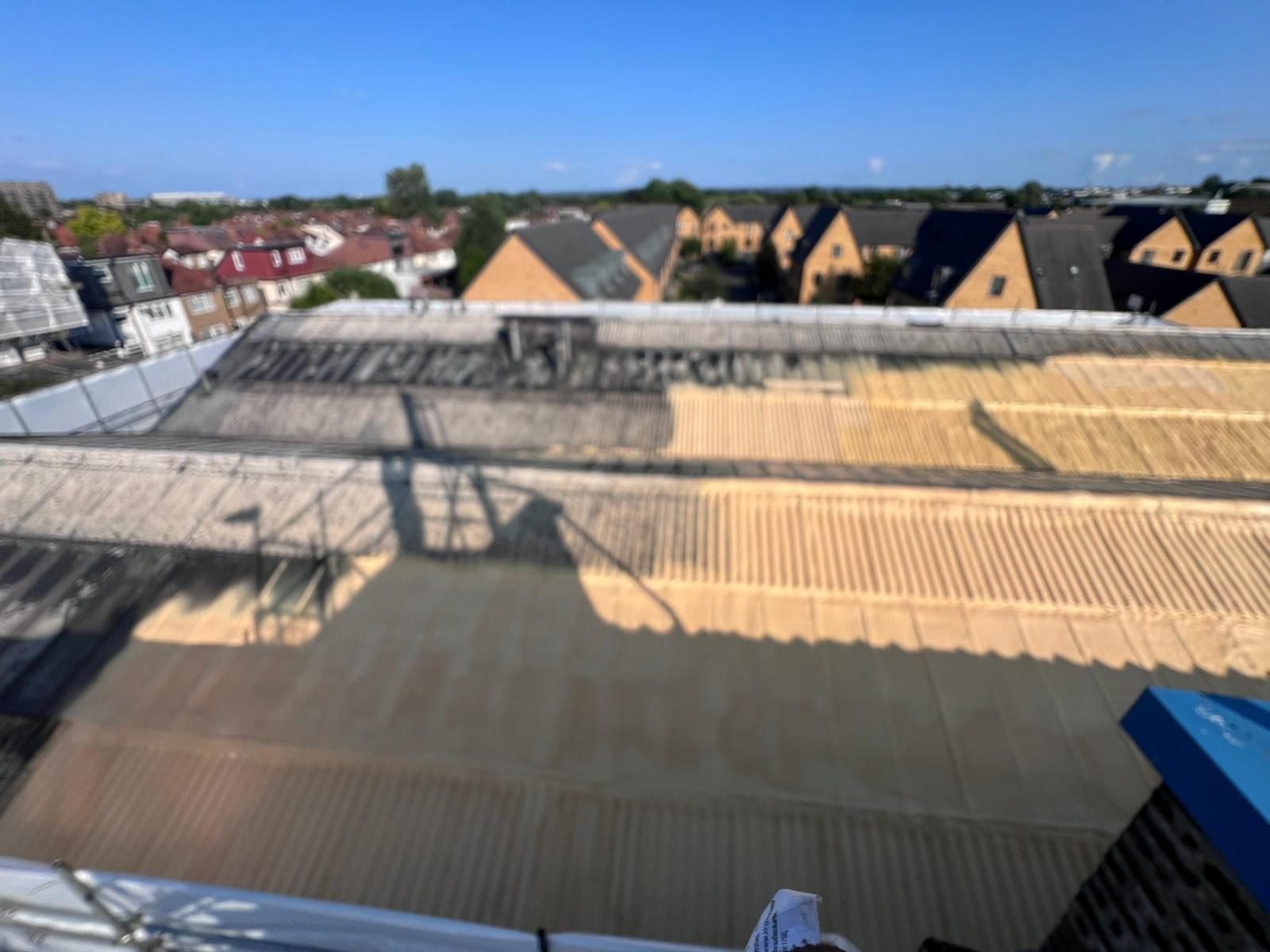
Global House, Surbiton, provides a recorded example of work from outside:
 Project recordGlobal House, Surbiton
From the project record
external work from above on about 1575 m² of pitched asbestos-cement roofs and an office roof: biocidal wash, 25 mm closed-cell roofing foam, airless silicone finish, as one continuous system; removal ruled out with homes and businesses close by.
Read Global House, Surbiton.
At Global House, the wash, roofing foam and silicone finish formed one complete external system. The preparation and weathering layer explain what that job involved. We check your roof at survey before proposing the same route.
A coating-life answer needs the specified system and the conditions it will face. Substrate, preparation, exposure and maintenance all matter. There is no single lifespan to attach to commercial roof repair as a category. Read commercial roof coating and waterproofing for the application route.
04When sealing or insulation from beneath addresses the problem
When sealing or insulation from beneath addresses the problem
Correctly diagnosed and specified, closed-cell spray foam stops roof condensation. Zero call-backs for condensation. So if your roof is sound and the drips form underneath it, we look at the inside treatment. We check the roof layers and how you use the building, then set the depth. Existing leaks go to a roofer first.
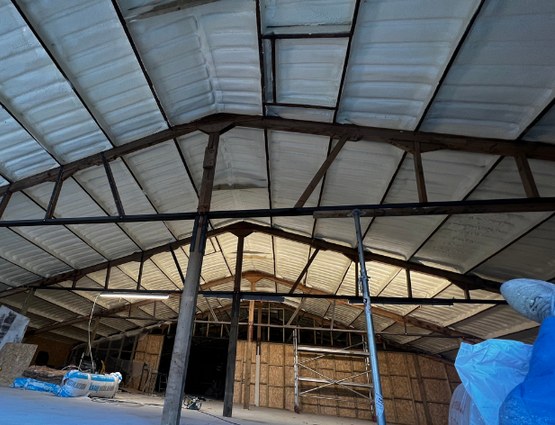
The Midlands warehouse needed an answer to three problems:
 Project recordMidlands distribution warehouse
From the project record
corrugated metal roof that leaked air, ran with condensation and drummed under rain.
We chose 75 mm closed-cell for that roof and applied it beneath the corrugated sheets in one continuous layer.
That 75 mm layer answered the warehouse's air leakage, condensation and rain noise. Your survey starts with your own problems and sets the depth from there. Tell us which matters most, and include the others in the brief.
A condensation risk analysis sets the proposed build-up. The survey also needs to consider access, rooflights, services and the areas being retained untreated. If the building has several different roof constructions, one depth or detail may not be suitable across all of them. A clear specification shows where each treatment starts and ends.
Where the roof is sound and the problem is condensation, not a leak, closed-cell spray foam stops roof condensation. It is sprayed to the underside, typically 25 mm or 50 mm closed-cell, depending on the roof make-up, confirmed before we spray. On the TJW Grab Hire warehouse in Bournemouth, about 505 m² of sound box-profile steel received 50 mm closed-cell, and the customer reported the condensation eliminated. TJW Grab Hire warehouse.
05Can production continue?
Can production continue?
With the treatment decided, we can plan the floor. Tell us which areas you can release, what needs protecting and when production runs. We agree the separated work zones, ventilation and re-entry before starting, so the rest of the building can operate around the plan.
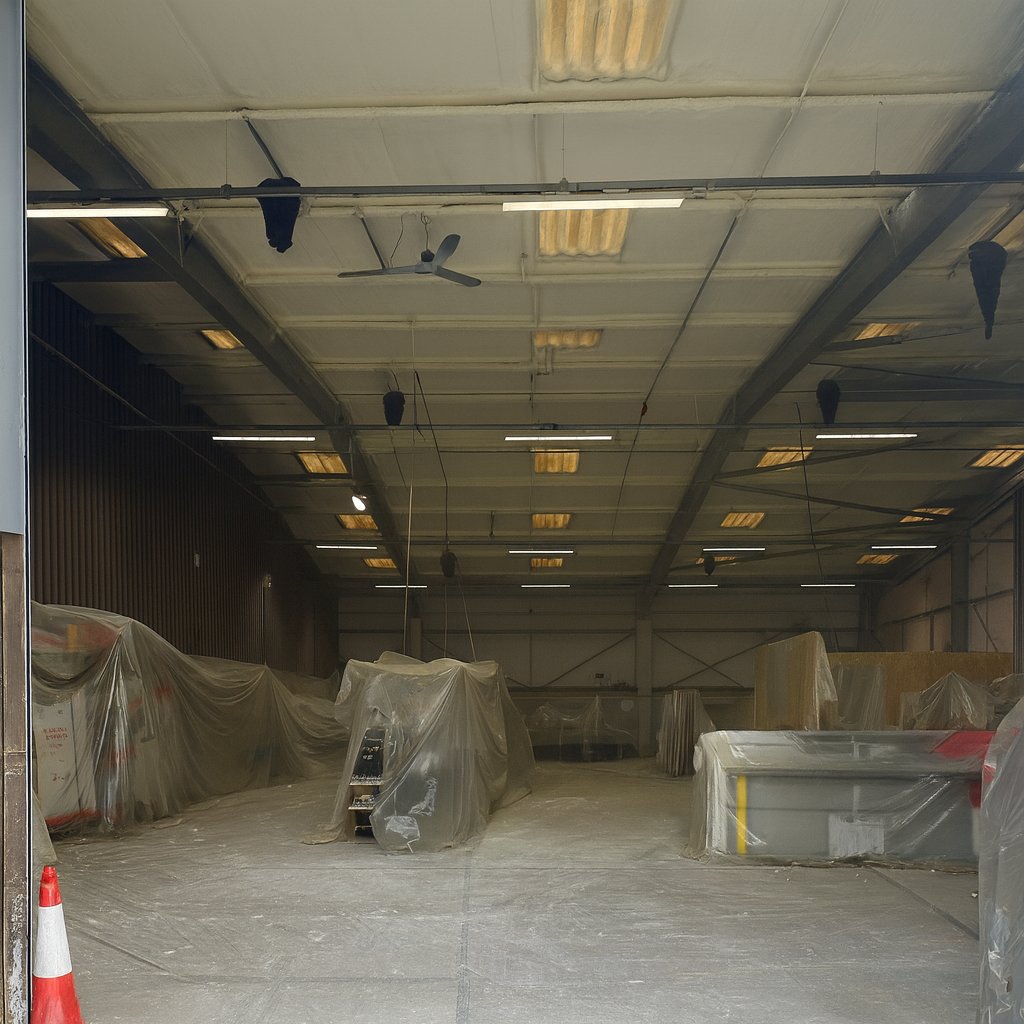
Nuneaton Signs gives a specific example of working around production:
 Project recordNuneaton Signs
From the project record
about 2924 m² of factory roof of insulated panels over 150 mm of mineral wool, whose original sheets were suspected of containing asbestos, sealed from beneath with 25 mm closed-cell, worked at weekends with production untouched.
Read Nuneaton Signs.
At Nuneaton Signs, weekend access kept weekday production running. The roof was panels over mineral wool, with suspected asbestos sheets beneath, so both the construction and shift pattern shaped the work. Bring those details into your own enquiry.
Walk us through the floor: stock, machinery, food areas, vehicles and anything fixed in place. Then agree what moves, who protects it and how each work zone is controlled. If we work in phases, you should know when every area is released and handed back.
A building may need a temporary closure even when no stripping is proposed. It may also support a workable phased route. The programme should describe the actual restriction, rather than use a broad promise that business will continue unaffected.
Industrial roof repair follows the same order: a roofer for leaks first, then insulation from beneath where condensation or heat loss is the issue. On the Nuneaton Signs factory, about 2,924 m² of roof was sprayed from beneath with 25 mm closed-cell at weekends, so weekday production was untouched. Nuneaton Signs factory.
06Compare what the quotes include
Compare what the quotes include
Now compare the finished jobs. Does the price include fixing the leaks, or assume a roofer has already done it? Does it include preparation, coating and access, or just foam beneath the sheet? Get those answers alongside the total before choosing.
Use this checklist when reviewing a proposal:
- What defect or objective is the treatment addressing?
- Which roof areas and details are included?
- What evidence supports keeping the existing roof?
- What preparation is specified, and what condition must be achieved?
- Which repairs are prerequisites, and which contractor owns them?
- How are rooflights, penetrations and interfaces handled?
- What access, protection and exclusion zones are included?
- What interruption to normal use is planned?
- What inspection, handover and maintenance information will be supplied?
- Which exclusions could require a separate quotation?
Ask the contractor to point to the details on your roof: the damaged lap, wet layer or fragile rooflight. Photographs help with that first conversation. The survey then checks the parts that need a closer look and puts the work in writing.
For pricing context, read the commercial spray foam insulation cost guide. A foam-only rate should not be used as the price of an external system with preparation and a weathering finish. Removal and replacement need their own quotations.
Roof repairs are priced by the roofer after an inspection. For the underside insulation route, closed-cell spray foam is from £16/m² + VAT (foam only, 25 mm). Coated systems are priced per project, never at foam-only rates. The full rates are in our cost guide. cost guide.
07When replacement becomes the route
When replacement becomes the route
Sometimes that closer look points to replacement. If the sheets or frame cannot support the proposed treatment, a roofer or structural engineer sets out what needs changing. We tell you when keeping the roof is the wrong choice.
For that route, price the complete new roof. Include access, removal, waste, new rooflights and weathering details, plus the effect on your operation. If asbestos is present, start with the dutyholder's information and qualified asbestos advice so the contractors price the right work.
Age is a reason to inspect the roof, not a reason to replace it automatically. Compare what is still sound with the work it needs. Read ageing commercial roof: refurbish or replace for how to make that decision.
08Give us a useful first view
Give us a useful first view
Ready to discuss it? Send your location, building use and rough roof area, with the water pattern you have noticed. Include previous repairs and any roof or asbestos surveys you already hold. That gives us a useful starting point before a visit.
Take the overall underside, affected areas and visible junctions from safe positions inside. Existing outside photographs help too. If a detail is out of reach, say so and leave it for the planned inspection. Stay off fragile roofs and leave suspect materials undisturbed.
Start a project brief or Send photographs. We will check the next step with you, including any roofing or structural work needed before treatment.

