
The short answer
Metal roof repair starts with one question: is water coming through the roof, or forming underneath it? A leak at a fixing, lap or rooflight goes to a roofer first. Condensation, and the corrosion it drives at fixings and laps on a sound sheet, is treated from below with closed-cell spray foam, confirmed before we spray.
We coat, seal and insulate commercial roofs. A roofer repairs failed sheets and weathering details; a structural engineer checks the supports where needed. We help you put those jobs in the right order, so you spend on the roof's actual problem.
01Read the condition before the specification
Read the condition before the specification
Before comparing methods, show us the roof you have. Is it one sheet or an insulated build? When does it get wet, and where? Drawings and previous repair reports help us connect what you see underneath with the layers above.
Then check how much sound steel remains. A stain is a clue, but the roofer needs to inspect the sheet, laps and fixings up close. Damaged supports need a structural engineer. Those findings decide what can be repaired, coated or kept for insulation.
Keep inspection separate from access. HSE's fragile-surface guidance explains the risks around roof work. Do not walk onto a roof or rooflight to obtain photographs. Accessible views from the floor and existing external images can start the discussion.

02Compare four routes that answer different problems
Compare four routes that answer different problems
| Route | What it can address | What to check before choosing | Working arrangements | What needs checking first |
|---|---|---|---|---|
| External coating | A specified weathering refurbishment of a suitable retained roof | That damaged sheets or structure are repaired by covering them | External access, preparation and weather-dependent work | Sheet condition, repairs, existing finish and treatment compatibility |
| Sealing and insulation from beneath | Air sealing and stopping roof condensation, with depth confirmed before we spray; TJW Grab Hire is a recorded example | That an active rainwater leak or lost steel section is repaired | Internal access and protected working zones | Condensation or leak check; depth typically 25 mm or 50 mm closed-cell, depending on the roof make-up, confirmed before we spray, with a condensation risk analysis where needed |
| Overcladding | A new roof covering over an existing assembly, where professionally designed | That the existing roof can carry the proposed assembly without assessment | Roofing access and an agreed occupation plan | Structure, loading, moisture strategy and interfaces |
| Replacement | Renewal where retaining the existing covering is unsuitable | That all supporting structure is automatically included in the quotation | Removal and new-roof programme, with closures assessed | Check the roof, supporting frame and working area |
With those findings, compare overcladding and replacement as complete roofing jobs. Ask the roofer about the supports, new layers, rooflights and gutters. We can then explain where a coating or underside treatment fits alongside them.
Correctly diagnosed and specified, closed-cell spray foam stops roof condensation. Zero call-backs for condensation. Existing leaks go to a roofer first. The depth is typically 25 mm or 50 mm closed-cell, depending on the roof make-up, confirmed before we spray. At TJW Grab Hire, a sound steel roof took 50 mm from beneath and the customer reported the condensation eliminated. Backed by our 25 year HOLVEM workmanship warranty, plus the manufacturer's 25 year product warranty issued directly to you. Your survey shows which parts of the roof can stay and which need repair.
Compare the roof you will have when each job is finished.
03A sound sheet can still run with condensation
A sound sheet can still run with condensation
At TJW Grab Hire in Bournemouth, the steel was sound and the water was condensation:
 Project recordTJW Grab Hire, Bournemouth
From the project record
At TJW Grab Hire, the sound 505 m² box-profile steel roof was dripping onto vehicles and equipment. We applied 50 mm closed-cell foam underneath to address the condensation, keeping the existing roof.
the customer reported that the condensation was eliminated.
TJW's roof was in good condition and received 50 mm of closed-cell foam. Closed-cell spray foam stops roof condensation; a leak needs a roofer first. The depth is typically 25 mm or 50 mm closed-cell, depending on the roof make-up, confirmed before we spray, with a condensation risk analysis where needed. Backed by our 25 year HOLVEM workmanship warranty, plus the manufacturer's 25 year product warranty issued directly to you. This is condensation treatment on a sound roof. A corroded or damaged sheet needs its own roofing assessment and repair.
For the application itself, read metal roof insulation. A condensation risk analysis sets the build-up for the proposed conditions; an area figure and a photograph do not set the thickness on their own.
Steel roof repair follows the same rule on box-profile and corrugated sheet: when the sheet is sound and the water forms underneath, repairing the metal roof means stopping the condensation, not replacing the steel.
04Why inspect both faces of the roof?
Why inspect both faces of the roof?
That is why we look at both faces. Outside, the coating, laps and washers keep rain out. Underneath, a cold sheet can drip even in dry weather. Checking both helps us separate a weathering repair from the insulation job.
If you can see rust, the next question is what keeps the steel wet and how much metal remains. The survey checks those separately. We can stop condensation on a sound roof; a roofer repairs or replaces steel that has already deteriorated.
For that first check, read metal roof corrosion. If your roof is corrugated, the corrugated roof insulation page shows how we treat its underside once the sheet is sound.
05Cut edges and fixings: where metal roofs fail first
Cut edges and fixings: where metal roofs fail first
Cut-edge corrosion starts where a sheet was cut, at laps and sheet ends, because the bare edge has no protective coating. Fixings fail the same way: every fixing hole breaks the coating, and the sealing washer hardens with age. From below, a continuous layer of closed-cell spray foam seals the underside of laps and fixings and removes the condensation that keeps them wet. From above, cut edges on a sound roof can be treated with a roof coating, a HOLVEM service, once failed fixings are replaced and cracked sheets repaired. Spray foam is not waterproofing, and holed or badly thinned sheets go to a roofer first.
- Cut edge at the lap
- Fixing and sealing washer
- Condensation underneath
- Closed-cell layer below
Metal roof problems and who fixes them first
| Problem | What you see | First call | Where we come in |
|---|---|---|---|
| Loose or rusted fixings | Rust rings or rain drips at a fixing | Roofer replaces the fixings | Underside closed-cell once watertight, if condensation is present |
| Lap or seam leak | A wet track after rain | Roofer repairs the lap | Condensation treatment once the leak is repaired |
| Cut-edge corrosion | Rust and peeling coating at sheet ends | Survey of the sheet | Roof coating where the sheet is sound |
| Hole or puncture | Daylight or a single drip point | Roofer repairs or replaces the sheet | Treatment after the sheet is sound |
| Condensation drips | Beads across the sheet on cold mornings | HOLVEM survey | Typically 25 mm or 50 mm closed-cell, depending on the roof make-up, confirmed before we spray |
| Underside rust | Rust streaks or white bloom | Roof survey to check remaining steel | Closed-cell after a roofer replaces any thinned sheets |
06One roof can need several jobs
One roof can need several jobs
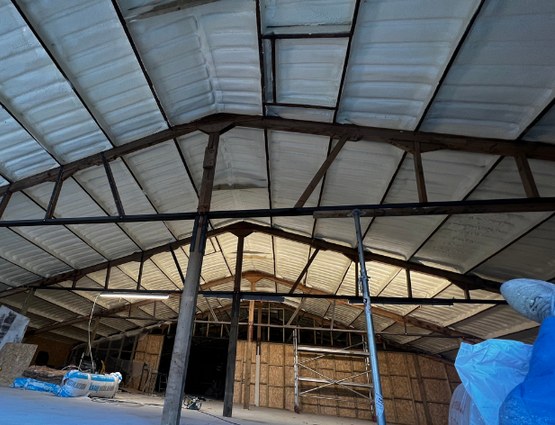
The Midlands warehouse shows why we ask what is leaking:
 Project recordMidlands distribution warehouse
From the project record
corrugated metal roof that leaked air, ran with condensation and drummed under rain.
We applied 75 mm closed-cell beneath the corrugated metal in one continuous layer, with the depth chosen for that warehouse.
There the problem was air leakage, condensation and rain noise. Those are different from rain getting through a hole. Your quote should name the problems you want solved and show how the chosen treatment addresses each one.
If the objective is external weathering refurbishment, read commercial roof coating. The preparation and finish should be specified for the retained substrate, with prerequisite roofing work identified.
07Related steel evidence: a container is not a roof
Related steel evidence: a container is not a roof
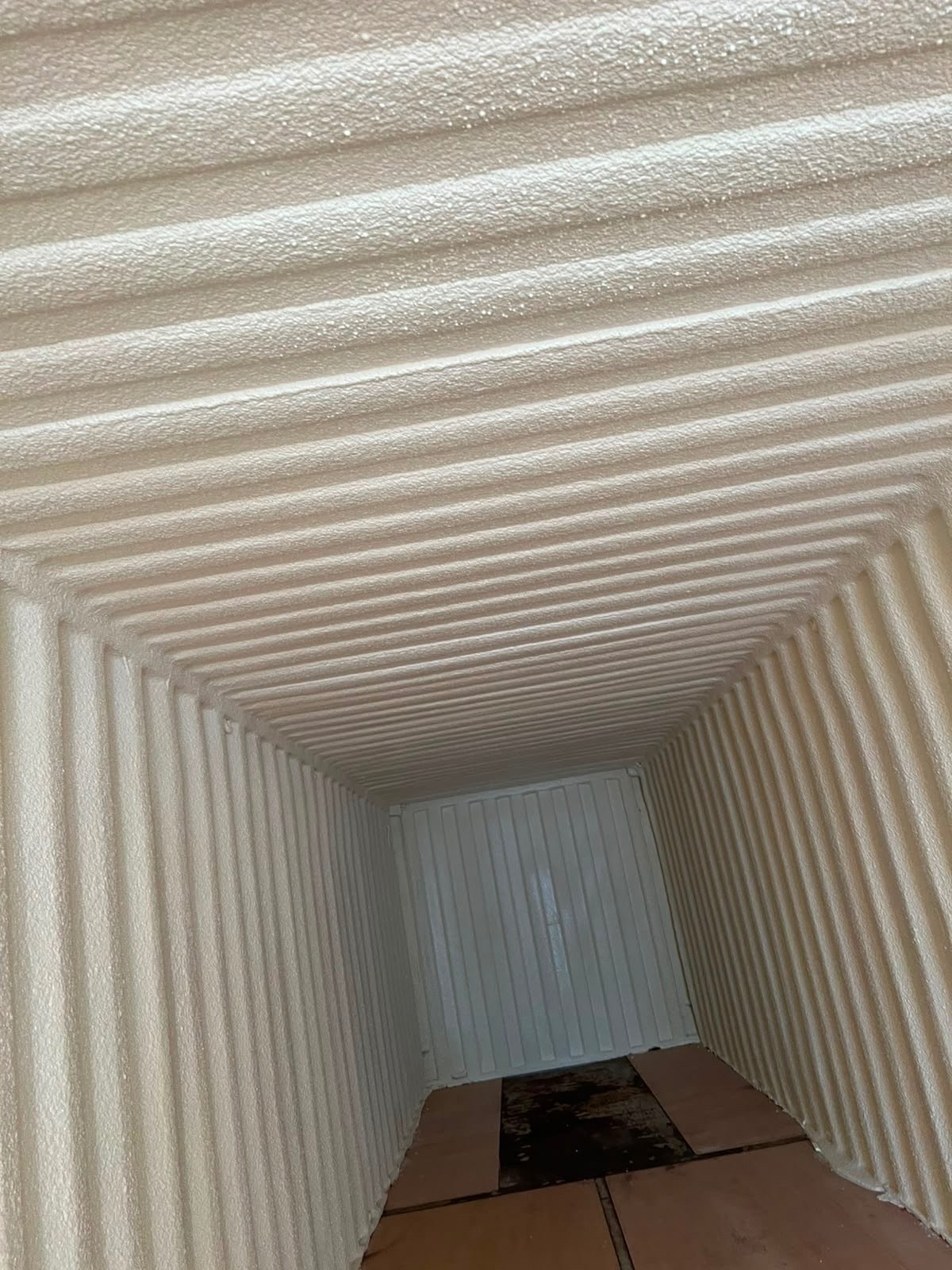
The Regis School in Bognor Regis shows the same first decision on steel containers:
 Project recordThe Regis School, Bognor Regis
From the project record
The treated container: condensation reported stopped.
The second container had a live leak, so we did not spray it.
The container example helps explain the diagnosis: condensation needs a different response from an active leak. It is evidence from a steel container, rather than proof of a roofing repair. A defective roof sheet still needs the appropriate repair first.
08Plan work around what is underneath
Plan work around what is underneath
Once the roof treatment is agreed, turn to the floor. Tell us about equipment, stock and vehicle movements, including what can move and what must stay. We use that layout to plan protection, working zones and access from beneath.
For external work, the access and roofing programme still affect occupation. Ask who controls the area, which routes remain available and what restrictions apply while work is under way. A retained roof may allow a practical phased programme, but continued use should be agreed for the actual building.
Before comparing proposals, ask for:
- Which roof defects need fixing first, and what you want the treatment to achieve.
- Evidence that the areas being retained are suitable.
- Roofing repairs required before coating or insulation.
- How the surface will be prepared and the laps, edges and openings finished.
- The basis for any insulation depth.
- Access, protection and occupation arrangements.
- Handover information and any maintenance requirements.
Start a project brief or Send photographs. Include the use, rough area and roof layers you know, then tell us when it gets wet. That gives us more to work with than a description of a rusty roof.


