Before 3pm on a working day, contacted the same day. After 3pm, the next working day. Contact, not a quotation. Telephone
Start a project brief
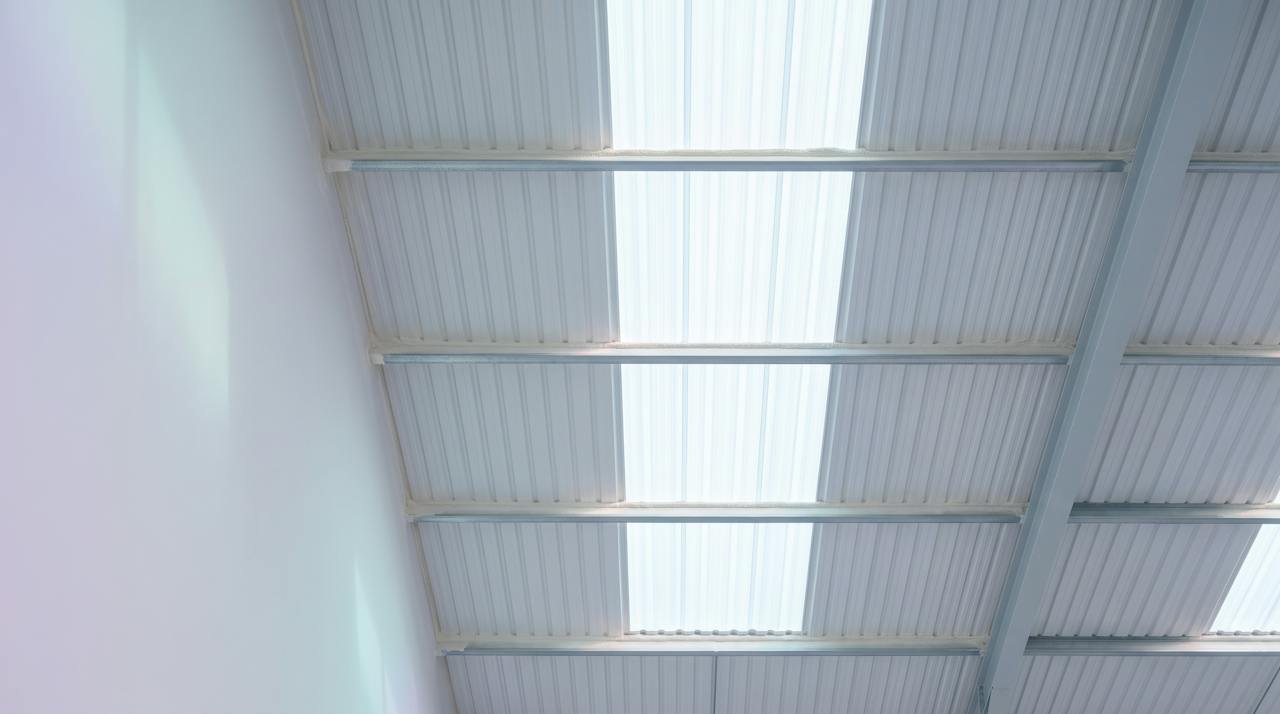
Looking up at a profiled metal roof: a translucent rooflight strip coated in a thin pale primer film, the steel sheets and purlins either side sprayed in ivory closed-cell foam.

Coating service

Bostik Idenden ET‑150: the sealing coat under a sprayed rooflight.

A water-based, sprayable vapour barrier coating from Bostik that dries to a flexible, water-resistant film. Where a client opts to have rooflights sprayed for a fully sealed roof, HOLVEM primes them with ET-150 first. It is a sealing coating, not a fire coating, and it is never offered as one.

  • Primed before any rooflight is sprayed
  • Two coats in two colours, so coverage shows
  • Nationwide coverage

01What it is

A sprayable coating that seals a surface and stays flexible.

Idenden ET-150 is made by Bostik in Stafford. It is a water-based co-polymer emulsion, thick enough to hold on a vertical surface, applied by airless spray or brush in two coats. It dries to a durable, flexible, water-resistant film that resists liquid water while letting small amounts of water vapour pass. Bostik calls it a vapour barrier coating and, for internal work, a breather coating.

What Bostik makes it for, and how HOLVEM uses it.

Bostik's stated uses are a vapour barrier coating on internal and external insulated pipework, equipment and air-conditioning ductwork, and the encapsulation of sound asbestos. On a HOLVEM job it has one lead role and two that are asked about.

The lead role is the rooflight. Some clients want the whole roof sprayed as one sealed layer, rooflights included, and give up the daylight at those rooflights to get it. Before any rooflight is sprayed, HOLVEM primes it with two coats of ET-150 to protect the rooflight and the foam that goes over it. Daylight through a rooflight carries ultraviolet light, which weathers exposed polyurethane over time; the dried film sits between the two, and the foam goes onto a sealed, flexible surface rather than onto bare GRP or polycarbonate. That is HOLVEM's reasoning and HOLVEM's method, built on a coating Bostik makes for sealing surfaces. It is not a Bostik specification for rooflights or for spray foam, and it is written here as our practice.

The two asked-about roles are the ones Bostik lists: a sealing coat over insulated ductwork and pipework. Where a project has plant to seal, ask us, and it is surveyed with the rest of the work.

ET-150 does nothing for the fire strategy. It has no Euroclass and no fire test on a foam build-up. For an exposed foam surface that must reach a class, the coating is DC315, and the two are kept apart on every job.

Profiled metal roof undersideCondensation risk analysis
02Where we use it

Rooflights first. Insulated plant when you ask.

Every roof HOLVEM sprays has a decision to make at each rooflight: keep the daylight and detail a closed stop edge around it, or spray it in for a fully sealed roof. Where the client chooses the second, ET-150 goes on first. On the same buildings, insulated ductwork and pipework are where the coating's other uses come up.

The lead use

Rooflights a client opts to have sprayed

On profiled and corrugated roofs over warehouses, industrial units and agricultural buildings. Two coats of ET-150 on the rooflight, then the foam over it once the film has dried through.

Corrugated roof underside

The other choice

Rooflights kept clear

Most clients keep the daylight. The rooflight is boxed off or covered, the layer stops short at a closed, coated edge, and ET-150 is not needed. The choice is yours, and both are detailed before the work starts.

How the stop edge is detailed

Ask us

Insulated ductwork

Bostik's stated use. A sealing coat over insulated air-conditioning and ventilation ductwork, with reinforcing cloth embedded where the duct moves or gets knocked.

Surveyed per project

Ask us

Insulated pipework and equipment

Bostik's stated use. A vapour barrier coating over insulated pipework, tanks and vessels, internal or external, shaped so water does not stand on it.

Pipework
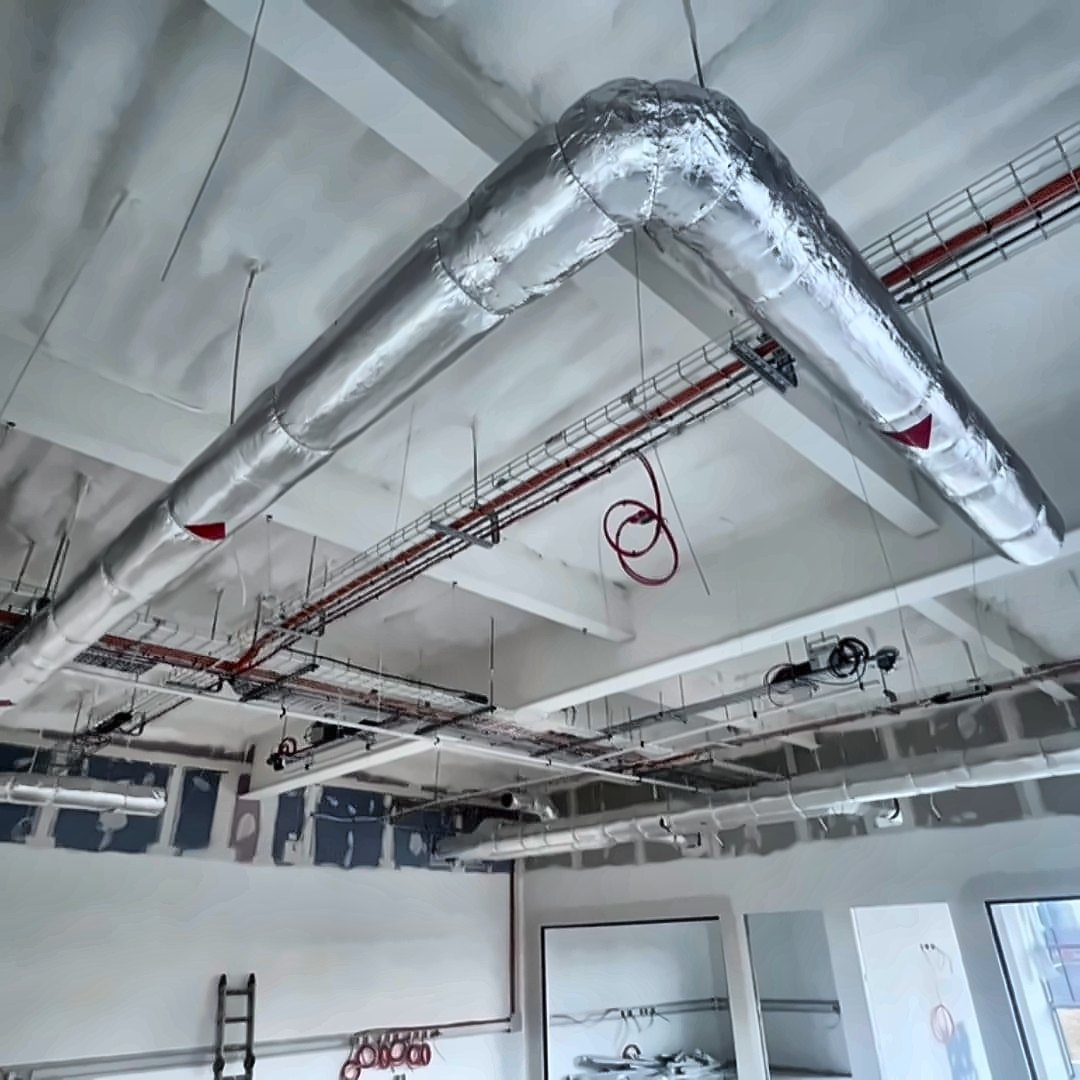
Looking up at a new-build concrete roof deck sprayed from beneath in a continuous pale closed-cell layer, with foil-wrapped ductwork, red sprinkler pipework and cable trays running below it and stud walls being built beneath.
Project recordPlant under a sprayed soffit
The plant a sealing coat is asked about. Foil-lagged ductwork and pipework under a sprayed concrete soffit. Where insulated plant like this needs a vapour barrier coat, ET-150 is the one Bostik makes for it.

Warehouse and distributionIndustrial units and factoriesAgricultural buildingsTanks and vessels

03How we apply it

Two coats, two colours, then the foam.

The second coat goes on in a different colour from the first, so a thin patch shows as the first colour and is caught on the day. The drawing shows the rooflight sequence, HOLVEM's lead use. The steps beneath are Bostik's directions as HOLVEM follows them, with the rooflight step at the end.

Section, not to scaleThe film is drawn thick to be seen. Two internal coats dry to about 0.5 mm.

  1. Prepare the surface.

    Clean, dry, and free of dust, oil, grease and anything loose. Adjacent surfaces are masked. On a rooflight that means the sheet is washed down and dry before the first coat.

    HOLVEM checksA clean, dry surface; masking in place.
  2. Check the conditions.

    Above +5 °C, and for external work no rain expected and good drying conditions. Outside, the work is tented or protected while it dries.

  3. Apply the first coat.

    Airless spray or brush, at the system rate: 2 m² per litre internally, 1 m² per litre externally.

  4. Reinforce where it will move or be knocked.

    On pipework, ductwork and joints, a scrim or glass cloth is embedded in the wet first coat with 50 mm overlaps, so the film does not split at a seam or under a knock.

  5. Apply the second coat in a contrasting colour.

    Once the first coat is touch dry, about two hours, and within 24 hours. Internally 2 m² per litre again; externally 1.5 m² per litre. White over grey, or grey over white: a thin patch shows at once.

    HOLVEM checksNo first-coat colour visible anywhere on the finished film.
  6. Let it dry through and test it.

    About 24 hours to dry through. A damp rag rubbed over the film should lift no colour. Surfaces that could hold water are shaped to at least a 15° fall.

  7. On a rooflight: now the foam.

    HOLVEM's practice. Once the second coat has dried through, the closed-cell layer is sprayed over or around the rooflight as agreed with you, and the rest of the roof carries on in the same pass.

    HOLVEM hands overThe product, colours, coverage and dates in the job record.
Project recordCoating over finished foam
A protective coating going on over finished foam, on a HOLVEM project. Played on request. The same care goes into a sealing coat as into the foam beneath it: a stated rate, a stated film, a record.

04What it achieves

What the coating does, and what it does not.

ET-150 is good at one thing: a flexible, water-resistant film that seals a surface and tolerates heat and cold. Everything it is not is just as important, because it is easy to ask a sealing coat to do a fire coat's job.

DoesSeal and protect

A flexible, water-resistant film that stays put.

Dries to a durable finish that moves with the surface and resists liquid water.

  • Internal and external use, with a heavier external system where the weather reaches it.
  • Service temperature −29 °C to +82 °C, so it sits happily between a cold roof sheet and a warm building.
  • Coverage you can see: the second coat in a contrasting colour, so a thin patch is found on the day.
  • Low VOC at 42 g/L; water clean-up while wet.

DoesPrime a rooflight before foam

HOLVEM's method where rooflights are sprayed.

  • Two coats of ET-150, dried through, before the closed-cell layer goes over the rooflight. Our practice, stated as such.
  • Where the client keeps the daylight, the rooflight is left clear and the layer stops at a closed edge; the coating is not needed.

Does notProtect against fire

No Euroclass. No fire test on a foam build-up.

Bostik quotes fire tests on the coating alone, without a report, substrate or film thickness. None of it classifies spray foam.

  • Where an exposed foam surface must reach a class, the coating is DC315 in the tested build-up. ET-150 is never a substitute for it.
  • ET-150 and DC315 are not combined into one claim. Each does its own job and is recorded as such.

Does notAct as a full vapour control layer

A breather coating, not a high-resistance AVCL.

  • Bostik rates it at 0.6 perms at 1 mm dry film, about 29 MN·s/g vapour resistance (converted). It lets small amounts of vapour through by design.
  • Whether a roof needs an air and vapour control layer is decided by the condensation risk analysis to BS EN ISO 13788 and BS 5250, not by this coating. Condensation risk analysis.

Does notCome with rooflight or UV data

The rooflight use is ours, not Bostik's.

  • Bostik's data sheet does not mention spray foam, rooflights or ultraviolet light. The rooflight priming is HOLVEM's method and is written here as that.
  • The film can be damaged by knocks and needs reinforcement where that is likely; standing water is avoided by shaping to a fall.
  • Bostik lists asbestos encapsulation as a use. HOLVEM does not offer ET-150 for that. Asbestos-cement roofs have their own route: fibre-cement encapsulation.

05Specification

Key data, from Bostik's data sheet.

Manufacturer's figures for Idenden ET-150. Converted values are marked. The rooflight sequence is HOLVEM's method and sits outside this table. A coated system is priced per project; what moves the figure is on the cost guide. Source document: Bostik ET-150 data sheet (PDF).

ItemBostik Idenden ET-150
TypeWater-based, thixotropic co-polymer emulsion. Sprayable vapour barrier coating; a breather coating for internal use. Bostik Ltd, Stafford
Stated usesVapour barrier coating on internal and external insulated pipework, equipment and air-conditioning ductwork. HOLVEM's rooflight priming is our method, not a Bostik use
Reaction to fireNot a fire-protection coating. Bostik quotes tests on the coating alone to BS 476 Parts 6 and 7, without a report, substrate or film thickness. No Euroclass; no classification of a foam build-up
Internal systemTwo coats at 2 m² per litre each, giving about 0.5 mm dry film
External systemTwo coats, 1 m²/L then 1.5 m²/L, giving about 0.8 mm dry film
Coverage range0.5 to 4.0 m² per litre per coat, depending on the surface and the performance required
Water vapour permeance0.6 perms at 1 mm dry film (ASTM E96 Method A); about 29 MN·s/g vapour resistanceCONVERTED FROM THE MANUFACTURER'S FIGURE
DryingTouch dry about 2 hours; dry through about 24 hours. Second coat once the first is touch dry and within 24 hours
Application temperatureAbove +5 °C. No external work in poor drying conditions or when rain is imminent
Service temperature−29 °C to +82 °C
ColoursWhite, black, grey. Second coat in a different colour to show coverage
ReinforcementScrim canvas or glass cloth embedded in the wet first coat, 50 mm overlaps, on pipework, ductwork and where mechanical damage is likely
VOC42 g/L
ApplicationAirless spray (0.017 to 0.021 tip) or brush. Specific gravity about 1.26. Packs of 10 L (all colours) and 19 L (white)
Storage18 months at +5 to +25 °C. Protect from frost
Clean-upWater while wet; white spirit once dry

06DC315 or ET-150?

Not the same job.

HOLVEM applies two coatings over or around spray foam, and they do different things. One seals a surface. The other is about fire. Neither stands in for the other, and a job that needs both gets both, each recorded on its own terms.

Bostik Idenden ET-150 · this page

A sprayable sealing coating. Not a fire coating.

Sealing

A water-based vapour barrier coating that dries to a flexible, water-resistant film. Primes a rooflight before a client has it sprayed; seals insulated ductwork and pipework when asked.

Job
Surface protection and sealing
Film
Two coats; 0.5 mm dry internally, 0.8 mm externally
Evidence
Bostik data sheet. No Euroclass, no foam fire test
Where
On a rooflight before the foam; on insulated plant

DC315

An intumescent coating for the fire strategy.

Fire

Applied to the exposed face of cured closed-cell foam where the building needs a classified surface and a lining is impractical. Swells to a char under heat. The coating in the tested Euroclass B-s2,d0 build-up for NexSeal LE.

Job
Reaction to fire of the exposed surface
Film
0.7 mm wet, minimum, for the tested build-up
Evidence
Euroclass B-s2,d0 in the tested build-up, BS EN 13501-1
Where
Inside the building, on the foam

DC315 intumescent coating

07Straight answers

Ask us the hard ones.

The questions building owners and facilities managers ask about sprayed rooflights and sealing coats, answered the way the specialist answers them on the call.

Is ET-150 a fire coating?

No. It is a sealing coating. It has no Euroclass and no fire test on a foam build-up, and Bostik's own fire figures are for the coating alone, without a report, substrate or film thickness. Where an exposed foam surface has to reach a class, the coating is DC315, applied at the tested film.

Why prime a rooflight before spraying it?

To protect the rooflight and the foam. Daylight through a rooflight carries ultraviolet light, which weathers exposed polyurethane over time, and bare GRP or polycarbonate is not a surface we want to spray straight onto. Two coats of ET-150 dry to a flexible, water-resistant film that sits between the two. It is HOLVEM's method, built on a coating Bostik makes for sealing surfaces; Bostik's data sheet does not cover rooflights or spray foam, and we say so rather than claim otherwise.

Will I lose the daylight?

At that rooflight, yes. A sprayed rooflight is a sealed rooflight, and no daylight comes through it. Most clients keep the daylight: the rooflight is boxed off or covered, the layer stops at a closed, coated stop edge, and no ET-150 is needed. The two choices are set out before the work, rooflight by rooflight if you want.

Is it a vapour barrier? Do we still need an AVCL?

Bostik calls ET-150 a vapour barrier coating and, for internal work, a breather coating: it resists liquid water but lets small amounts of vapour through, at 0.6 perms at 1 mm of dry film. That makes it a vapour retarder, not a high-resistance air and vapour control layer. Whether your roof needs an AVCL is decided by the condensation risk analysis to BS EN ISO 13788 and BS 5250, using the foam's declared vapour resistance, not by this coating.

Can you seal our insulated ductwork or pipework with it?

That is what Bostik makes it for: a vapour barrier coating over internal and external insulated pipework, equipment and air-conditioning ductwork, with cloth reinforcement embedded where the surface moves or gets knocked. Ask us. It is surveyed with the rest of the project so the coating, the reinforcement and the fall are specified for the plant you actually have.

How long between the coats, and before the foam goes on?

The second coat goes on once the first is touch dry, about two hours, and within 24 hours. The film dries through in about 24 hours; a damp rag rubbed over it should lift no colour. On a rooflight the foam is sprayed only after that. In cold or damp air everything takes longer, and the work is not done below +5 °C.

Your next step

Your building.
Your brief.
A specialist.

You do not need to decide about the rooflights before you start. Tell us what the building is and what it is for. The choices at each rooflight, and any plant that wants sealing, are set out with you before anyone prices them. Coated systems are priced per project.

Start a project brief About five minutes. Photographs help; nothing else is needed.

Already have drawings or a specification?

Send them for technical review. Drawings, a written specification or a rooflight schedule are checked against the roof as it will be built, the rooflights included. A review, not a quotation.

Upload for technical review