Before 3pm on a working day, contacted the same day. After 3pm, the next working day. Contact, not a quotation. Telephone
Start a project brief
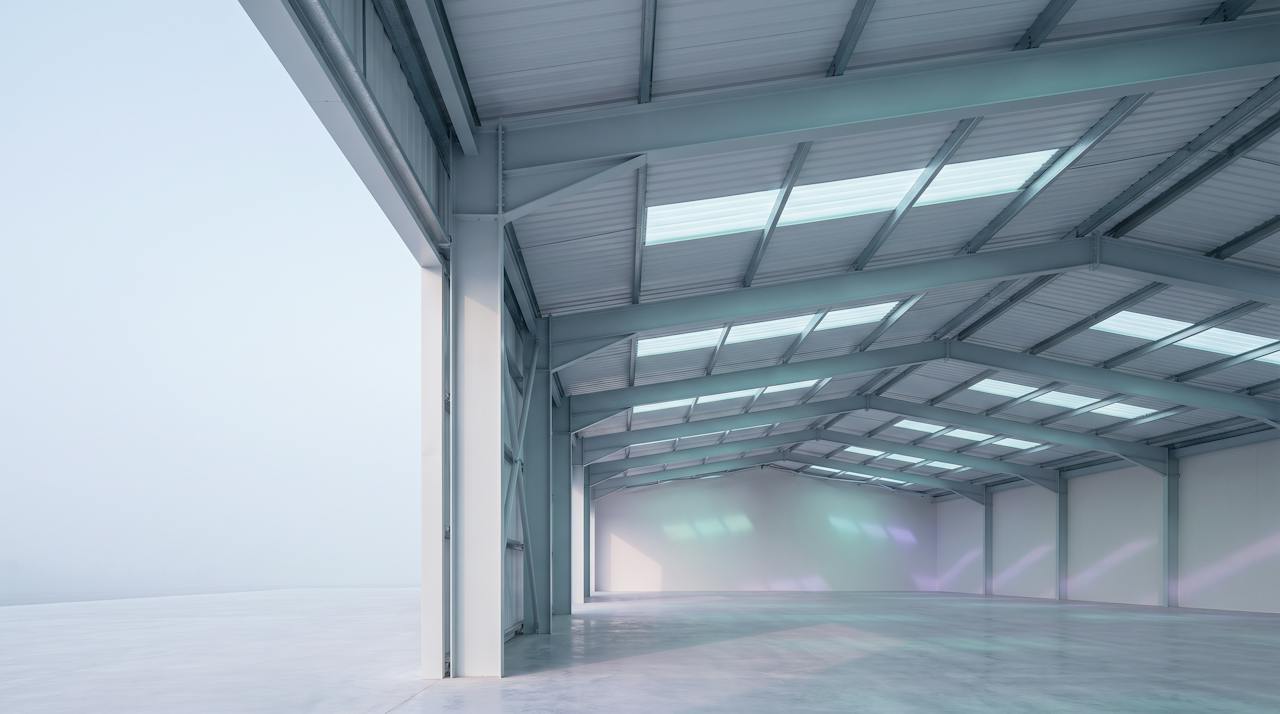
The underside of a large profiled metal roof seen from the floor of an industrial unit, purlins running into the distance under cool daylight.

Coating service

DC315 intumescent coating for exposed spray foam.

Where closed-cell foam stays exposed inside a building, HOLVEM coats it with DC315 at the wet film the fire test used, checks the film with a gauge as it goes on, and hands over the readings. It is the coating in the Euroclass B-s2,d0 build-up tested for Enverge NexSeal LE.

  • Euroclass B-s2,d0 in the tested build-up
  • 0.7 mm wet film, gauge-checked and recorded
  • Nationwide coverage

01What it is

A water-based coating that swells into a char when it is heated.

DC315 is a single-component, water-based intumescent coating made by International Fireproof Technology Inc. in the United States. It was developed to protect spray polyurethane foam. Sprayed onto cured foam it dries to a flat, paint-like film. In a fire that film swells to many times its own thickness and forms an insulating char over the foam, which slows how fast the surface contributes to the fire.

Why the coating is part of the fire specification, not a finish.

Closed-cell spray foam on its own is a combustible plastic. Where it sits behind plasterboard, the board is the face the fire sees and the board's class is what the building relies on. Where the foam stays exposed, the coating is that face. The two are different build-ups and they carry different classes.

Reaction to fire is classified for the build-up as tested. For HOLVEM's closed-cell system that build-up is Enverge NexSeal LE sprayed onto plasterboard and coated with DC315 at 0.7 mm wet film thickness. Tested to BS EN 13823 and BS EN ISO 11925-2 at a UKAS-accredited laboratory and classified to BS EN 13501-1:2018, it reached Euroclass B-s2,d0: very limited contribution to fire, limited smoke, no flaming droplets.

The classification applies to the build-up tested. We confirm the fire strategy for each project against Approved Document B and your fire engineer or building control, and where a roof differs from the tested build-up we say so before anyone prices it.

How reaction to fire is classifiedClosed-cell system data
02Where we use it

Commercial roofs and walls where the foam stays on show.

A plasterboard lining is the usual way to put a classified surface in front of spray foam. In a high bay, over a profiled roof or across a steel frame, lining is often impractical. DC315 is how the exposed underside gets its class instead. These are the buildings where that case is common.

Storage and logistics

Warehouse and distribution

Open floors, high eaves and racking to the roof. The underside stays exposed, so the coating is the face the fire strategy classifies.

Warehouse and distribution

Production

Industrial units, factories and workshops

Profiled roofs over working floors, with plant, cranes and services that rule out a ceiling. Coated after the foam, before the floor is handed back.

Industrial units and factories

Rural

Agricultural buildings

Barns, stores and livestock sheds with the roof sprayed from beneath. The manufacturer lists agricultural buildings as a use, with additional steps where the space is unconditioned.

Agricultural buildings

Unconditioned spaces

Cold stores and car parks

Listed by the manufacturer with additional steps. The coating needs air and substrate at 10 °C or above while it goes on and cures, so the sequence of the job is planned around that.

Cold stores
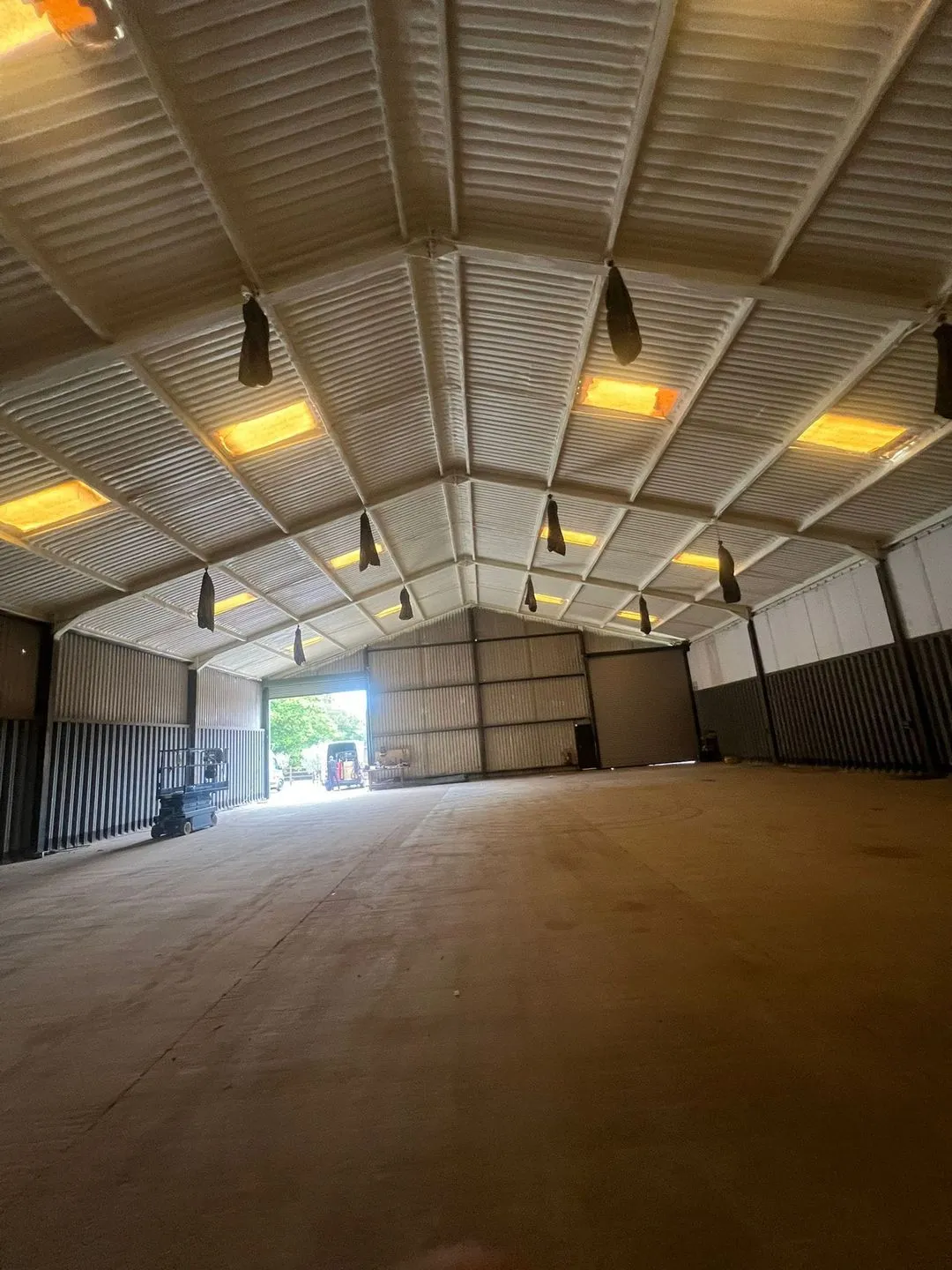
An empty warehouse floor looking towards an open roller-shutter door: the whole profiled steel roof and its purlins sprayed from beneath in a continuous pale closed-cell layer, rooflights and high-bay lights left exposed.
Project recordAn exposed underside
The underside that gets coated. A profiled steel roof sprayed from beneath and left on show. Where a roof like this must reach a classified surface and lining is impractical, the coating goes on once the foam has cured.

Profiled metal roof undersideCorrugated roof undersideWallsConcrete soffits

03How we apply it

Cured foam, a clean face, the film measured as it goes on.

The coating is only as good as the film thickness it is applied at. The fire test used 0.7 mm wet film, so that is the minimum HOLVEM applies and checks for the tested build-up. The drawing shows the layers in the order the fire reaches them. The steps beneath are the order of work.

Section, not to scaleThe film is drawn thick to be seen. At 0.7 mm wet it dries to about 0.47 mm (calculated from 67% volume solids).

  1. Spray the foam and let it cure and cool.

    The closed-cell layer goes on first and is left for at least an hour to cure and come back to room temperature before any coating touches it. That hour is the manufacturer's minimum, not ours.

  2. Inspect and repair the foam face.

    Gouges, holes, exposed cells and anything crumbling are cut back and made good. The surface has to be clean, dry and firm before a coating is asked to stay on it.

    HOLVEM checksA sound, dry, dust-free face across the whole area to be coated.
  3. Check the conditions and set up the air.

    Air and substrate at 10 °C or above, humidity monitored, cross-flow ventilation that does not blow straight onto the wet coating. Where the humidity stays high a dehumidifier runs.

    HOLVEM checksTemperature and humidity logged before the first litre is mixed.
  4. Mix the coating mechanically.

    Four to five minutes per pail, longer for a drum, to a creamy, lump-free consistency. Thinned with water only where the spray needs it.

  5. Flash coat a smooth or glossy skin.

    Where the foam has cured with a tight, shiny skin, a thin flash coat of about 0.1 mm wet film goes on first so the full film has something to key to. A primer is not normally needed.

  6. Spray the full film.

    Airless spray, 50% overlap, cross-hatched so no pass is thin at its edge. Brush or roller only where a gun cannot reach.

  7. Read the wet film and track the litres.

    A wet-film gauge is pressed into the fresh coating across the area. For the tested build-up the reading is at least 0.7 mm. The litres used are checked against the area coated; at that film the coating covers about 1.4 m² per litre before losses.

    HOLVEM checksGauge readings and litres per m² recorded for the job file.
  8. Fix medallions where the dry film is to be verified later.

    Small metal tabs, roughly one per 37 m², coated along with the foam so the dry film can be measured on the tab without cutting into the system. Optional, and worth it where building control wants a reading after completion.

  9. Ventilate the cure and hand over the record.

    At least 0.3 air changes per hour for 48 to 72 hours. Touch dry in one to two hours and ready to recoat in four to eight at 25 °C and 50% humidity; slower when it is colder or damper. The date, batch numbers, conditions and gauge readings go to you for building control.

    HOLVEM hands overA dated record of the coating as applied.

04What it achieves

What the coating does, and what it does not.

An intumescent coating does one job well: it changes how the exposed surface behaves in the first minutes of a fire. It is not a shortcut around the fire strategy, and it does not turn the foam into something it is not.

DoesA classified exposed surface

Euroclass B-s2,d0 in the tested build-up.

Very limited contribution to fire, limited smoke, no flaming droplets, to BS EN 13501-1:2018.

  • The tested build-up: 35 to 40 mm NexSeal LE on 9 mm plasterboard, DC315 at 0.7 mm wet film. BTTG report 27/06638/12/24.
  • A route where lining is impractical: high bays, profiled roofs, steel frames and soffits that would otherwise need a ceiling to carry a class.
  • A measured film: wet-film gauge readings and litres against area, recorded for building control.

DoesA workable, low-odour coating

Water-based, no flash point, cleaned up with water.

  • Low VOC: 10.3 g/L total; 18.6 g/L less water. Cures by coalescence, not by solvent.
  • Three colours: white, ice grey and charcoal black, in a flat finish.
  • Quick to handle: touch dry in one to two hours and recoatable in four to eight at 25 °C and 50% humidity.

Does notFire resistance

It is reaction to fire, not a rating in minutes.

A classified surface is not a fire-resisting element. Compartment walls, floors and structural protection are separate parts of the fire strategy.

  • No "fire rated", "fire resistant" or hour rating comes with the coating. Where a fire-resisting construction is needed, the designer specifies it.
  • The coating's US and Canadian listings are not UK approvals and are not quoted as such.

Does notCarry beyond the test

Other substrates and thicknesses are outside the report.

  • Foam sprayed to a metal deck, asbestos-cement sheet, timber or blockwork, or built thicker than 40 mm, is not covered by the classification until the manufacturer or a fire engineer confirms it.
  • Uncoated NexSeal closed-cell foam has achieved Class 1 surface spread of flame to BS 476-7:1997 (45 to 50 mm on 9 mm plasterboard). BS 476-7 is a British surface-spread-of-flame test, not a Euroclass; for exposed linings, current Approved Document B uses BS EN 13501-1 Euroclasses.

Does notWeather, seal or insulate

An interior fire-protective coating, and only that.

  • Designed for the inside of a building. Unconditioned spaces need a system design from the manufacturer, and a topcoat where weather or moisture reaches the surface.
  • It is not a vapour barrier, a waterproofing layer or insulation. Sealing a surface against moisture is a different coating and a different job: Bostik Idenden ET-150.
  • It is not applied below 10 °C or in high humidity. The application window is part of the programme.

05Specification

Key data, in the units a UK specification uses.

Manufacturer's figures from the DC315 data and application guide, with the tested film from the classification report. Converted values are marked. A coated system is priced per project; what moves the figure is explained on the cost guide. Source documents: DC315 data and application guide (PDF) and BTTG classification report (PDF).

ItemDC315 intumescent coating
TypeSingle-component, water-based intumescent coating for spray polyurethane foam. Flat finish. Made by International Fireproof Technology Inc. (IFTI)
Reaction to fire, coated systemEuroclass B-s2,d0 to BS EN 13501-1:2018 for 35 to 40 mm NexSeal LE on 9 mm plasterboard with DC315 at 0.7 mm wet filmBTTG REPORT 27/06638/12/24 · APPLIES TO THE BUILD-UP TESTED
Film for the tested build-up0.7 mm wet film thickness, minimum, checked with a wet-film gauge. About 0.47 mm dryDRY FILM CALCULATED FROM 67% VOLUME SOLIDS
Theoretical coverageAbout 1.4 m² per litre at 0.7 mm wet film; 1.6 m²/L at 0.61 mm; 2.8 m²/L at 0.36 mm. Before lossesCONVERTED FROM THE MANUFACTURER'S US FIGURES
Volume solids67%
VOC10.3 g/L total; 18.6 g/L less water
ColoursWhite, ice grey, charcoal black
Drying at 25 °C, 50% RHTouch dry 1 to 2 hours; recoat 4 to 8 hours. Cure slows above 70% RH
ApplicationAirless spray preferred; brush or roller where spraying is impractical. 50% overlap, cross-hatched
Application temperatureNot below 10 °C, air and substrate. Ideal 17 to 32 °C. Humidity ideally 50 to 65% RH
Foam before coatingCured and cooled to ambient for at least 1 hour; clean, firm and dry; damage repaired. Flash coat at about 0.1 mm wet film on a smooth or glossy skin. Primer not normally required
Ventilation during cureCross-flow, not directly onto the coating; at least 0.3 air changes per hour for 48 to 72 hours
Storage10 to 27 °C, off cold floors. Protect from frost; unusable once frozen. Shelf life 18 to 24 months unopened
Clean-upWater. No flash point

06DC315 or ET-150?

Not the same job.

HOLVEM applies two coatings over or around spray foam, and they do different things. One is about fire. The other is about sealing a surface. They are never substitutes for each other.

DC315 · this page

An intumescent coating for the fire strategy.

Fire

Applied to the exposed face of cured closed-cell foam where the building needs a classified surface and a lining is impractical. Swells to a char under heat.

Job
Reaction to fire of the exposed surface
Film
0.7 mm wet, minimum, for the tested build-up
Evidence
Euroclass B-s2,d0 in the tested build-up, BS EN 13501-1
Where
Inside the building, on the foam

Bostik Idenden ET-150

A sprayable sealing coating. Not a fire coating.

Sealing

A water-based vapour barrier coating from Bostik that dries to a flexible, water-resistant film. HOLVEM uses it to prime rooflights before a client has them sprayed, and it is asked about for insulated pipework and ductwork.

Job
Surface protection and sealing
Film
Two coats; 0.5 mm dry internally
Evidence
No Euroclass, no foam fire test
Where
On a rooflight before the foam; on insulated plant

Bostik Idenden ET-150 coating

07Straight answers

Ask us the hard ones.

The questions building owners, facilities managers and fire engineers ask about the coating, answered the way the specialist answers them on the call.

Does DC315 make the foam fire resistant?

No. Fire resistance is a rating in minutes for walls, floors and structure that hold a fire back. DC315 changes the reaction to fire of the exposed surface: how much it contributes to a fire's growth in its early stages. In the tested build-up that surface reached Euroclass B-s2,d0. Where your fire strategy needs a fire-resisting construction, that is a separate element and the designer specifies it.

Will my roof be Euroclass B-s2,d0 once it is coated?

The classification belongs to the build-up tested: 35 to 40 mm of NexSeal LE on 9 mm plasterboard with DC315 at 0.7 mm wet film. If your roof matches it, the class is quoted with the report. If your foam is sprayed to a metal deck, asbestos-cement sheet or timber, or built thicker, the report does not cover it on its own, and we ask the manufacturer or your fire engineer to confirm the build-up before anyone relies on the class. The requirement itself is set for your building under Approved Document B, agreed with building control.

How do you prove enough coating went on?

Three ways, on the day. A wet-film gauge is pressed into the fresh coating across the area and the readings are recorded; for the tested build-up the minimum is 0.7 mm. The litres used are checked against the area coated. Where a later check is wanted, metal medallions are coated along with the foam so the dry film can be measured without cutting into the system. The record goes to you for building control.

Can you coat foam that was sprayed by someone else, years ago?

The surface can usually be coated if it is sound, clean and dry, with damage repaired and a flash coat where the skin is glossy. What we cannot do is quote the Euroclass for it. The classification evidence is for NexSeal LE in the tested build-up, and an unknown foam at an unknown depth is not that. We would say so in writing before the work.

Does it work in a cold store, a car park or a barn?

The manufacturer lists cold stores, car parks and agricultural buildings as uses, with additional steps for unconditioned spaces, and a topcoat may be needed where weather or moisture reaches the coating. The coating is not applied below 10 °C, air or substrate, so in a cold store the sequence of the job is planned around that.

How long before we can use the space again?

The area is cleared while the coating is sprayed, because respiratory protection is required for the operatives. At 25 °C and 50% humidity the film is touch dry in one to two hours and recoatable in four to eight; colder, damper air slows that down. Ventilation runs at 0.3 air changes an hour or more for 48 to 72 hours while it cures. Most floors are back in use well within that, once the sprayed areas are dry and the air is clear.

Your next step

Your building.
Your brief.
A specialist.

You do not need to know whether your roof needs a coating. Tell us what the building is and what it is for. The fire strategy is checked with your designer or building control, and someone who does this every day comes back to you. Coated systems are priced per project.

Start a project brief About five minutes. Photographs help; nothing else is needed.

Already have a fire strategy or a specification?

Send it for technical review. A fire engineer's requirement, a written specification or drawings are checked against the tested build-up and the roof as it will be built. A review, not a quotation.

Upload for technical review