Before 3pm on a working day, contacted the same day. After 3pm, the next working day. Contact, not a quotation. Telephone
Start a project brief
A UK grain store at harvest: a large steel-framed shed with its doors open, a corrugated steel roof and two galvanised silos beside it under a pale evening sky.

Building type

Grain stores and silos: keep the drips off the crop.

A steel skin over stored grain sweats on cold nights and cooks on hot days. Closed-cell foam bonded to the inside follows the curve boards cannot, and keeps the skin above the dew point.

Flat stores, bins and round silosApplied when the store is emptyFrom £16/m² + VAT at 25 mm

Same-day estimator

About a minute · no obligation

Step 1 of 4: your building.

Which building is it?

This page's building is pre-selected. Change it if yours is different.

Takes about 30 seconds. No contact details yet.

01What is happening

A steel skin swings with the weather, and the grain pays for it.

Stored grain breathes and warms. On a cold night the roof sheet and the silo wall fall below the dew point of the air inside, water forms on the steel and drips onto the crop. On a hot day the same skin heats the top layer and drives moisture through the bulk. Caking and mould start where the drips land.

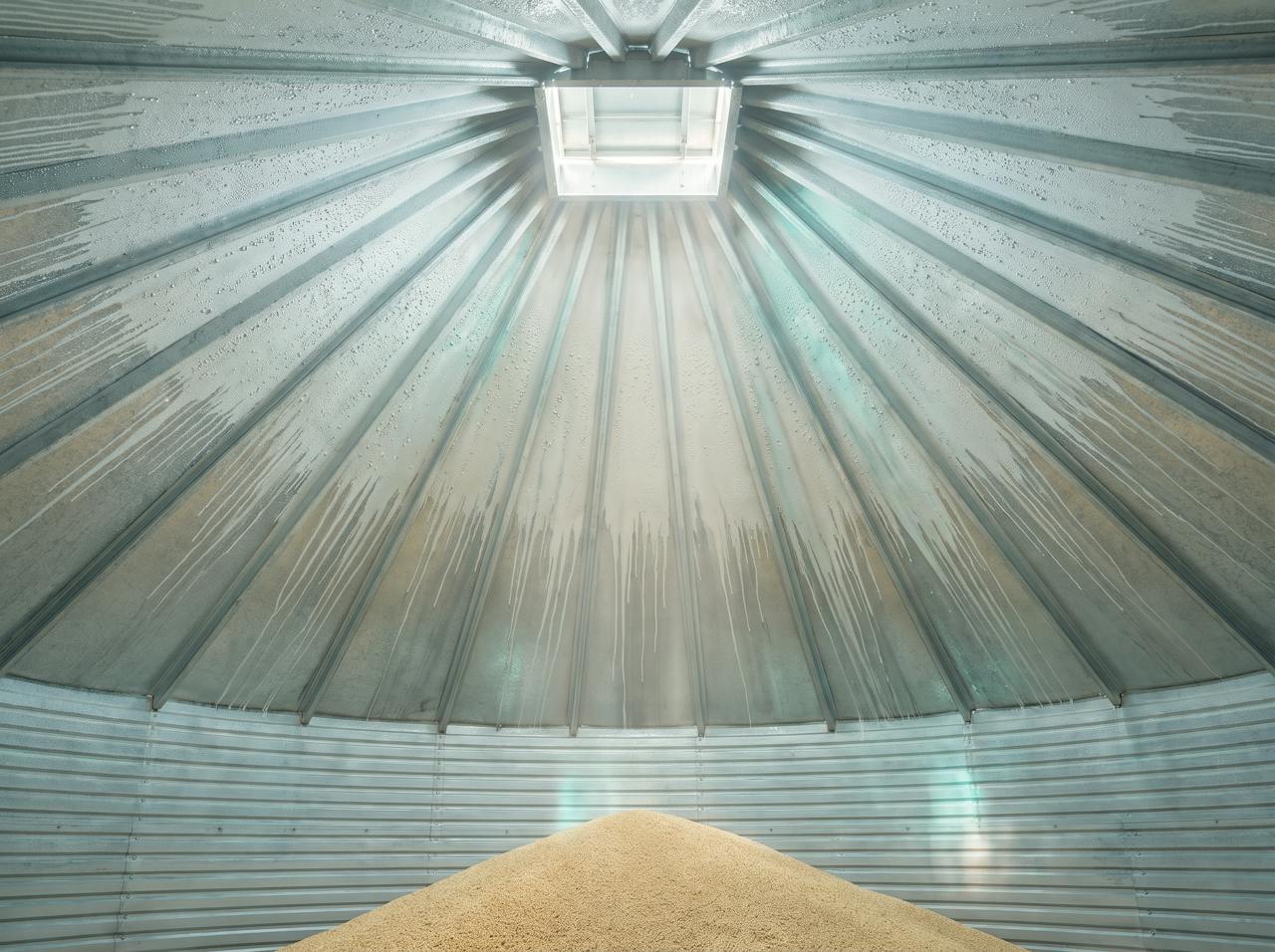
Inside a grain store on a cold morning: the underside of a corrugated steel roof beaded with condensation above a heap of stored grain, a drip line darkening the surface below one valley.
The skinBelow the dew point
  • Grain breathes. A stored crop gives off moisture and heat; the cold steel above it is where that moisture lands.
  • Swing, not just cold. Daily heating and cooling of a bare skin drives moisture migration through the bulk.
  • Curved and corrugated. Silo walls and conical roofs are shapes rigid board was never going to fit.

It is not a roof leak. Water across the whole underside on a dry, cold morning is condensation.

It is not solved by ventilation alone. Ventilation removes moist air; only insulation changes the cold surface. A working store needs both.

It is not always the roof. In a silo the wall condenses too, and the cone at the top most of all.

02Recent projects

A real silo, sprayed and finished.

HOLVEM's own record from an agricultural project: a round silo with its walls and cone sprayed in closed-cell foam, and the footage of the same layer being cut back and finished. Both carry the label they earn: Project record.

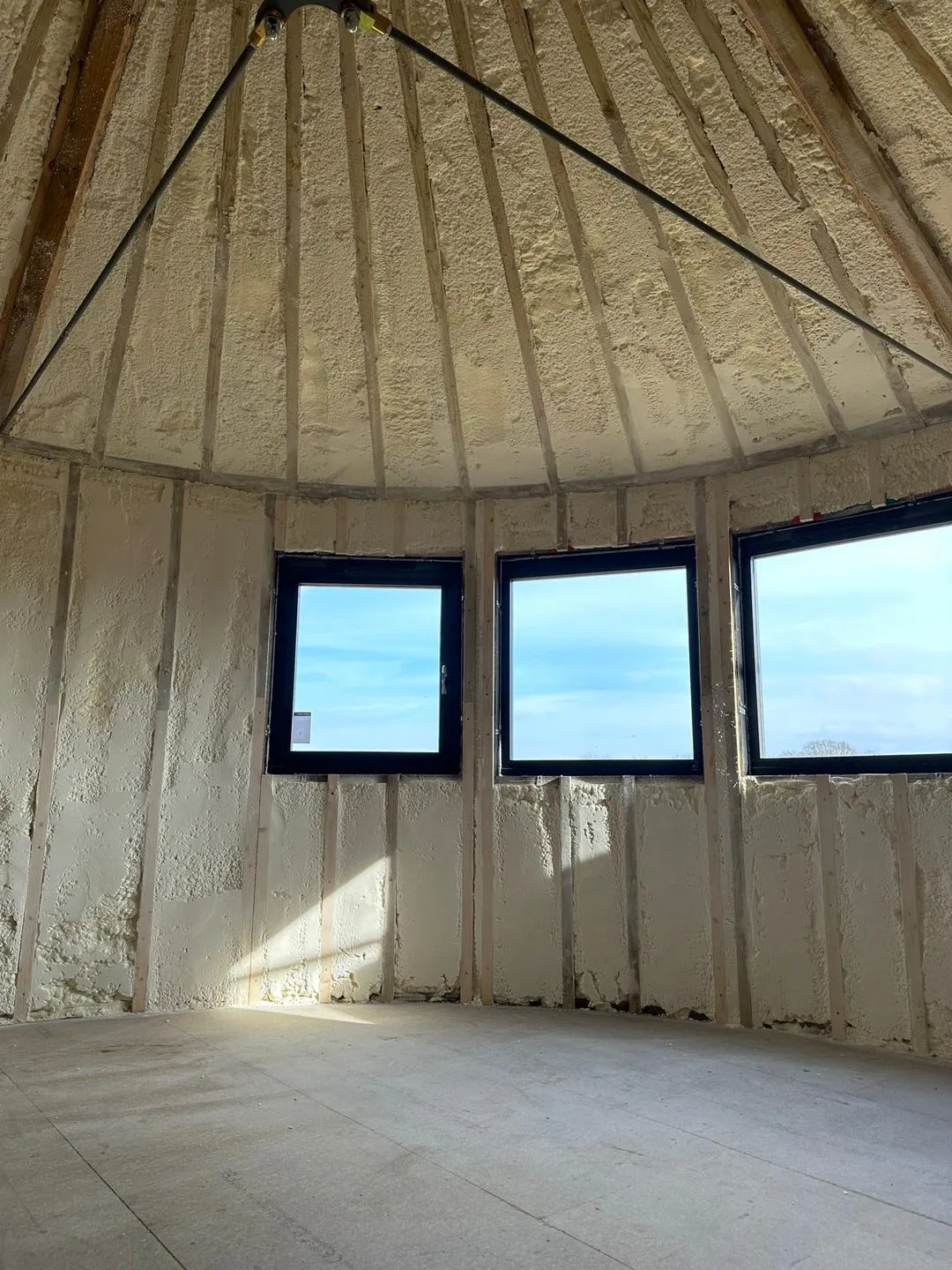
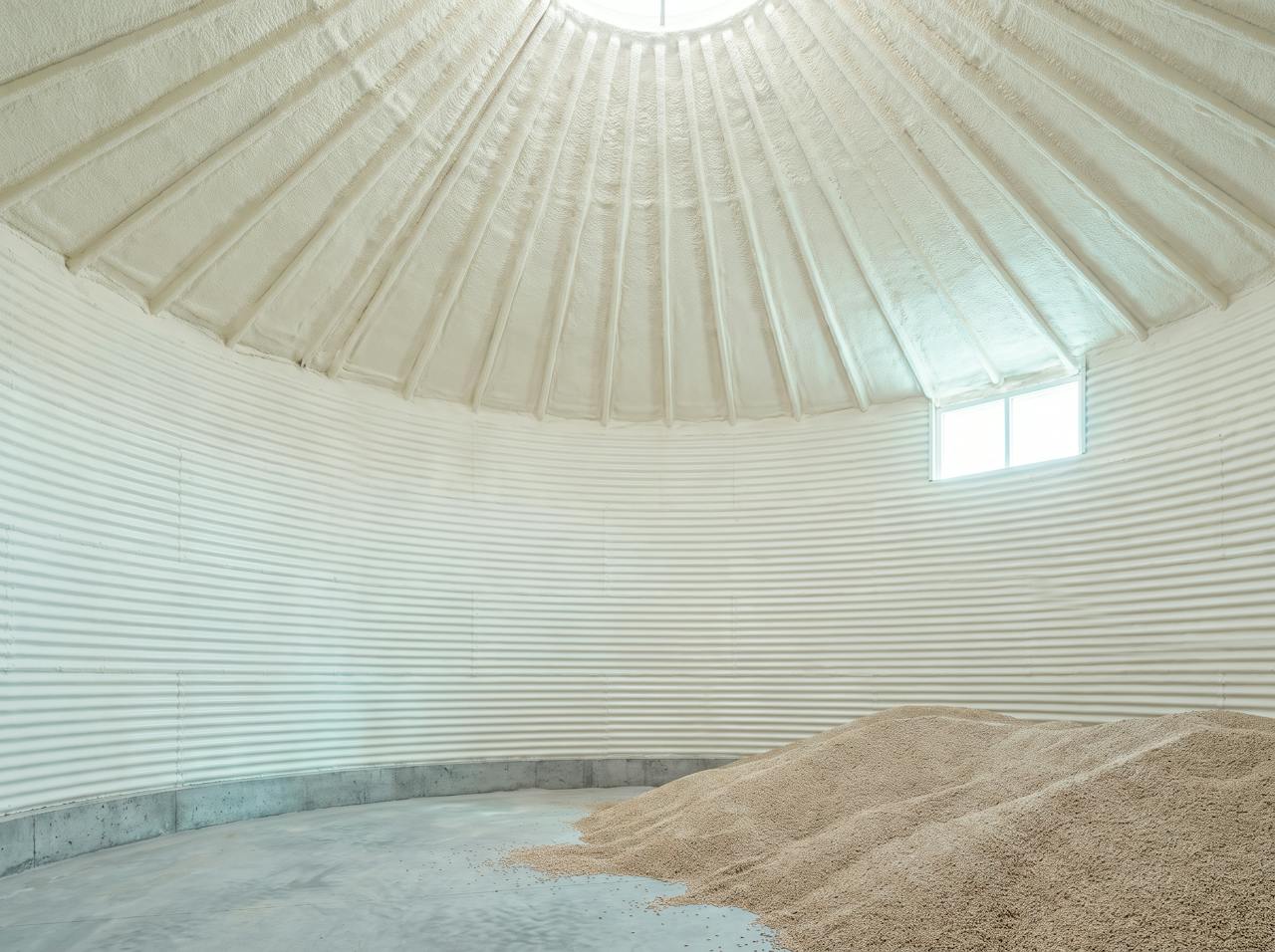
Inside a round silo: the walls and conical roof sprayed in a continuous cream closed-cell layer between timber studs, three small windows letting in daylight.
Project recordSilo
Silo insulatedClosed cell, walls and cone.
Project recordCut back and finished
Silo insulation cut back and finishedReal installation footage.

03What is applied

A bonded layer that follows the corrugation and the curve.

Closed-cell foam is sprayed onto the inside face of the sheet or the silo wall, following every corrugation and the curve of the vessel without cutting, jointing or fixing. The skin stays as the weather line. Where the store is converted or heated, the same layer goes deeper between studs; that is a different objective and a different depth.

Schematic / not to scaleKeyed 1 to 5 below

Inside a round silo after the work: the walls and conical roof sprayed in a continuous cream closed-cell layer between timber studs, three small windows letting in daylight.
AppliedWalls and cone, one layer
The layer follows the wall round and up into the cone. Vents, hatches and sensors are masked and left clear.
1 / Existing corrugated sheet

Roof or silo wall. It stays, and we do not make it watertight.

2 / Prepared face

Dust, loose coating and corrosion product removed. The store is emptied and cleaned first.

3 / Closed-cell layer, in passes

Follows the corrugation and the curve. λ 0.027 W/mK is the NexSeal LE product figure.

4 / Rail, ring or purlin

Encapsulated by the application, and still a thermal bridge in the calculation.

5 / Coating, where specified

A finish coat over the cured foam where the store's use or assurance scheme asks for one.

04Working around the building

Between harvests, with the store empty and clean.

The store is emptied, swept and prepared; the layer goes on; the store is handed back before the next intake. A silo is a confined space and is treated as one, with access and ventilation planned before anyone goes in.

  1. 1 / 3

    Time it to the season

    The work sits in the empty window between clearing the last of one harvest and taking in the next, agreed with you months ahead where possible.

  2. 2 / 3

    Clean, then spray

    Dust and residue on the sheet decide adhesion. The store is cleaned first; vents, sensors and hatches are masked and stay clear.

  3. 3 / 3

    Confined space, planned

    Silo interiors are entered under a method statement with ventilation and access equipment. Cure time before intake is set out in the method statement for your store.

Whether the finished surface is suitable for direct grain contact, or needs a specified coating, depends on your assurance scheme, and is confirmed before the specification is written.

05Enverge NexSeal LE

The material we spray, and why it matters.

Enverge NexSeal LE is a two component closed cell polyurethane, spray applied directly onto the prepared substrate. As it cures, it expands and sets into one rigid, continuous layer, bonding into corrugations, laps, fixings and awkward junctions without being cut, jointed or mechanically fixed.

That matters because most insulation problems start at the gaps.

Board systems can leave voids at ribs, laps and junctions, and every gap is a potential cold bridge where warm internal air meets a cold surface and condensation forms, hidden behind the insulation. NexSeal LE is applied as one continuous bonded layer, so there is nowhere for that to start: a sealed, stable building envelope that controls condensation, reduces heat loss and protects the structure underneath.

0.027 W/mKThermal conductivity · aged · BS EN 14315-1
Class 1Surface spread of flame · BS 476-7 · uncoated
B-s2,d0Coated, as tested · BS EN 13501-1
25 yearsWorkmanship warranty, plus the manufacturer’s

HOLVEM also installs open-cell foam. It is a different product with its own data sheet, specified for different objectives: hybrid build-ups, sound absorption, or where the layer has to breathe. It is not what goes onto a cold sheet or a cold soffit. Open-cell system data · Closed-cell system data

HOLVEM spray rig van with Enverge NexSeal LE A and B component drums plumbed into the proportioner.
HOLVEM rigA and B on board
The HOLVEM rig · Enverge NexSeal LE A and B components on board. HOLVEM's own photograph.

06How we check

We check the moisture before we spray.

A grain store is a moisture engine with a crop inside it. The condensation risk analysis runs with the crop, the drying regime and the ventilation in it, and the depth follows. Insulation changes the cold surface; only ventilation removes the moisture, and the two are specified together.

  1. 1 / 3

    Condensation risk analysis

    The roof and wall build-up is checked against the temperature and humidity the stored crop produces, to BS EN ISO 13788 and, where the case warrants it, a transient WUFI analysis. The depth that keeps the skin above the dew point comes out of this.

    How the analysis works
  2. 2 / 3

    Ventilation stays in the design

    Insulation does not replace the fans. The analysis states what the layer does and what the ventilation still has to do, so nobody switches the wrong thing off.

    Damp and mould
  3. 3 / 3

    U-value, where a figure matters

    A heated or converted store carries a target. The calculation is done for this build-up to BS EN ISO 6946 with the rails and rings in it.

    U-values and Approved Document L

07The objective sets the depth

Four objectives. Each one sets the depth.

What does the roof need to do? Pick one below and you will see the depth that does it, and just as plainly what it won’t do. Nothing is left to come out later: the survey confirms the right depth for your building.

Four depths, drawn to one scale and measured from the silo wall. The objective and the calculation set the thickness on your building.

Pick an objective above to see the depth that does it, and what it won’t do.

Thickness and objective

Want a figure for your building? It takes about a minute.Building, roof, reading, details. A real figure for your store the same working day; nothing sent to anyone else.

Get my estimate

08Straight answers

Ask us the hard ones.

The questions farmers and store managers actually ask on the call, answered the way the specialist answers them. A question we have not answered? Ask it on the call. No obligation.

Can you insulate a silo, or only a flat store?
Both. Feed and grain silos, bulk bins and hoppers suffer from internal condensation and temperature swing, and closed-cell foam follows curved and irregular surfaces that boards cannot. It is subject to access, the internal condition of the vessel, what it holds and any hygiene requirement, all of which the survey establishes.
Is the foam safe next to stored grain?
The cured layer is rigid, bonded and does not shed. Whether the finished surface is suitable for direct grain contact under your assurance scheme, or needs a specified coating over it, is confirmed for your store before the specification is written.
How much does grain store insulation cost?
It depends on the depth, and the depth depends on the objective. Condensation control on a working store starts at 25 mm and holding useful heat at 50 mm; the rate falls as the area rises. A converted or heated store with a U-value target is priced per project. A round silo is priced on its actual surface and access, so send the dimensions.
When can you do it?
When the store is empty and clean, which usually means the window between harvests. Cure time before intake and whether any ventilation is needed during cure are set out in the method statement for your store.
Do we still need the fans?
Yes. Insulation changes the cold surface so moisture stops landing on it; only ventilation removes moist air from the store. The condensation risk analysis states what each does, so the two are designed together rather than one being switched off.

The next step

Your building.
Your brief.
A specialist.

If you already know the thickness or U-value you need, we price to it and confirm it is right; if not, we work it out with you. The estimator at the top takes about a minute and asks for nothing until the reading is on screen. The store's dimensions and what it holds are enough to start.

Or call . Enquiries received before 3pm on a working day are contacted the same day. After 3pm, the next working day. A commitment to contact, not a quotation, a survey or a price.

Rather write it all down first? Start a project brief · about five minutes, photographs welcome.

Same-day estimate · about a minute Get my estimate