Before 3pm on a working day, contacted the same day. After 3pm, the next working day. Contact, not a quotation. Telephone
Start a project brief
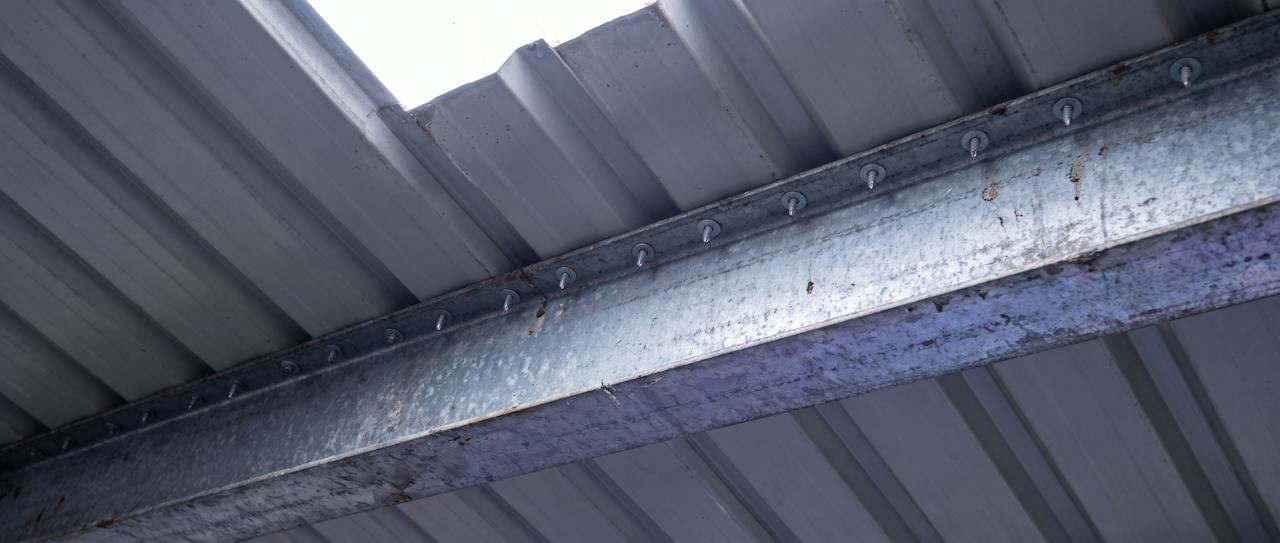
Looking up at the underside of a bare profiled steel roof inside a steel-framed building: a galvanised purlin crossing the frame, its line of fixings through the sheet, a rooflight beyond it in flat winter daylight.

Systems and specification

Fire performance: classified as a system, required by the building.

Reaction to fire is classified to BS EN 13501-1, and the class belongs to the system as tested: the foam, its coating and the substrate together. Uncoated and coated closed-cell foam carry different classes, and this page shows both. What class a roof has to reach is set for the building under Approved Document B.

  • BS EN 13501-1 reaction to fire
  • Uncoated and coated shown side by side
  • Approved Document B sets the requirement

01Reaction to fire

One class, from A1 to F, with smoke and droplets beside it.

Reaction to fire describes how much a product contributes to a fire's growth: ignition, heat release, flame spread, smoke and burning droplets. BS EN 13501-1 turns the tests into one class from A1 to F. It is not fire resistance, which is a different test, in minutes, for elements that hold a fire back.

ClassContribution to fireWhere closed-cell spray foam sits
A1Non-combustible. No contribution at any stage.
A2Limited combustibility. No significant contribution.
BVery limited contribution.THE COATED SYSTEM · NEXSEAL LE WITH DC315 · B-s2,d0 · AS TESTED, BTTG 27/06638/12/24Closed-cell foam coated with DC315, in the build-up tested: 35 to 40 mm on 9 mm plasterboard, DC315 at 0.7 mm wet film. The class the specification quotes for an exposed underside that matches it.
CLimited contribution: limited flame spread and heat release.
DMedium contribution. Resists a small flame for a time.
EHigh contribution. Resists a small flame only briefly.
FNo performance determined. Untested, or below E.
Smoke: s1 little or no smoke, s2 a limited amount, s3 no limit. Measured in the single burning item test, BS EN 13823.
Flaming droplets: d0 none, d1 none that persist beyond ten seconds, d2 no limit. A ceiling lining that drips burning material onto an escape route is the case the suffix exists for.

The class attaches to the product as tested, in the configuration it was tested in. For a spray-applied insulation that means the foam with its coating, at the tested thickness, on the tested substrate, with the coating at the tested film. Change any of those and the manufacturer or a fire engineer has to confirm the new configuration is covered, or the class does not carry. Uncoated NexSeal LE has no Euroclass on the evidence HOLVEM holds; its result is Class 1 surface spread of flame to BS 476-7, a British test that is not a Euroclass. That is why the coating is part of the specification and not a finish.
02Uncoated against coated

The same foam, two classes.

Closed-cell spray foam on its own is a combustible plastic. With an intumescent coating on its exposed face it is a different system, tested and classified as one. Read the two together, and never read the coated class into an uncoated roof.

Uncoated

NexSeal LE sprayed and left exposed.

Class 1SURFACE SPREAD OF FLAME · BS 476-7:1997 · BTTG 27/06605/10/24

The foam alone. Uncoated NexSeal closed-cell foam has achieved Class 1 surface spread of flame to BS 476-7:1997, tested at 45 to 50 mm on 9 mm plasterboard. BS 476-7 is a British surface-spread-of-flame test, not a Euroclass. For exposed linings, current Approved Document B uses BS EN 13501-1 Euroclasses, and no Euroclass is established for the uncoated foam. HOLVEM leaves closed-cell foam uncoated only where a lining in front of it is the face the fire sees, and the specification then names that lining.

Foam
Enverge NexSeal LE closed-cell, any depth the objective sets
Face
Foam, as sprayed
Where
Behind a ceiling or lining (route 2 below)

Coated

NexSeal LE with the DC315 coating, as tested.

Euroclass B-s2,d0TO BS EN 13501-1:2018 · BTTG REPORT 27/06638/12/24 · AS TESTED

Very limited contribution, limited smoke, no flaming droplets. The class attaches to the coated system as tested: 35 to 40 mm of NexSeal LE on 9 mm plasterboard with DC315 at 0.7 mm wet film thickness (BTTG report 27/06638/12/24), tested to BS EN 13823 and BS EN ISO 11925-2 at a UKAS-accredited laboratory. It applies to the build-up tested and is confirmed for each project against Approved Document B with your fire engineer or building control. This is the system HOLVEM specifies where an exposed underside must reach Euroclass B.

Foam depth
Depth dependent, set by the scope and what the roof has to achieve; the test report covers 35 to 40 mm on 9 mm plasterboard
Coating
DC315 intumescent coating at 0.7 mm wet film thickness, as tested, checked with a wet-film gauge
Coverage
About 0.7 litres per m² before losses (theoretical, about 1.4 m² per litre at 0.7 mm wet film, converted from the manufacturer's US figures), checked by wet film thickness as it goes on
Drying
Touch dry 1 to 2 hours; recoat 4 to 8 hours at 25 °C and 50% RH
Under heat
Swells to an insulating char that shields the foam beneath
Colours
White, ice grey or charcoal black
Applied
After the foam has cured, before the roof is handed back; priced on top of the foam as part of the coated system

03The role of the coating

The coating is the face the fire sees.

Sprayed foam is a combustible plastic. What stands between it and a fire in the room below is either a coating applied to its face or a lining in front of it. Both are ways of giving the exposed surface the class the building needs; which one a job uses is a real choice, and both are set out below.

Section, not to scaleThe coating follows the foam's face across every crown and trough; the class is the coated surface's.

Route 1 · Coated and exposed

An intumescent coating on the foam's face.

A thin, paint-like film applied to the cured foam. Under heat it swells to a char many times its own thickness, which insulates the foam beneath and slows the surface's contribution to the fire. It is applied at the wet film thickness the test report used, 0.7 mm, checked by wet film thickness as it goes on, after the foam has cured and before the roof is handed back.

This is the route for an open warehouse, workshop or barn where the underside stays visible. The coated system HOLVEM specifies for a Euroclass B requirement is NexSeal LE with the DC315 coating, at a foam depth that depends on the scope and what the roof has to achieve. The test behind the class covers 35 to 40 mm on 9 mm plasterboard; where a roof differs from the tested build-up, we say so before it is priced and confirm it with the manufacturer or your fire engineer.

How we apply DC315

Route 2 · Lined

A lining in front of the foam.

Where the foam sits behind a ceiling or a lining, the lining is the surface the fire sees, and it is the lining's class that the building relies on. A 12.5 mm plasterboard is the common example; the designer confirms the lining meets the requirement for that room.

This is the route for an office, a mezzanine or any space that is being lined anyway. The foam still does its thermal and condensation work behind it; it just is not the exposed face.

04What class a roof has to reach

The requirement depends on the building and its use.

Approved Document B gives guidance on meeting the Building Regulations for fire safety. For an exposed roof underside the relevant question is the one it asks of every wall and ceiling lining: what class must this surface reach, given where it is and what the building is for.

01 · The surface

An exposed underside is a ceiling lining.

Approved Document B classifies linings by where they are. Small rooms, other rooms and circulation spaces each carry a minimum class, and the class required rises where people escape: circulation spaces and escape routes carry the highest.

A sprayed roof underside over an open warehouse floor is a ceiling lining to that room, so it is classified as one.

02 · The building

The purpose group sets the context.

Storage, industrial, office, assembly and residential buildings sit in different purpose groups, and the guidance treats them differently: the height of the building, its floor area, its compartmentation and whether it is sprinklered all bear on what is asked of it.

The requirement is set for the building by its designer or fire engineer, agreed with building control. A product cannot set it.

03 · Beyond the regulation

Insurers and clients may ask for more.

A property insurer, a landlord's specification or a client's own standard may require a class above the regulatory minimum for a roof underside, or ask for a particular coating and its report. Where that applies, it is part of the brief, and the specification is written to it.

Reaction to fire is one part of a fire strategy; compartmentation, structural fire protection and detection are others, and none of them is a spray foam question.

05What HOLVEM specifies

The coated system, its report, and the coverage it was tested at.

A fire specification from HOLVEM names the system, the depth, the coating and the classification, and points to the report the classification comes from. Where a figure below is not yet on this page, the specification still carries it.

ItemThe coated system
InsulationEnverge NexSeal LE closed-cell spray foam, at a depth set by the project where Euroclass B is required; the test report covers 35 to 40 mm on 9 mm plasterboard
CoatingDC315 intumescent coating, applied to the cured foam at the tested film: 0.7 mm wet film thickness minimum, checked with a wet-film gauge. About 1.4 m² per litre before losses (converted from the manufacturer's US figures)
Reaction to fire, coated systemEuroclass B-s2,d0 to BS EN 13501-1:2018, for the build-up tested: 35 to 40 mm of NexSeal LE on 9 mm plasterboard with DC315 at 0.7 mm wet film thickness (BTTG report 27/06638/12/24). Classification applies to the build-up tested and is confirmed for each project against the fire strategyBTTG TEST REPORT 27/06638/12/24 · 6 DECEMBER 2024
Reaction to fire, foam aloneClass 1 surface spread of flame to BS 476-7:1997, uncoated, tested at 45 to 50 mm on 9 mm plasterboard. BS 476-7 is a British surface-spread-of-flame test, not a Euroclass; for exposed linings, current Approved Document B uses BS EN 13501-1 EuroclassesBTTG TEST REPORT 27/06605/10/24 · 12 NOVEMBER 2024
Substrates covered by the report9 mm plasterboard only, at 35 to 40 mm of foam. The report relates only to the items tested and gives no extended field of application; a metal deck, asbestos-cement sheet, timber, blockwork or a thicker layer needs manufacturer or fire-engineer confirmation
DocumentsBTTG report 27/06638/12/24, Euroclass B-s2,d0 · DC315 data and application guideSAFETY DATA SHEETS ON REQUEST · ALL IN THE DOCUMENT LIBRARY

Your next step

Your building.
Your brief.
A specialist.

You do not need to know the class your building needs. Tell us what the building is and what it is for; the requirement is checked with your designer or building control, and someone who does this every day comes back to you.

Start a project brief About five minutes. Photographs help; nothing else is needed.

Already have drawings or a specification?

Send them for technical review. Drawings, a written specification or a calculation are checked against the roof as it will be built, the bridge included. A review, not a quotation.

Upload for technical review