1The sheet
Thin, cold, and wet by morning.
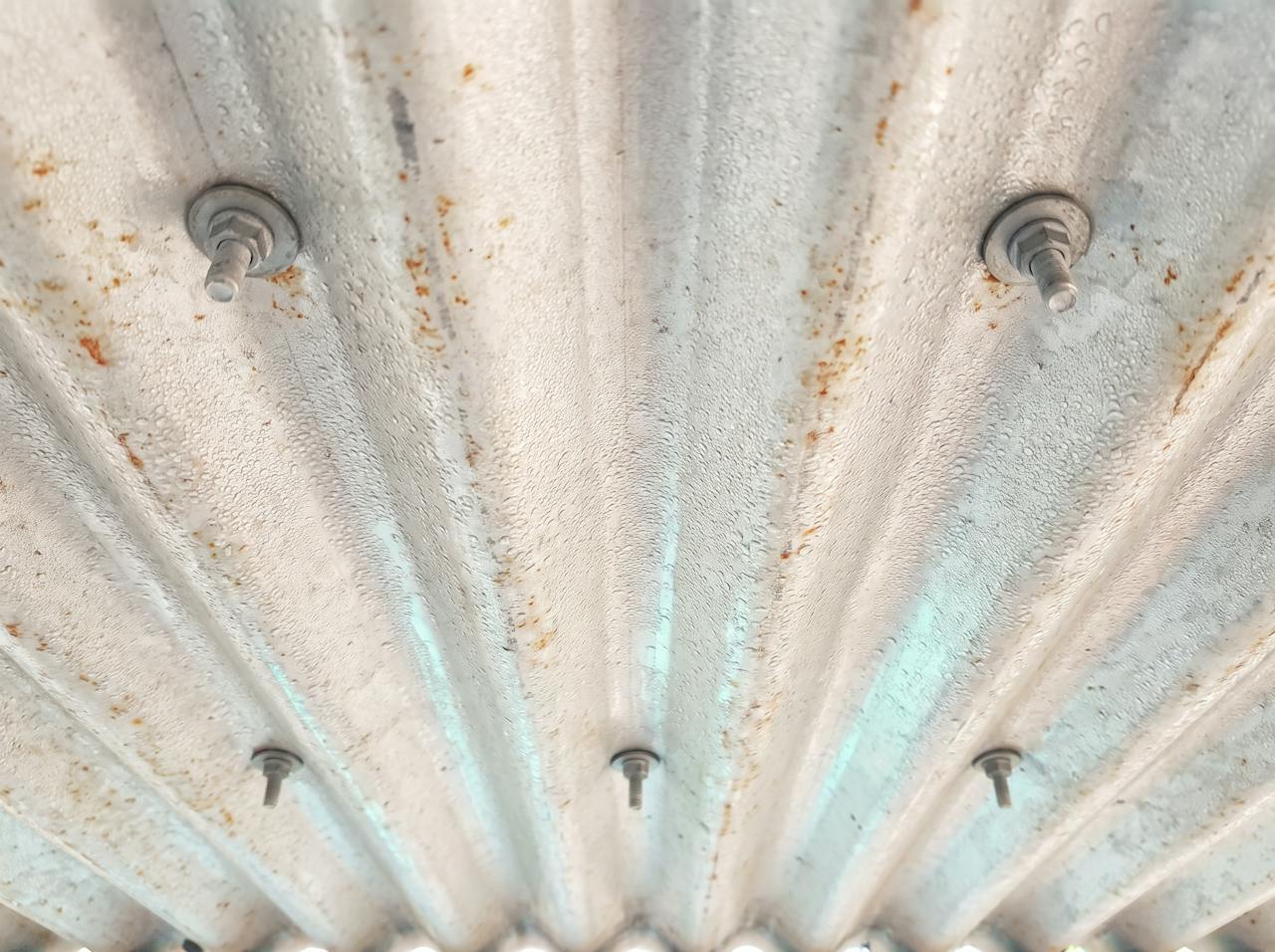
A corrugated sheet has almost no thermal mass. On a still, cold morning it is the coldest surface in the building: below the dew point of the air beneath it, so that air gives up its water onto the metal.
Application
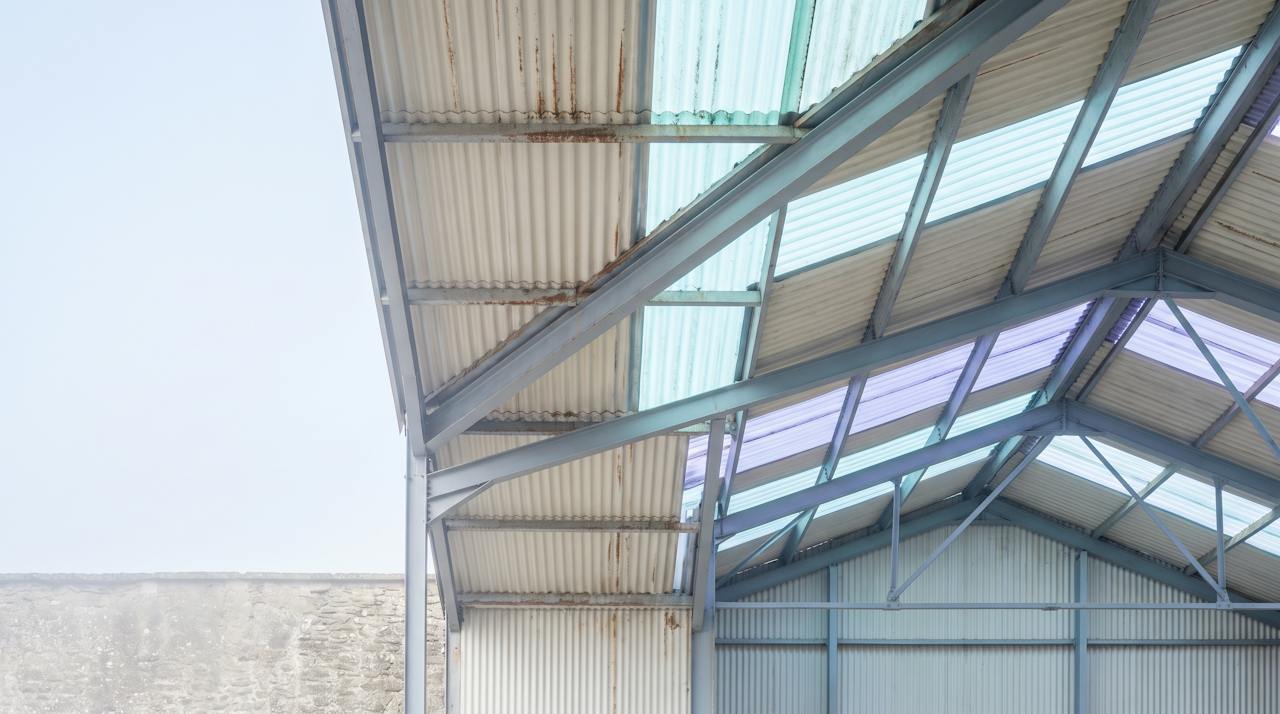
Sinusoidal steel, box profile or fibre-cement, the layer follows the wave of the sheet instead of bridging it, closes the laps and fixings, and stops the drip that looks like a leak.
Is this your roof?
01The build-up
A corrugated sheet has more surface, more laps and more fixings per square metre than any flat roof, and every one of them is a path for warm, wet air to reach cold metal. Switch the drawing between the bare roof and the sprayed roof; the three marks and the reading beneath follow.
Two states. Switch between them; the marks and the reading follow.
Swipe across to see the whole section.
BARE SHEET · A COLD MORNINGSection, schematic, not to scale. Three marks in each state; the cards beneath read them.
Cold sheet · below the dew pointThe dew point · water formsAbove the dew point · dry
1The sheet
A corrugated sheet has almost no thermal mass. On a still, cold morning it is the coldest surface in the building: below the dew point of the air beneath it, so that air gives up its water onto the metal.
2Laps and fixings
Every side lap, end lap and fixing is a path for warm, wet air to the cold sheet. An insulation that bridges the corrugations leaves those joints open behind it.
3The drip
Water forms across the whole sheet, runs to the troughs and falls. Repairing the roof would not stop it; nothing is getting in.
1The profile, followed
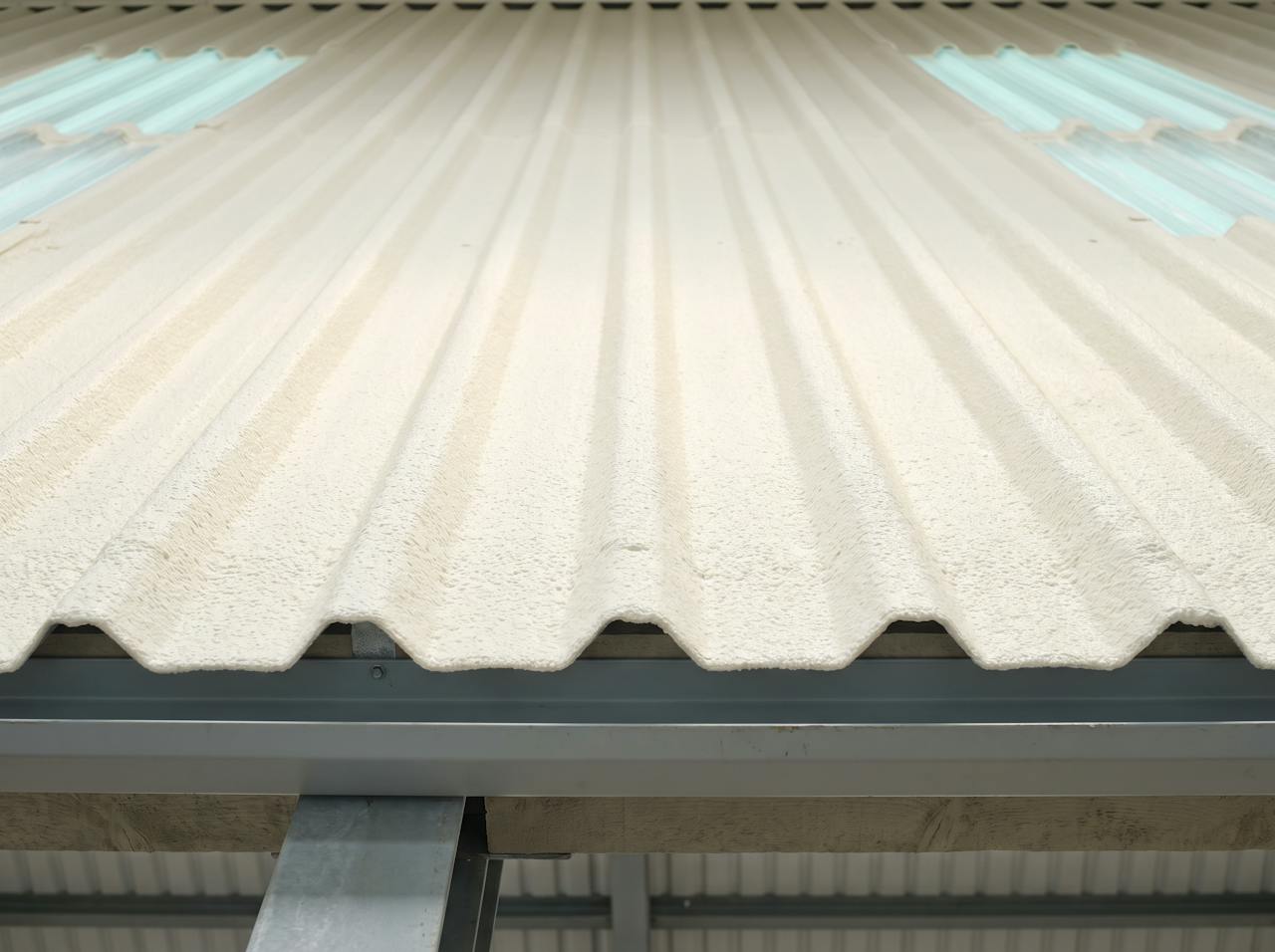
Closed-cell foam is applied from below in passes and takes the shape of every corrugation, closing the laps and burying the fixings. There is no gap for air to reach the sheet.
2The face the air touches
The inside face is the foam, not the metal. It sits above the dew point of the air beneath it, so no water forms. The reading moves to the dry end.
3The purlin, inside the layer
The purlin runs through the layer and is still a thermal bridge. HOLVEM's U-value calculation includes it rather than ignoring it.
The short version: a corrugated sheet gets condensation faster than most roofs, and a sprayed layer is the one that follows its shape instead of bridging it. A board cannot. The rest of this page is how the layer goes on properly.
02Project record
Installation footage from HOLVEM's own projects. This item is a project record, played on request; nothing on this page that is not real footage carries that label.
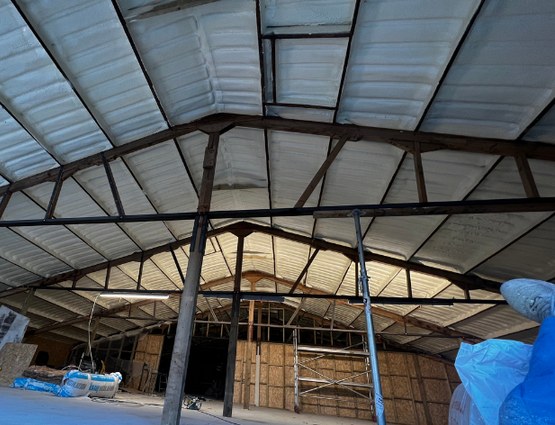
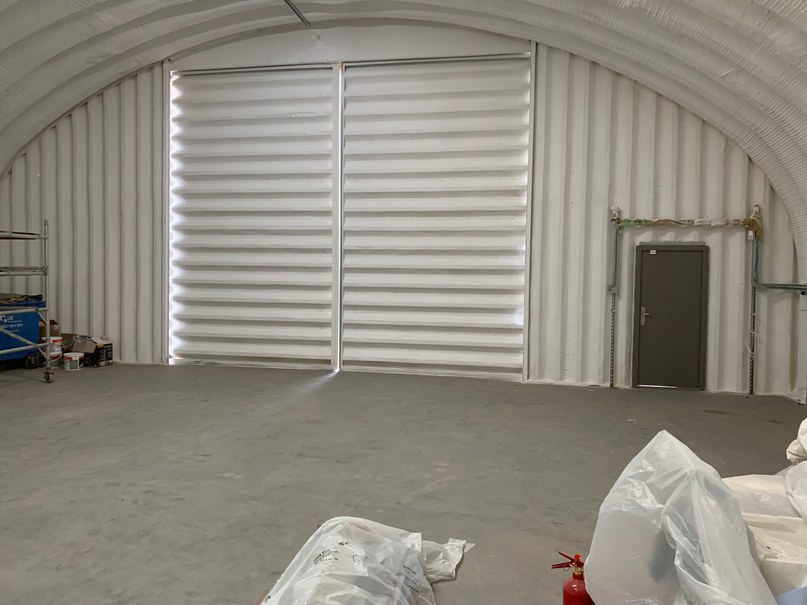
The applicator works along the bay, each pass overlapping the last, the layer taking the shape of the sheet as it cures. What you see is the face the building will have from then on.
03The order of work
The work is done from inside the building, from the floor or from access equipment, bay by bay. Each step is checked before the next begins; where one cannot be met on the day, the work stops and the reason is recorded.
The sheet is inspected from below: profile, coating, corrosion, moisture and whether it leaks. A leaking roof is repaired first, by someone else. The layer does not make a roof watertight.
HOLVEM checksSound, dry and weathertight before any foam goes on.
Loose coating, corrosion product, dust and contamination come off the underside. Rooflights, lights, cables and the floor beneath are masked or covered. Adhesion is decided here.
HOLVEM checksClean, dry, keyed surface; everything beneath protected.
Closed-cell foam is sprayed in passes, following each corrugation and closing the side laps. Depth is built up to the specified figure and measured as the work proceeds.
HOLVEM checksApplied thickness measured and recorded, bay by bay.
Where a reaction-to-fire classification is required, an intumescent coating is applied over the cured foam. Where it is not specified, the foam is left as the finished face.
HOLVEM checksCoverage logged where a coating is specified.
Eaves, ridge, gutters, penetrations and rooflight upstands are detailed per project. The layer stops at a closed, coated edge, never feathered out or left open.
HOLVEM checksEvery stop closed and detailed.
Every step is checked before the next. The evidence is compiled into a QA record handed over at completion: thickness measured, coverage logged.
04Preparation
Most of what decides a good result happens before the gun is switched on. Three things HOLVEM establishes on a corrugated roof, and what happens if one of them is not met.
Weathertight
Foam is not a roof repair. Slipped sheets, failed laps and holed fixings are put right by a roofer before the layer goes on. Spraying over a leak traps the water where nobody can see it.
Clean and dry
Corrosion product, loose paint, dust and oil come off the underside, and the sheet is dry at the time of application. A wet or dusty sheet fails the bond, and a failed bond fails the seal.
Protected beneath
Masking, sheeting and containment protect stock, plant, lighting and the floor. On a working building the bays are sequenced around the shift pattern rather than the other way round.
Survey, or photographs?How HOLVEM works: we understand your project before we price it
05Thickness and objective
Three objectives, three depths. Each one is a direction for the survey to confirm on your roof, with the purlin bridge in the calculation. What it costs is on the cost guide, not here.
25 mmCondensation control
Enough to stop the drip on most corrugated roofs: the face the air touches is the foam, warm and dry, and the laps and fixings are closed. The objective where the building is unheated or lightly used.
50 mmHeat retention
Controls condensation and keeps warmth in the building, so there is less to bring back in the morning.
75 mm and aboveA calculated U-value
Set by the U-value the project has to reach, calculated for this roof as built, purlins included. Specified per project and confirmed by the calculation, not by a rule of thumb.
06Where it suits
Corrugated sheet is the roof of the British farm and of a great many older industrial sheds. Three building pages written for it.
Building
Livestock, machinery and grain under corrugated steel or fibre-cement: the condensation drip onto stock and feed is the reason most farmers call.
Read the building pageBuilding
Older single-skin sheds still working hard. The layer stops the drip onto plant and product and keeps the heating bill in the building.
Read the building pageBuilding
Small, cold, and damp by morning. A corrugated roof sealed from beneath makes the space usable all year.
Read the building page07What HOLVEM checks
HOLVEM does not quote a depth from a photograph. The roof is understood first: how it behaves in winter, whether fire performance is required, and what U-value it must reach.
Condensation risk analysis
A condensation risk analysis to BS EN ISO 13788 for the roof as built, with the internal conditions the building actually runs at. Where the simple method is inconclusive, HOLVEM runs a dynamic simulation to BS EN 15026.
Fire
Where it is, the coated system (closed-cell foam with an intumescent coating) is specified, classified B-s2,d0 in the build-up tested. Where it is not, the foam is left uncoated. The requirement is established before the depth.
U-value
Calculated to BS EN ISO 6946 for this build-up, purlins and fixings included, not read off the foam's own conductivity. The calculation is yours to keep.
Condensation risk analysisU-values and Approved Document LFire performance and coatings
08Straight answers
The questions people with a corrugated roof actually ask on the call, answered the way the specialist answers them.
Project records
The next step
If you already know the thickness or U-value you need, we price to it and confirm it is right; if not, we work it out with you. Tell us what the roof is, what it does in winter and what you want it to do. Photographs of the underside are the most useful thing you can send.
Or call . Enquiries received before 3pm on a working day are contacted the same day. After 3pm, the next working day. We understand your project before we price it.