Before 3pm on a working day, contacted the same day. After 3pm, the next working day. Contact, not a quotation. Telephone
Start a project brief
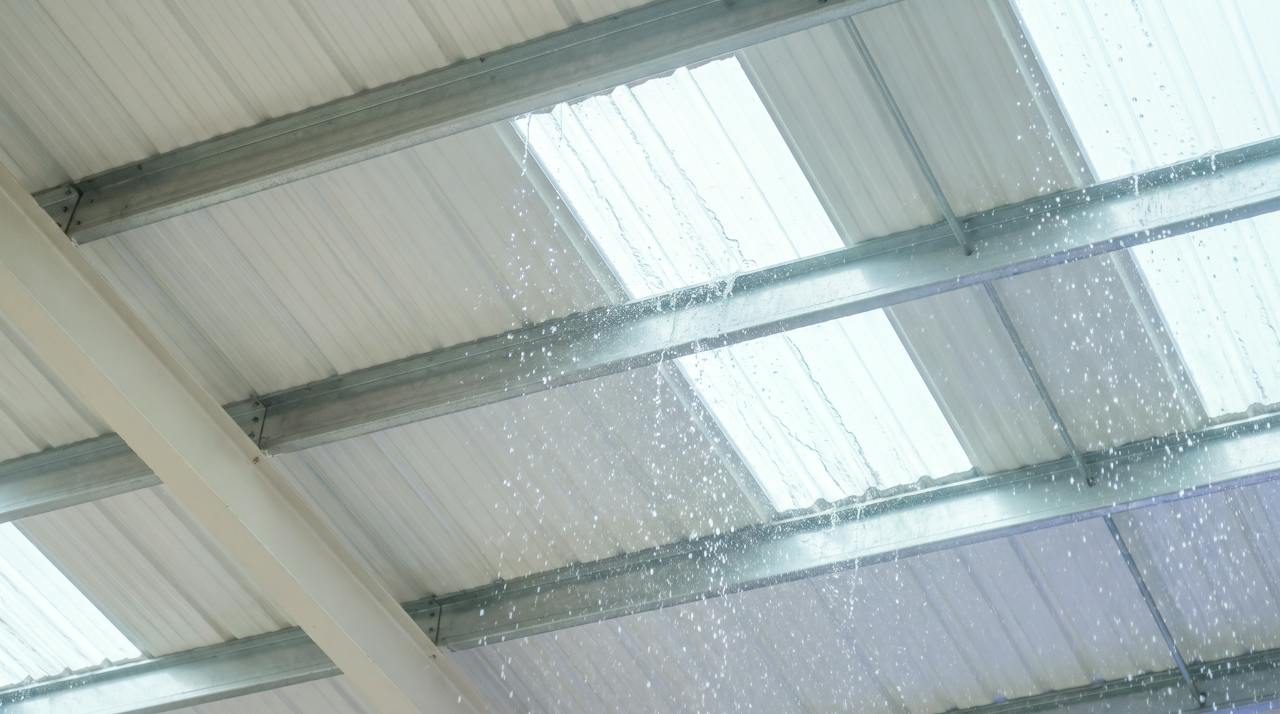
A wide indoor hall under a profiled metal roof during heavy rain, the sheet and its purlins seen from below, grey daylight through the rooflights.

Building problem

Rain noise: a bare metal roof is a drum, and the weather plays it.

Rain landing on a thin steel sheet sets the whole sheet vibrating, and the sheet gives that vibration to the room as noise. In a workshop, a school hall, a stable or an office under a metal roof, heavy rain stops conversation. This page is why the sheet drums, what damps it, and where open-cell foam has a part to play.

  • Metal and corrugated roofs
  • Closed-cell damping, open-cell absorption
  • Nationwide coverage

01What you see

Loud in rain, louder in hail, and worst under the widest bays.

Rain noise has a signature. It follows the weather to the second, it comes from the whole roof rather than one place, and it is worst where the sheet is thinnest and the spans between supports are longest.

Looking up at a bare profiled steel roof from inside a workshop during heavy rain, water streaming down the rooflight, the thin sheet spanning between purlins.
Follows the weatherBare sheet in rain
  • A drumming, not a patter. A thin sheet with nothing bonded to it rings at each impact. Hail turns the drumming into a roar.
  • From the whole roof at once. Every bay drums, so the sound has no direction and nowhere in the room is quiet.
  • Worst under long, thin spans. The larger the unsupported panel and the lighter the gauge, the more freely it flexes and the louder it is.

Not a fault in the roof.Not cured by a louder radio.The sheet is doing what a thin sheet does. Change what the sheet is bonded to.

02Why it happens

Impact on a thin sheet, in a hard room that keeps the sound alive.

Two things make rain loud. The sheet is thin and light, with nothing bonded to it, so each drop makes it flex and ring like a drum skin. And the room below is hard, so the sound the sheet radiates is reflected back rather than absorbed, and lingers.

Switch between the two states

Rain on the bare sheet. Each drop makes the thin sheet flex and ring, and the whole underside radiates that vibration into the room as a drumming sound.

Schematic, not to scaleWaves show vibration, not a measured sound level.

03What it costs you

Work that stops, animals that startle, a space that cannot be let for what it is.

The cost of rain noise is measured in what cannot happen while it rains. In a UK climate that is many hours a year, and they arrive without warning.

  1. The work

    Phones, meetings, teaching

    In an office, a school hall or a workshop office, heavy rain ends the call and pauses the lesson. Nobody logs the lost minutes, and they add up across every wet day of the year.

  2. The animals

    Stables, livestock buildings

    Horses and livestock hear the drumming above them and react. A bare metal roof over a stable or an arena is a source of stress that follows the weather.

  3. The building

    Lettings and use

    A hall that cannot be used in rain, a studio that cannot record, a unit whose tenant complains. The roof limits what the building can be used for and what it can be let as.

04What usually gets tried

Ceilings soften the room. The sheet keeps drumming above them.

Each of the usual remedies works on a different part of the chain and leaves the sheet as it was. Acoustic fleeces are for new sheets; suspended ceilings treat the room and create a cold void; a heavier roof is a new roof.

  1. Acoustic fleece or membrane

    A fleece bonded to a new sheet at the factory takes some of the ring out of it. It is a specification for a new roof, not a treatment for a roof already in place.

  2. A suspended ceiling

    Absorbent tiles soften the room and cut what you hear. Above them the sheet drums as before, and the void between is now a cold, unventilated space where moist air meets a cold sheet.

  3. A heavier or new roof

    A heavier gauge or a composite panel rings less. It is also a roof replacement, with everything that involves.
05What fixes it

Damp the sheet with closed-cell. Soften the room with open-cell where it belongs.

Two foams, two jobs. Closed-cell foam is bonded to the cold sheet from below, where it damps the drumming and stops condensation in one pass. Open-cell foam absorbs airborne sound and is used in lined ceilings, partitions and vapour-open build-ups where the analysis allows it. Never on a cold metal sheet.

  1. The sheet, damped

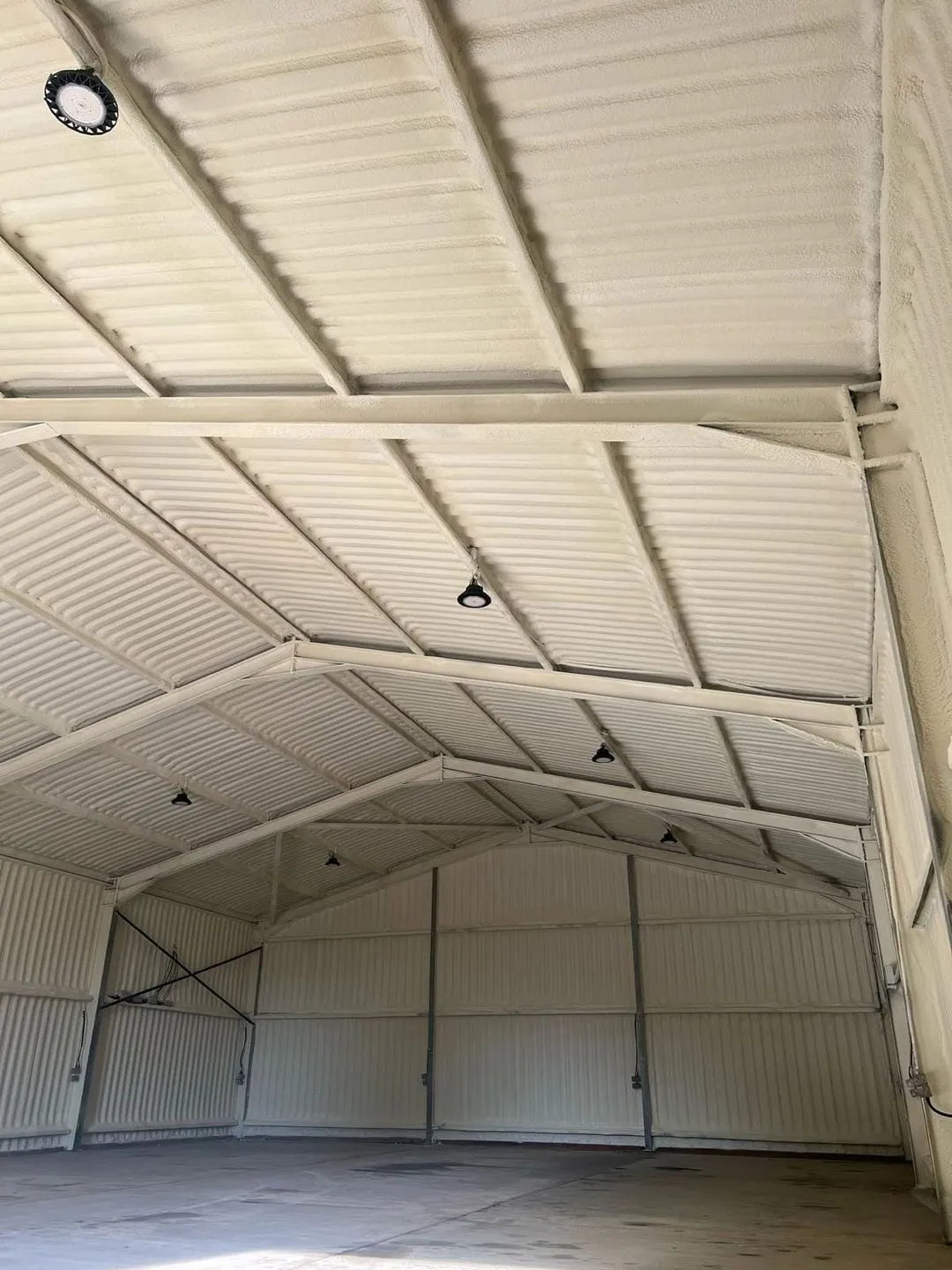
    Closed-cell spray foam applied to the underside in passes, following the profile, bonded across every corrugation. Mass, stiffness and damping added to the sheet, laps and fixings sealed, the sheet kept dry.

    The application, step by step
  2. The room, softened

    Where reverberation is the problem, open-cell foam in a lined ceiling void, a partition or under a floor absorbs the sound that would otherwise bounce. The build-up must be able to dry, and the condensation risk analysis says whether it can.

    Open-cell system data
  3. Both, in one building

    A hall or an arena often needs the sheet damped and the room softened. The two systems are specified together, each where it belongs.

06How HOLVEM checks

The sheet, the spans and the room are looked at before either foam is named.

How much quieter a roof gets depends on the sheet, its gauge, the spans, the fixings and the room beneath. HOLVEM looks at all of them from below, checks the moisture risk of any vapour-open build-up, and specifies each foam where it belongs.

  1. Photographs, then a survey from below

    Two photographs with a postcode tell a specialist the roof type. The survey records the sheet, its gauge and spans, the room's surfaces and what the building is used for.

    Survey, or photographs?
  2. Condensation risk analysis

    Essential wherever open-cell is proposed and whenever a vapour-closed layer goes on a sheet. Assessed to BS EN ISO 13788 and, where inconclusive, with a dynamic model to BS EN 15026.

    How the analysis is done
  3. Applied thickness recorded

    The depth is checked and recorded as the work proceeds and compiled into the completion pack you hold at handover.

07From our own jobs

The layer bonded across the corrugations.

Footage and a photograph from HOLVEM's own projects. Everything here carries the label it has earned.

Project recordCoverage checked
Metal roof coverage checked after applicationReal footage. The layer is checked across the whole sheet before the roof is handed back.
A corrugated metal roof sprayed from beneath in a continuous pale closed-cell layer, seen from inside the building.
Project recordCorrugated metal roof
Corrugated metal roof sprayedClosed cell bonded to the sheet across every corrugation.

Written records, with their figures and the basis each one rests on, live on the project pages.All project records

Your next step

Your building.
Your brief.
A specialist.

You do not need to know the depth or the system. Tell us what the building is used for, where the noise is worst and what else the roof does badly; if something is uncertain, say so. Someone who does this every day reads it and comes back to you.

Start a project brief About five minutes. Photographs help; nothing else is needed.

Or pick up the phone

Telephone . Before 3pm on a working day, you are contacted the same day. After 3pm, the next working day. A commitment to contact, not a quotation.

Two photographs first? The roof from inside, and the room beneath it. Send photographs of the roof