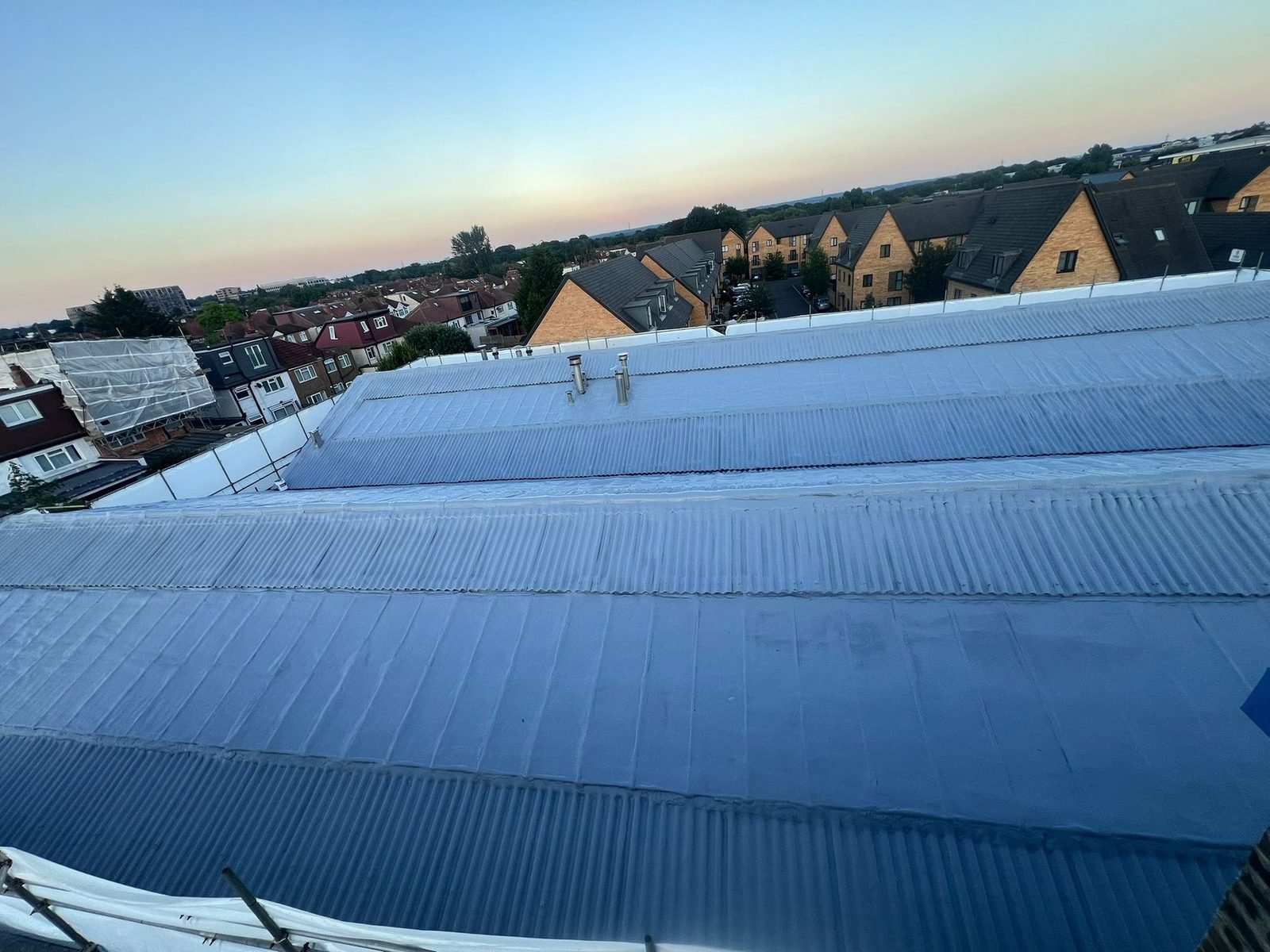
1The weathered sheet
Porous now, and brittle.
Decades of weather leave asbestos-cement porous on the surface and brittle at the edges. It holds water, dries slowly, and sheds fibres where it is worn. It is usually still sound as a sheet.
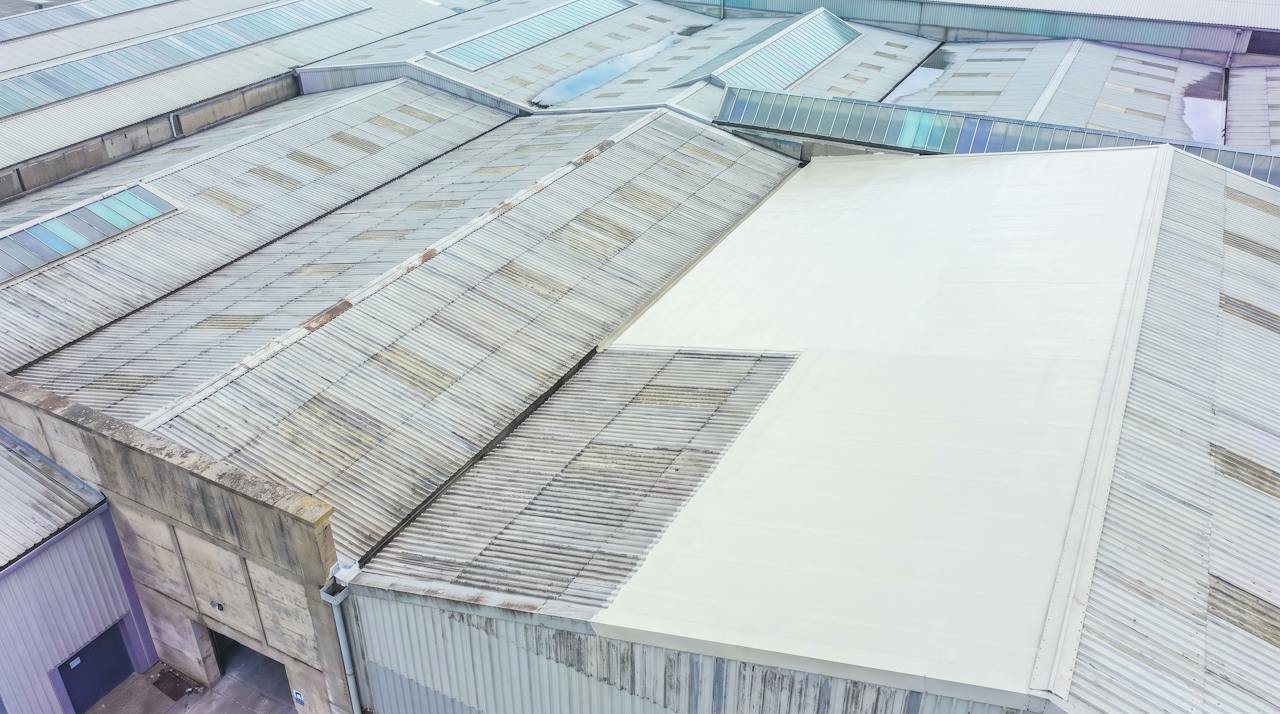
Application
A liquid-applied silicone coating that follows the roof, seals every fixing and lap, stays flexible under UV and tolerates standing water. On weathered metal, aged single-ply, ponding flat roofs, and asbestos-cement roofs that are better encapsulated than removed.
Is this your roof?
01The build-up
An old asbestos-cement roof does not usually fail as a sheet. It fails at the fixings, the laps and the cracks, and it grows moss in the troughs that holds water against it. Switch the drawing between the weathered roof and the coated roof.
Two states. Switch between them; the marks and the reading follow.
Swipe across to see the whole section.
WEATHERED SHEET · WATER FINDS A PATHSection, schematic, not to scale. Three marks in each state; the cards beneath read them.
Weathered sheet · water held and let throughThe threshold · water finds a pathSealed surface · water sheds
1The weathered sheet
Decades of weather leave asbestos-cement porous on the surface and brittle at the edges. It holds water, dries slowly, and sheds fibres where it is worn. It is usually still sound as a sheet.
2Fixings and laps
Hook bolts work loose, washers perish, and the laps open as the sheets move. Nearly every leak on a roof like this is at a fixing or a lap, not through the field of the sheet.
3Moss, cracks and ponding
Moss in the troughs holds water against the sheet for weeks. Cracks propagate from fixing holes. On a low-slope roof, water ponds and finds the weakest point.
1The coating, following the sheet
A silicone coating is applied over the cleaned roof and follows the profile exactly, corrugation by corrugation. It bonds to asbestos-cement, metal, aged membranes and foam without a primer on most substrates, and cures into a seamless skin.
2Fixings and laps sealed
Every fixing is capped and every lap is reinforced before the field coats go on, so the places the water was getting in are closed by the thickest part of the system.
3Rain sheds; the sheet stays
The finished surface sheds water, stays flexible under UV and tolerates standing water. Its pale colour reflects summer heat. The asbestos-cement is sealed in place, the fibres bound, and nothing has been removed.
The short version: an ageing roof usually leaks at its fixings and laps, not through its sheets. A liquid-applied silicone coating closes those first and then seals the whole roof as one skin, without stripping anything off. The rest of this page is how it goes on properly.
02Project record
Installation footage from HOLVEM's own projects: a protective coating applied over finished spray foam. This item is a project record, played on request; nothing on this page that is not real footage carries that label.
Whether it protects a foam jacket from UV or seals an ageing roof from above, a liquid-applied coating is specified, applied to a film thickness and logged. What you see is the same care applied to a coating as to the foam beneath it.
03The order of work
The work is done on the roof, with the building beneath it open and the sheets left in place. Each step is checked before the next begins. On an asbestos-cement roof, the condition survey gate comes first and is not skipped.
The roof is inspected from above and, where possible, beneath: sheet condition, fixings, laps, cracks, moss and ponding. On asbestos-cement the survey establishes that the sheets are sound enough to be encapsulated rather than replaced, and the building's asbestos register is consulted.
HOLVEM checksSound sheets; a roof that can be worked on safely.
Moss, lichen, dirt and loose material are removed with methods that do not damage the sheet or release fibres. Failed fixings are replaced and cracked sheets repaired. The roof is dry before coating.
HOLVEM checksClean, dry, repaired roof; fixings sound.
Every fixing head is capped and every lap and crack is reinforced with the coating's detailing grade, so the failure points carry the thickest part of the system.
HOLVEM checksEvery fixing and lap sealed before the field coats.
The silicone coating is applied across the whole roof in the specified number of coats to the specified film thickness, following the profile and curing into one seamless skin. Gutters and valleys are lined in the same system where specified.
HOLVEM checksCoverage and film thickness logged.
Ridges, verges, eaves, rooflights, penetrations and gutter edges are detailed per project. The coating stops at a closed edge, and rooflights are either coated over or left clear, as you choose.
HOLVEM checksEvery edge closed and detailed.
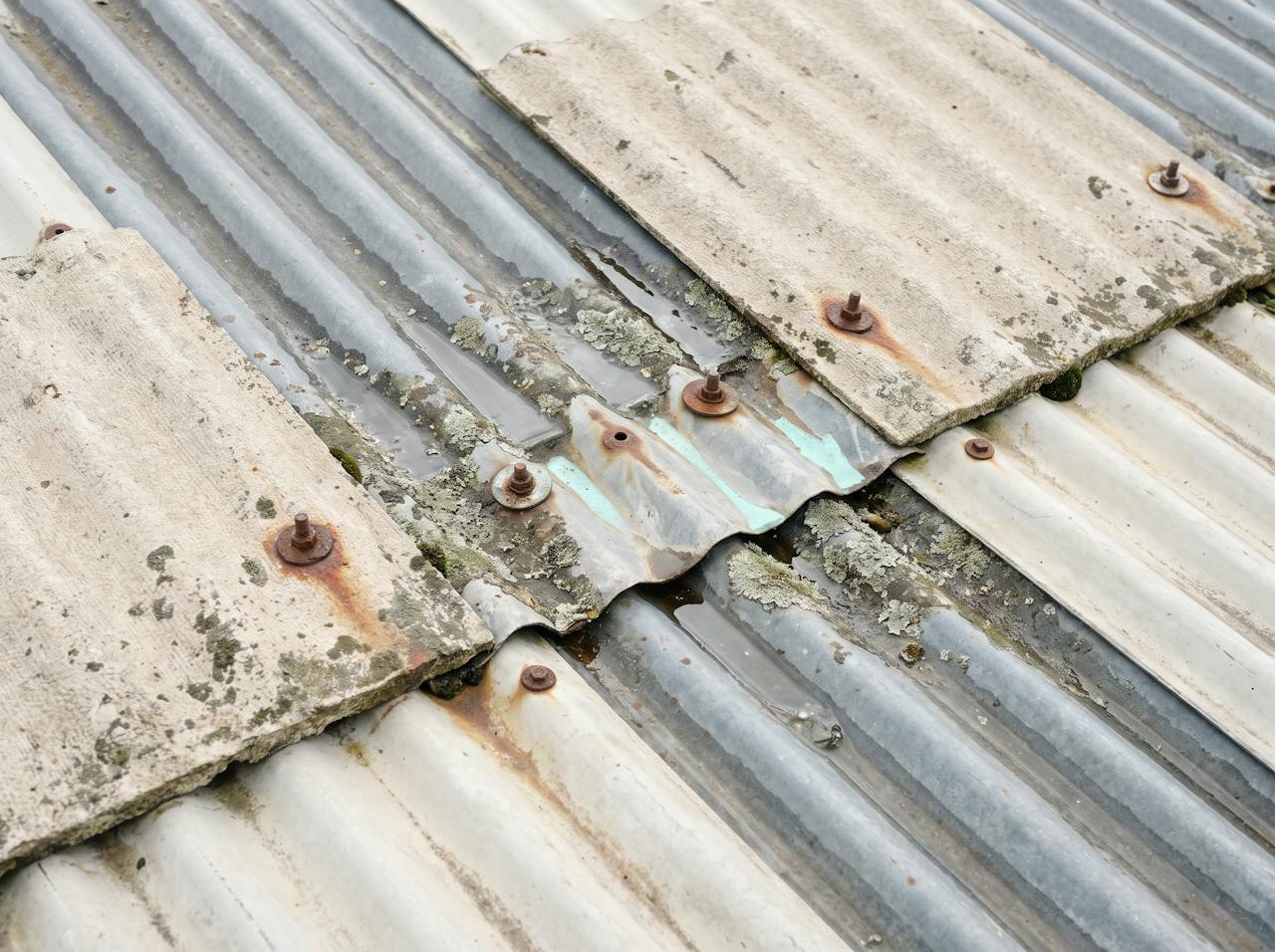
Every step is checked before the next. Film thickness measured, coverage logged, compiled into a QA record at completion.
04Preparation
Coating is only as good as what is under it. Three things HOLVEM establishes first, and the fourth is what this page does not do.
Sound
A coating restores a roof that is weathered but sound. It does not hold up sheets that have gone soft, delaminated or broken. The condition survey says which the roof is, and where the two meet, which sheets are replaced first.
Clean and dry
Moss, lichen, chalking and dirt come off, with methods suited to the substrate. The roof is dry at the time of coating. A coating over a dirty or wet roof peels, and a peeling coating is worse than none.
Understood
Encapsulating an asbestos-cement roof in place is a recognised way of managing it, and it avoids stripping and disposal. HOLVEM coats and encapsulates; it does not remove asbestos or advise on its legal management, and the roof's asbestos register is consulted first.
Survey, or photographs?How HOLVEM works: we understand your project before we price it
05What the coating achieves
A roof coating is a waterproofing and restoration system. Three things it achieves on an ageing roof, and the one thing it is not. What it costs is priced per project and explained on the cost guide, not here.
WaterproofRestoration
Fixings and laps sealed, cracks reinforced, the field coated, gutters lined where specified: the roof is waterproofed as one skin, and an asbestos-cement roof is encapsulated in place with its fibres bound.
FlexibleDurability
Silicone stays flexible as the roof moves with temperature and does not break down in sunlight. On low-slope roofs where water ponds, it does not soften or swell, which is where acrylic coatings fail.
ReflectiveSummer comfort
The pale finish reflects a large share of summer sun, so the building beneath runs cooler. The coating is not insulation: for winter heat loss and condensation, the roof underside pages carry the thermal case.
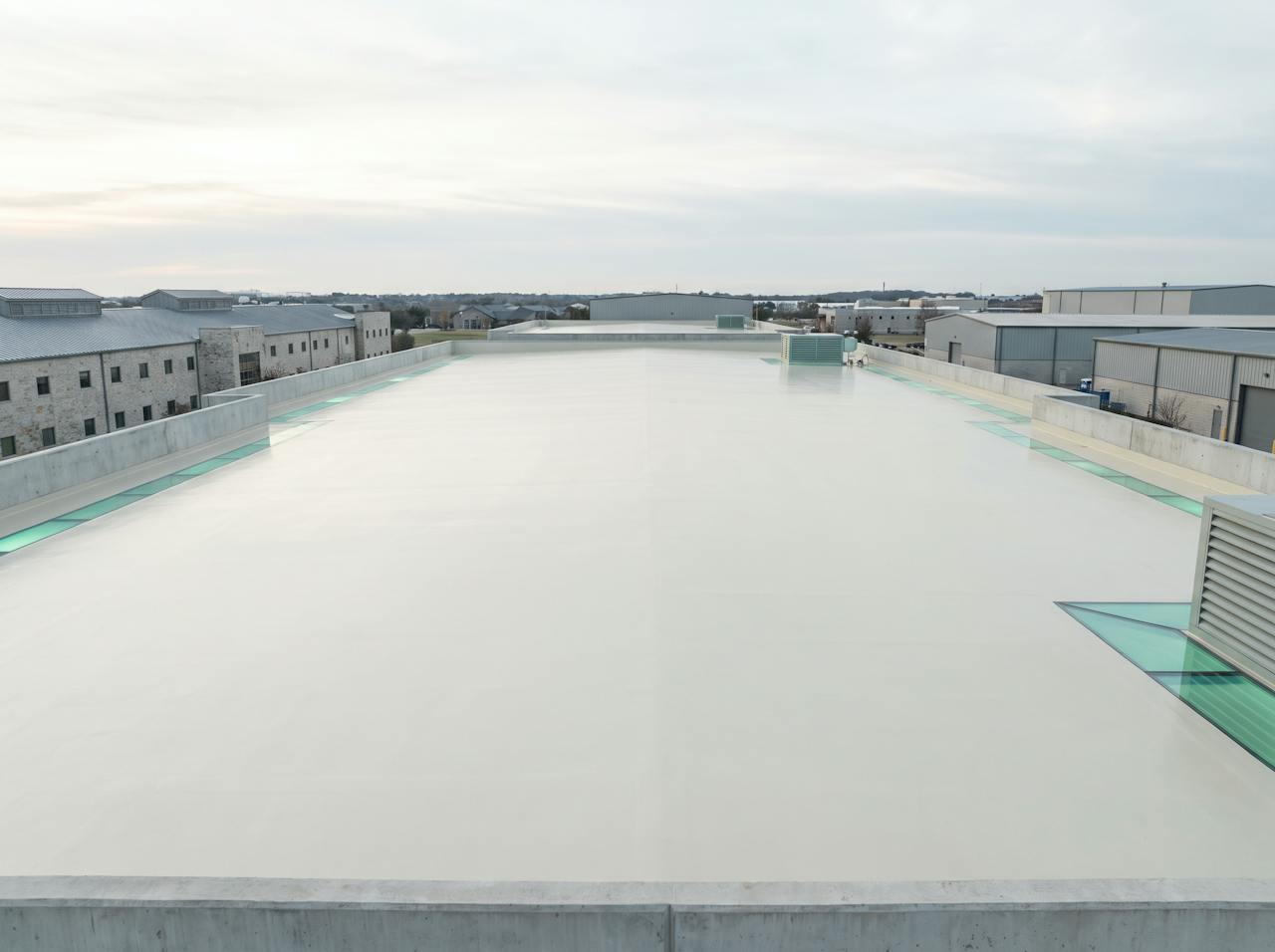
06Where it suits
Asbestos-cement and weathered metal roofs cover a large part of Britain's older industrial and agricultural estate. Three building pages where this application is common.
Building
Asbestos-cement and corrugated steel roofs on barns and stores, restored from above without stripping and without stopping the farm.
Read the building pageBuilding
Ageing roofs over working production, waterproofed in place with the line running beneath.
Read the building pageBuilding
Large low-slope roofs with ponding and failing laps, sealed as one skin while the racking stays where it is.
Read the building page07What HOLVEM checks
HOLVEM does not specify a coating from a photograph. The roof is understood first: whether it can be coated, what the coating has to withstand, and what the building needs from the roof beyond keeping the rain out.
Condition survey
Sheet condition, fixings, laps, cracks and ponding, from above and where possible from below. On asbestos-cement, whether the sheets are sound enough to encapsulate. Where they are not, HOLVEM says so; a coating over a failed roof is not offered.
The exposure
UV, ponding, temperature movement, foot traffic and anything the site adds: the coating system, its detailing grade and its film thickness are specified for them.
The building beneath
If the roof also runs with condensation or loses heat, that is a separate case for the underside: closed-cell foam beneath the same sheet, with a condensation risk analysis and U-value calculation. The two are often done together, from above and from below.
Condensation risk analysisU-values and Approved Document LFire performance and coatings
08Straight answers
The questions people with an ageing or asbestos-cement roof actually ask on the call, answered the way the specialist answers them.
Project records
The next step
You do not need to know the system to start. Tell us what the roof is made of, where it leaks and how old it is. Photographs from above and from inside are the most useful thing you can send.
Or call . Enquiries received before 3pm on a working day are contacted the same day. After 3pm, the next working day. We understand your project before we price it.