Before 3pm on a working day, contacted the same day. After 3pm, the next working day. Contact, not a quotation. Telephone
Start a project brief
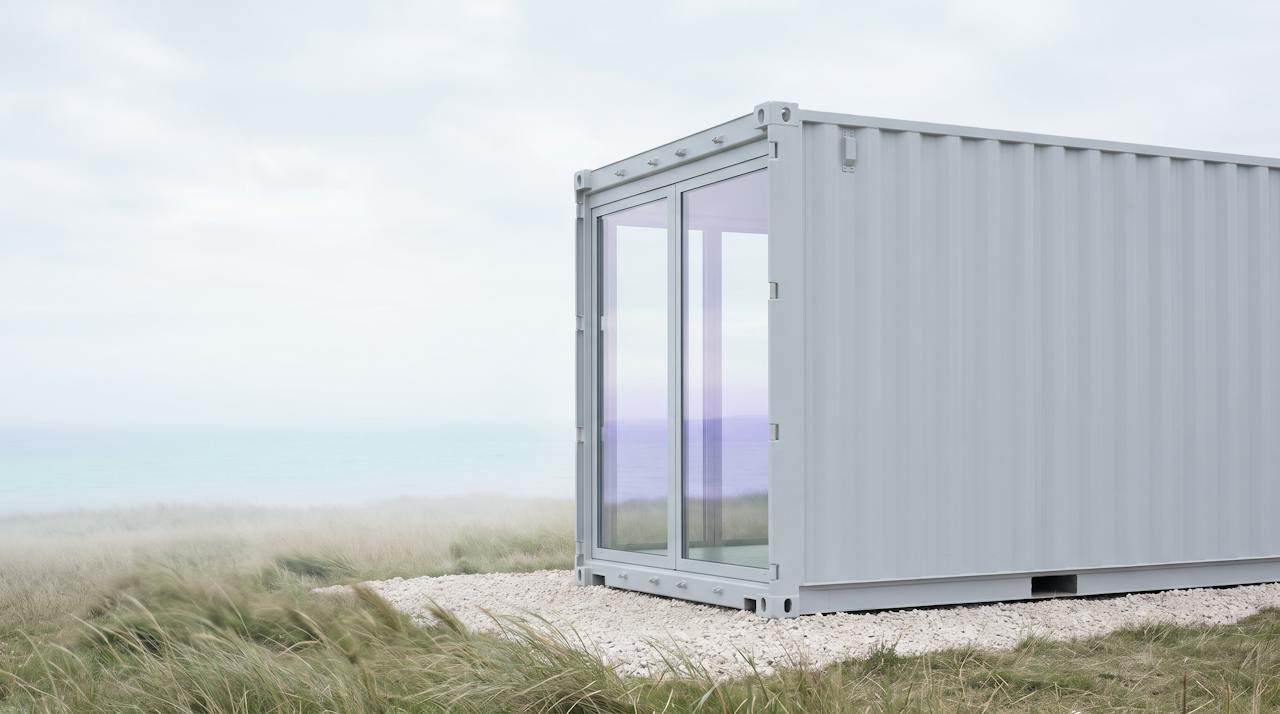
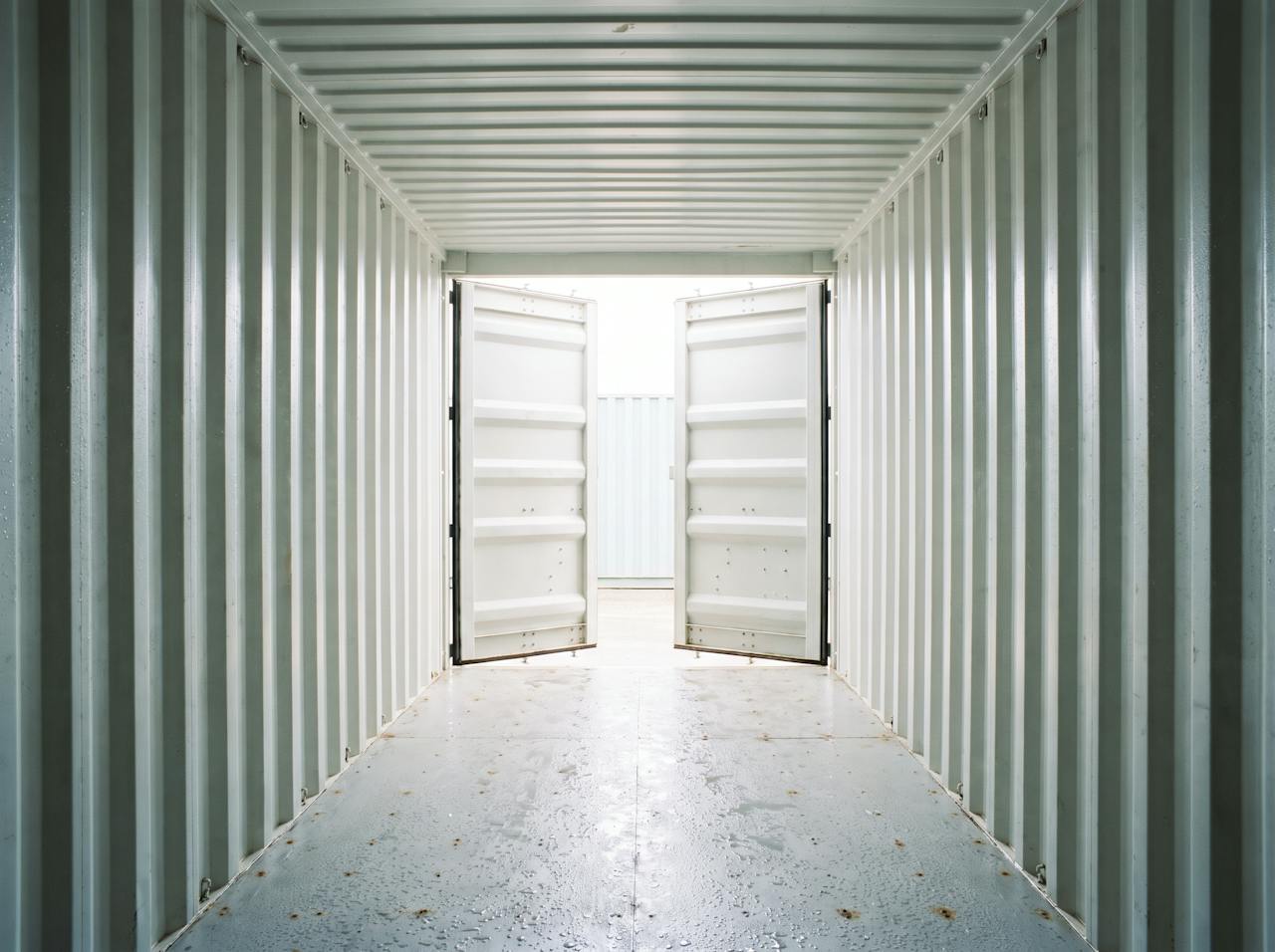
A row of shipping containers in a UK yard at first light, one with its doors open showing the bare corrugated steel interior, pale sky and wet concrete.

Building type

Shipping containers: stop the steel sweating before you fit it out.

A container is a steel box that heats and cools with the day. Bare, it runs with condensation. Closed-cell foam sprayed straight to the corrugated steel gives a dry, sealed shell for the office, workshop, store or home going inside it.

Walls, roof and floor undersideBefore fit-out, usually one visitFrom £16/m² + VAT at 25 mm

Same-day estimator

About a minute · no obligation

Step 1 of 4: your building.

Which building is it?

This page's building is pre-selected. Change it if yours is different.

Takes about 30 seconds. No contact details yet.

01What is happening

Bare steel, daily swing, and water running down the walls.

Steel has no insulation and no mass to speak of. A container skin follows the outside temperature within minutes, so on a cold night it falls below the dew point of the air inside and every wall and the roof run with condensation. Fit a board lining and the same water forms behind it, in the corrugations, where nobody sees it until the rust does.

Inside a bare shipping container on a cold morning: the corrugated steel walls and roof beaded with condensation, a run of drips on the floor and rust starting along a lower seam.
The steelBelow the dew point
  • Steel follows the weather. No mass, no insulation: the skin is at outside temperature within the hour.
  • The UK climate does the rest. Damp maritime air, cold nights and mild days are the recipe for a box that sweats.
  • Boards leave a gap. Behind a rigid board the corrugation is an air gap, and the water forms there instead.

It is not a leak. Water across the whole underside of the roof on a dry cold morning is condensation.

It is not solved by a heater. Warmer air holds more moisture and finds the same cold steel.

It is not solved by ventilation alone. Vents help; only insulation changes the temperature of the steel.

02Recent projects

Real containers, sprayed to the steel.

Installation footage and photographs from HOLVEM's own container projects: conversions and units sprayed to the corrugation before fit-out, walls and ceilings in one continuous layer. Every item is labelled Project record.

Project recordSprayed to the steel
Container sprayed to the steelReal installation footage.
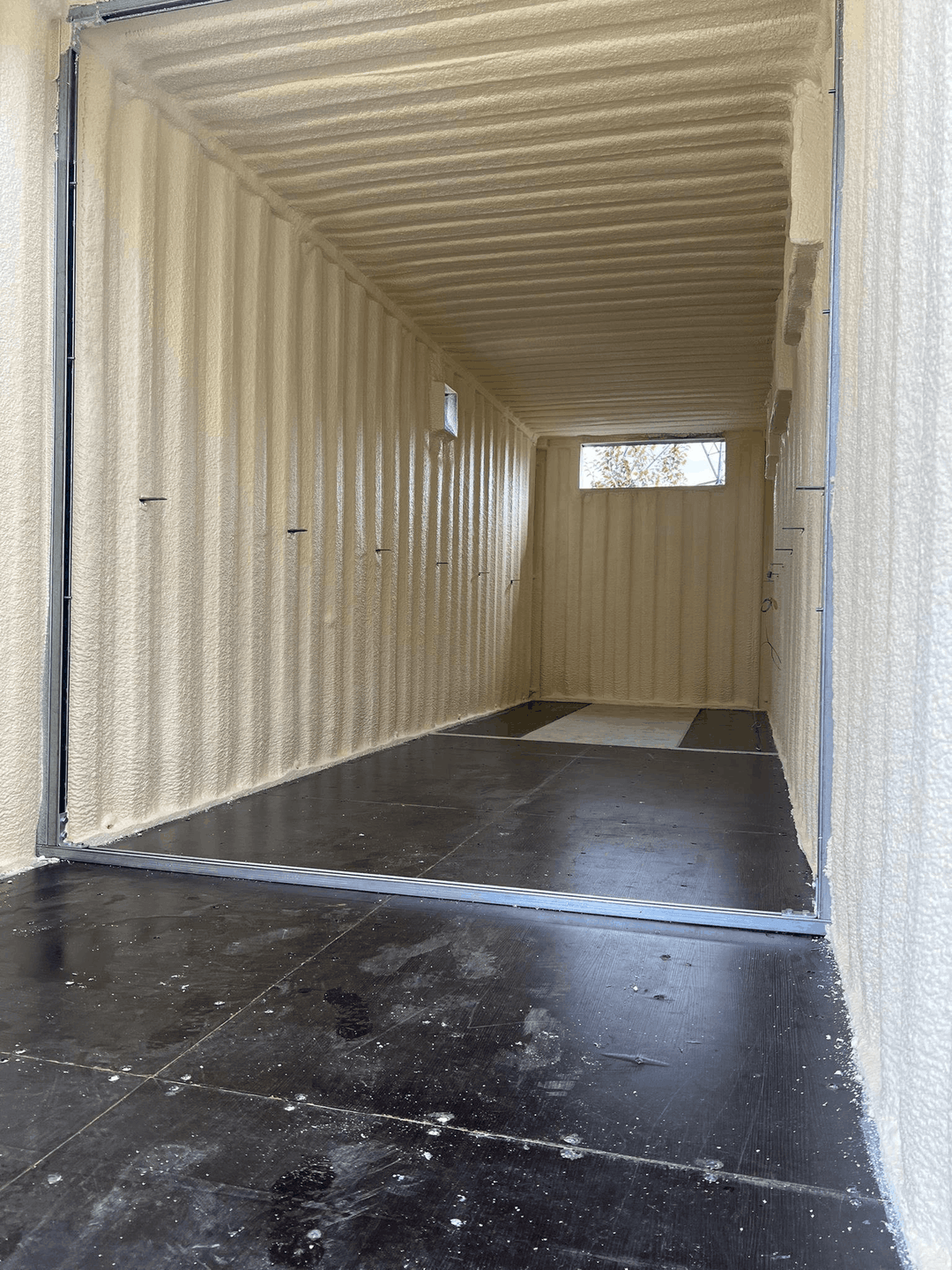
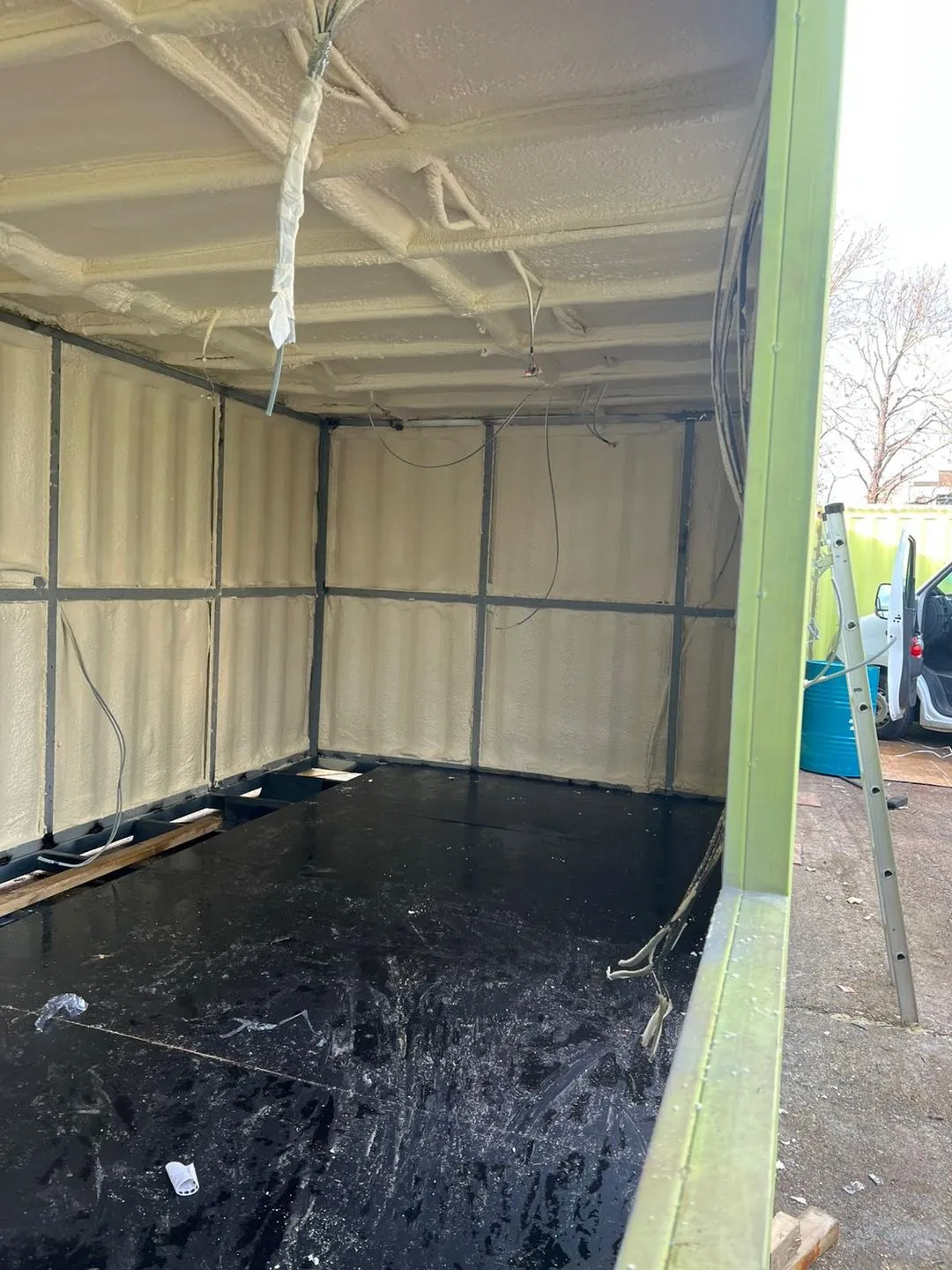
A shipping container conversion interior sprayed with closed-cell foam, walls and roof in one continuous cream layer.
Project recordConversion
Container conversionSprayed to the steel before fit-out.
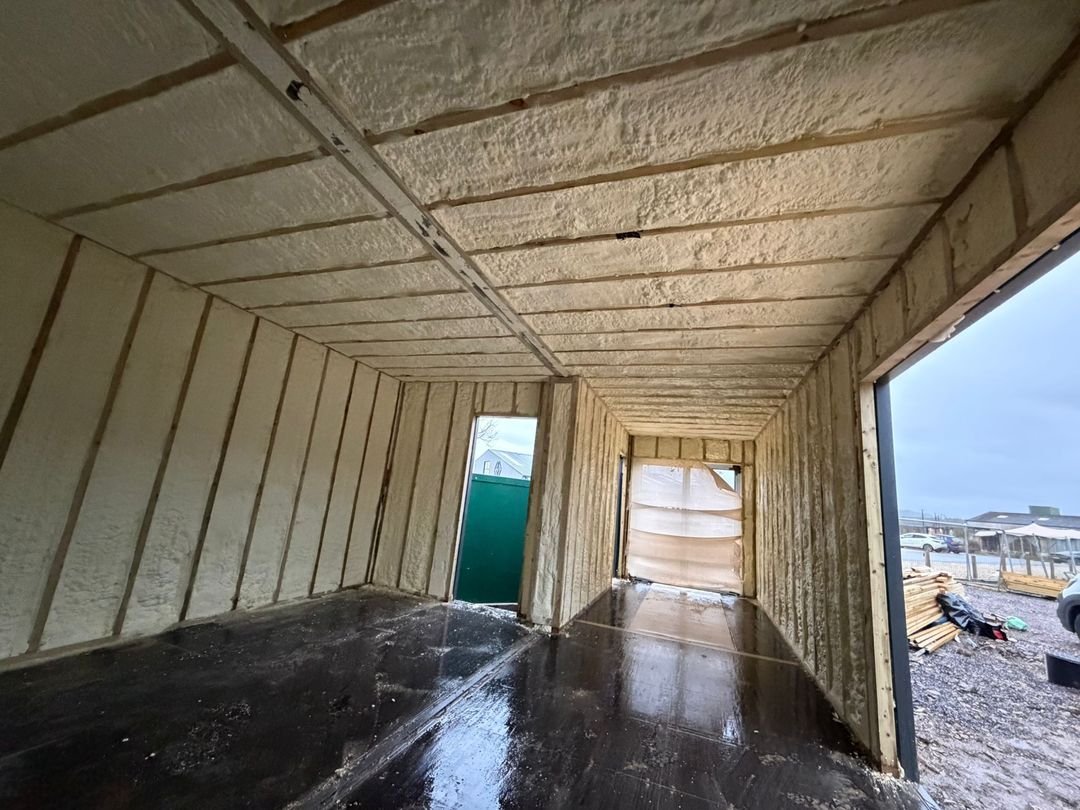
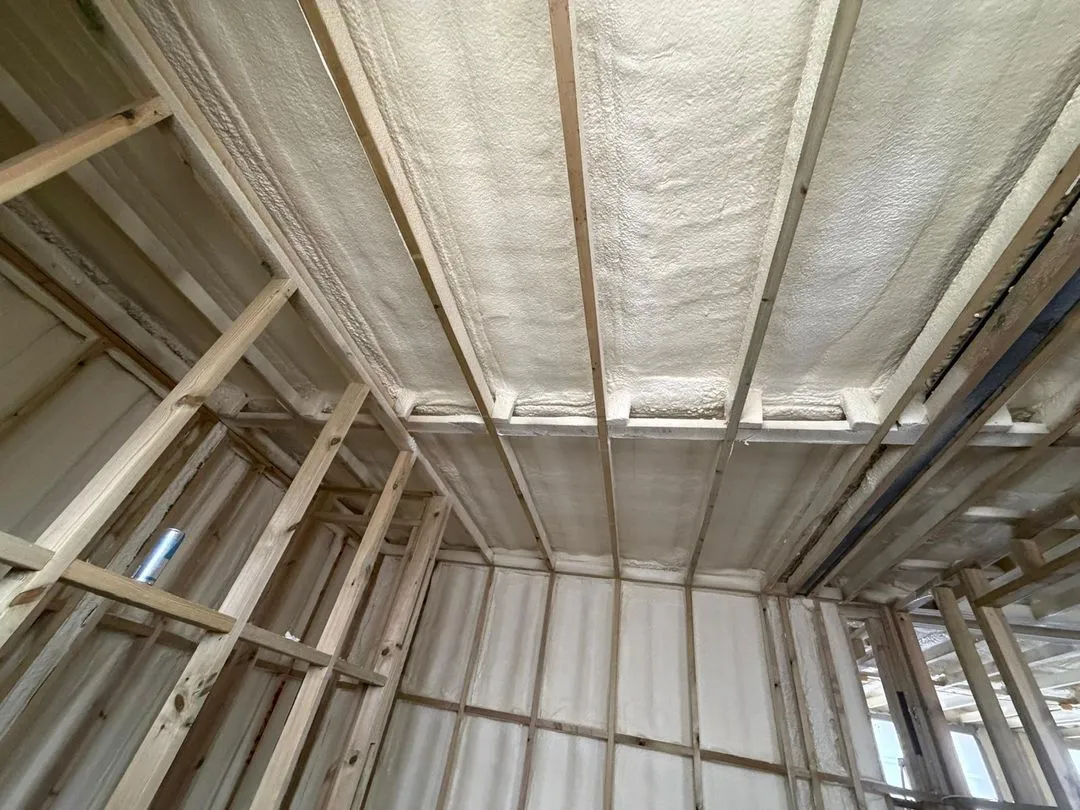
A container interior with walls and ceiling insulated with closed-cell spray foam between timber battens, ready for lining.
Project recordBetween battens
Walls and ceiling sprayed before fit-outClosed cell between the battens.
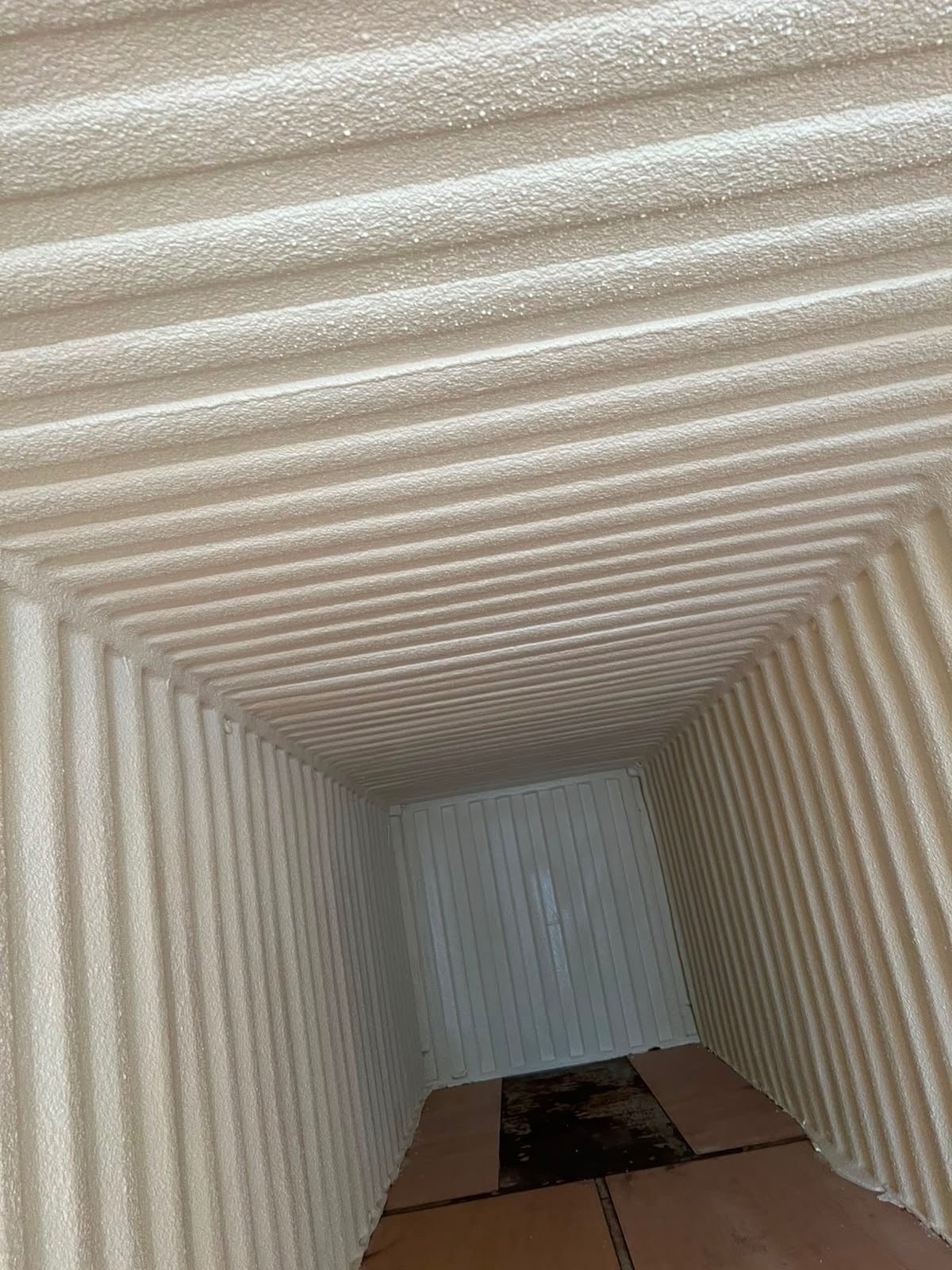
A container interior sprayed to the corrugation with closed-cell foam, the profile of the steel still legible under the layer.
Project recordTo the corrugation
Interior sprayed to the corrugationClosed cell.
A container ceiling sealed with closed-cell foam, the roof corrugation and end wall in one layer.
Project recordCeiling sealed
Container ceiling sealedClosed cell, roof and end wall.
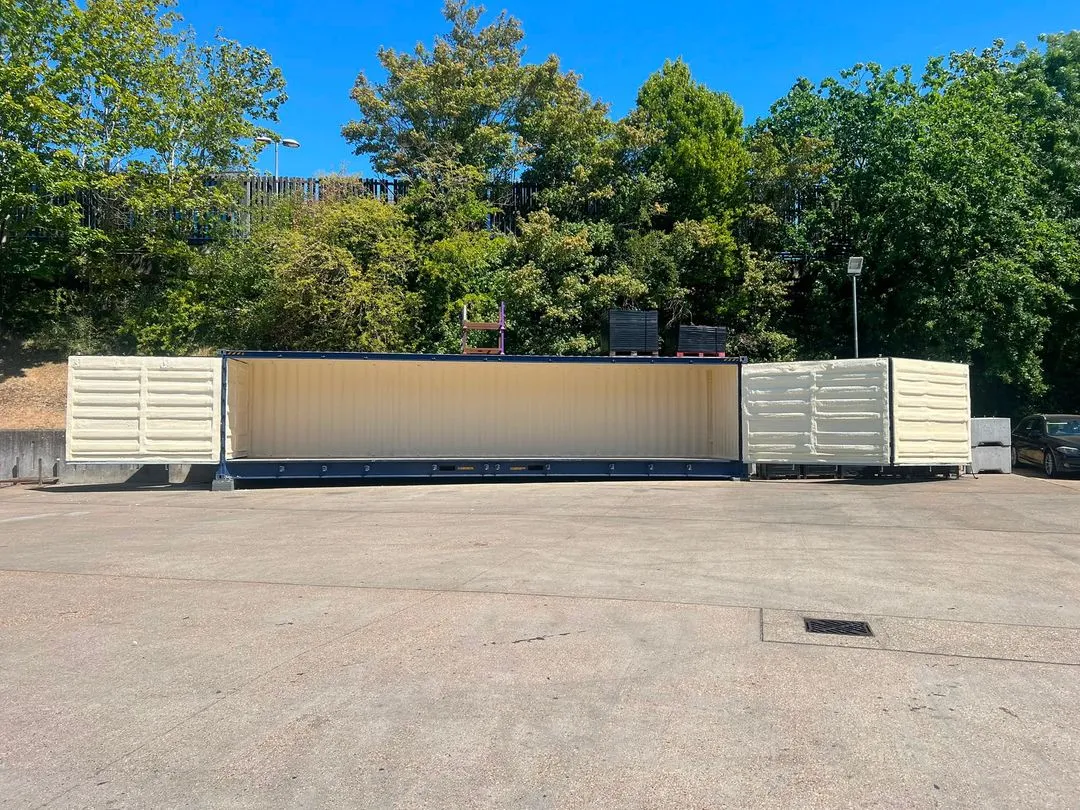
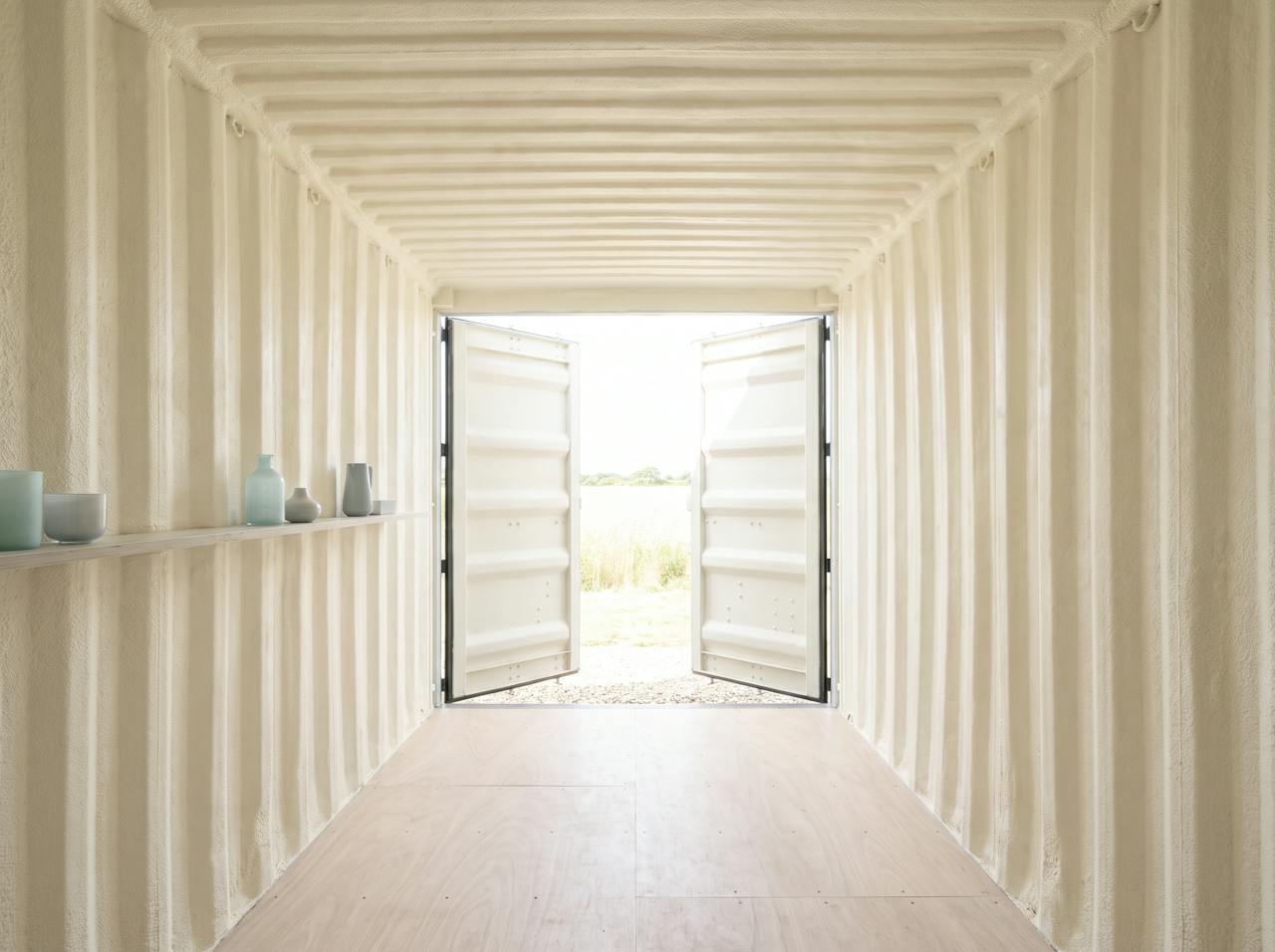
A container conversion before fit-out with the whole shell sprayed in closed-cell foam, doors open to daylight.
Project recordBefore fit-out
Container conversion before fit-outClosed cell, the whole shell.

03What is applied

Closed-cell foam sprayed straight to the steel, following the corrugation.

The layer is sprayed onto the prepared inside face of the walls and roof, following every corrugation and sealing the seams, corner posts and floor edge. It bonds without primer or fixings and needs no cutting or jointing. The battens for the lining go on after, and the lining sits on a dry, sealed shell.

Schematic / not to scaleKeyed 1 to 5 below

Inside a shipping container after the work: walls and roof sprayed in a continuous cream closed-cell layer following the corrugation, timber battens fixed ready for the lining, daylight through the open doors.
AppliedSprayed to the steel
The layer follows the corrugation into the corners and along the floor edge. The battens and lining go on afterwards.
1 / Corrugated steel skin

Wall or roof. It stays as the weather line, and its paint and seams are checked first.

2 / Prepared face

Loose paint, rust and residue removed. Adhesion is decided here.

3 / Closed-cell layer, in passes

Follows the corrugation and seals the seams. λ 0.027 W/mK is the NexSeal LE product figure.

4 / Battens, posts and floor edge

Wrapped by the application; the lining fixes to battens set after the layer.

5 / Finish, where specified

Left exposed, coated, or lined for fit-out. Where a fire classification is required the coated system carries B-s2,d0, as tested.

04Working around the building

Before the fit-out, usually in a single visit.

A standard container is a small area and a simple shape. It is prepared, masked and sprayed in one visit, ready for battens and lining. Several containers are done in a run. Where the container is already converted, the work is planned around what is inside.

  1. 1 / 3

    Empty and prepared

    The box is emptied, loose paint and rust are removed, doors, vents and fittings are masked.

  2. 2 / 3

    Sprayed in one visit

    Walls, roof and, where access allows, the floor underside in continuous passes. A standard 20 ft or 40 ft container is usually a single day, confirmed in your specification.

  3. 3 / 3

    Ready for fit-out

    Battens, lining and services go on after cure. Re-entry time and any ventilation needed are set out in the method statement.

05Enverge NexSeal LE

The material we spray, and why it matters.

Enverge NexSeal LE is a two component closed cell polyurethane, spray applied directly onto the prepared substrate. As it cures, it expands and sets into one rigid, continuous layer, bonding into corrugations, laps, fixings and awkward junctions without being cut, jointed or mechanically fixed.

That matters because most insulation problems start at the gaps.

Board systems can leave voids at ribs, laps and junctions, and every gap is a potential cold bridge where warm internal air meets a cold surface and condensation forms, hidden behind the insulation. NexSeal LE is applied as one continuous bonded layer, so there is nowhere for that to start: a sealed, stable building envelope that controls condensation, reduces heat loss and protects the structure underneath.

0.027 W/mKThermal conductivity · aged · BS EN 14315-1
Class 1Surface spread of flame · BS 476-7 · uncoated
B-s2,d0Coated, as tested · BS EN 13501-1
25 yearsWorkmanship warranty, plus the manufacturer’s

HOLVEM also installs open-cell foam. It is a different product with its own data sheet, specified for different objectives: hybrid build-ups, sound absorption, or where the layer has to breathe. It is not what goes onto a cold sheet or a cold soffit. Open-cell system data · Closed-cell system data
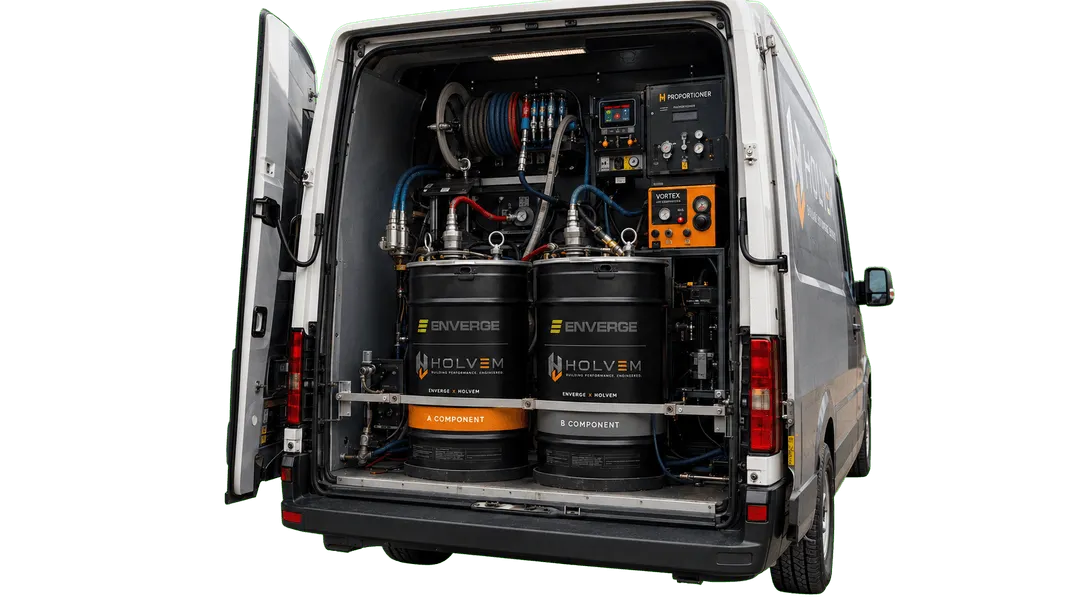
HOLVEM spray rig van with Enverge NexSeal LE A and B component drums plumbed into the proportioner.
HOLVEM rigA and B on board
The HOLVEM rig · Enverge NexSeal LE A and B components on board. HOLVEM's own photograph.

06How we check

We check the shell before we spray.

A container is simple, which is why it is worth getting right. The use decides the objective: a dry store needs the steel kept above the dew point; an office or a home needs a U-value and probably a fire classification. The reading is written to the use, and the depth follows.

  1. 1 / 3

    Condensation risk analysis

    The steel shell is checked against the temperature and humidity the container will hold in use, to BS EN ISO 13788. For a storage or welfare unit that sets the depth; for a habitable conversion it is the start.

    How the analysis works
  2. 2 / 3

    U-value for a conversion

    A container becoming an office, classroom or home carries a target. The calculation is done for this shell to BS EN ISO 6946 with the corner posts and floor edge in it.

    U-values and Approved Document L
  3. 3 / 3

    Fire, where people will occupy it

    An occupied conversion often needs a reaction-to-fire classification. The coated NexSeal LE and DC315 system achieves B-s2,d0 in the build-up tested; the lining specification decides what else is needed.

    Fire performance and coatings

07The objective sets the depth

Four objectives. Each one sets the depth.

What does the roof need to do? Pick one below and you will see the depth that does it, and just as plainly what it won’t do. Nothing is left to come out later: the survey confirms the right depth for your building.

Four depths, drawn to one scale and measured from the container wall. The objective and the calculation set the thickness on your building.

Pick an objective above to see the depth that does it, and what it won’t do.

Thickness and objective

Want a figure for your building? It takes about a minute.Shell, use, reading, details. A real figure for your container the same working day; nothing sent to anyone else.

Get my estimate

08Straight answers

Ask us the hard ones.

The questions container converters, site managers and owners actually ask on the call, answered the way the specialist answers them. A question we have not answered? Ask it on the call. No obligation.

Why spray foam and not board?
Because a rigid board cannot follow a corrugation. Behind the board the corrugation is an air gap, warm air reaches the cold steel there and the condensation forms where nobody sees it until the rust does. Sprayed closed-cell foam bonds to the steel, follows every corrugation and seals the seams, so there is no gap for water to form in.
How long does a container take?
A standard 20 ft or 40 ft container is a small area and a simple shape: prepared, masked and sprayed in a single visit, usually one day, confirmed in your specification. Several containers are done in a run. Battens and lining go on after cure.
How much does container insulation cost?
A container is a small area, so it is priced as a job rather than at a large-area rate. Condensation control starts at 25 mm; a conversion that has to hold heat starts at 50 mm. A U-value target for a habitable conversion, and a fire coating where the use requires it, are priced per project. Send the container size and its use and we will ring you with a figure.
Can you do a container that is already fitted out?
Sometimes, from whichever face is accessible, and the survey establishes which. The clean answer is to spray before fit-out: the layer goes on the bare steel, the battens go on after, and the lining sits on a dry, sealed shell.
Does it need a fire coating?
That depends on the use. A storage container usually does not. An office, classroom, welfare unit or home that people occupy often needs a reaction-to-fire classification, and the coated NexSeal LE and DC315 system achieves B-s2,d0 to BS EN 13501-1 in the build-up tested. The lining specification and building control decide the rest.

The next step

Your building.
Your brief.
A specialist.

If you already know the thickness or U-value you need, we price to it and confirm it is right; if not, we work it out with you. Tell us the container size and what it will be used for; the estimator at the top takes about a minute and asks for nothing until the reading is on screen.

Or call . Enquiries received before 3pm on a working day are contacted the same day. After 3pm, the next working day. A commitment to contact, not a quotation, a survey or a price.

Rather write it all down first? Start a project brief · about five minutes, photographs welcome.

Same-day estimate · about a minute Get my estimate