Before 3pm on a working day, contacted the same day. After 3pm, the next working day. Contact, not a quotation. Telephone
Start a project brief
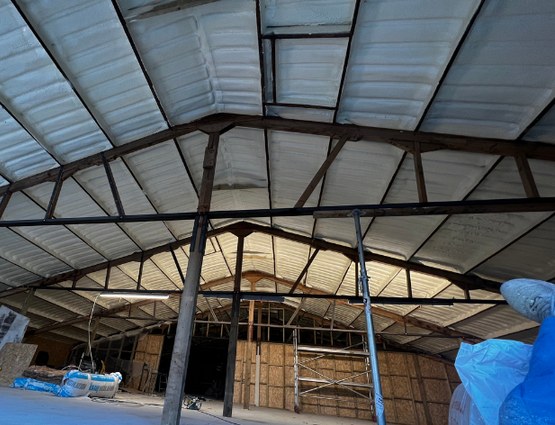
Inside the Midlands warehouse after the work: the whole corrugated metal roof and its steel trusses sprayed from beneath in a continuous cream closed-cell layer, wrapped pallets and an access tower on the floor.
Project recordThe roof, after

Project record · Metal roof underside

A Midlands distribution warehouse: 75 mm of closed-cell under a corrugated metal roof.

Early 2024. A large, busy warehouse whose metal roof let air through, ran with condensation in the cold months and drummed under rain. We sprayed 75 mm of Enverge NexSeal closed-cell foam to the underside of the sheet, in one continuous layer. The roof stayed exactly where it was.

75mm
Closed-cell, to the underside
2024
Early in the year
1 layer
Insulation, air seal and a quieter roof

01The building

A roof that let the weather in three ways.

A distribution warehouse is a thin steel skin over a lot of air and a lot of movement. This one had a corrugated metal roof with nothing on its underside: every lap and fixing was a path for air, every cold night put water on the sheet, and every shower was audible across the floor.

Air. A profiled sheet is fixed to purlins through hundreds of holes and laps. Warm air leaves through them, cold air arrives through them, and the heating runs to keep up. Inside, the temperature swung with the weather outside.

Water. Bare steel is the coldest surface in the building. In winter the air inside, carrying moisture from people, vehicles and the goods themselves, met it and condensed. Drips on stock and on the floor looked like a leak and were not one.

Noise. Rain on a bare metal roof drums. On a working floor that is a nuisance all day and a problem for anyone trying to hear a radio, a forklift horn or each other.

The brief. Stop the condensation, cut the energy use and bring the noise down, without taking the roof off or stopping the operation. One layer answers all three if it bonds to the sheet, so that is what we specified.

Building
Distribution warehouse, large single-storey
Location
The Midlands
Roof
Corrugated metal sheetKept in place as the weather line
Treated from
The underside
Application
75 mm closed-cell, Enverge NexSeal
Date
Early 2024
Client
Unnamed

02What we specified, and why

75 mm closed-cell, bonded to the sheet, so one layer insulates, seals and quietens.

The objective set the depth. Condensation control alone is a 25 mm job; this roof also had to hold heat overnight and stop the air movement that was driving the bills, so the layer went deeper.

  • The system: Enverge NexSeal closed-cell, at 75 mm. Sprayed in passes directly onto the underside of the corrugated sheet, following the profile into every trough and over every purlin and fixing. How thickness follows the objective.
  • Why closed-cell. It bonds to the steel and sets rigid, so the laps and fixing holes that were letting air through are closed in the same pass that insulates. NexSeal LE declares a water vapour resistance factor (μ) of 62 to BS EN 12086, which we use in condensation-risk analysis to BS EN ISO 13788; this is vapour control, confirmed by analysis, not an absolute barrier.
  • Why it is quieter. A bonded layer of rigid foam stops the sheet ringing like a drum under rain. It damps the drumming; it is not an acoustic treatment, and we do not describe it as one. Rain noise and acoustics.
  • Why from below. The roof is sound. Working from the underside keeps the weather line intact, keeps the building open and avoids scaffold, strip and waste.
Product
Enverge NexSeal, closed-cell
Depth
75 mm
Substrate
Corrugated metal sheet, underside
Vapour control
μ 62 (BS EN 12086), used in the risk analysis
Thermal
λ 0.027 W/mK aged, BS EN 14315-1 (product figure)
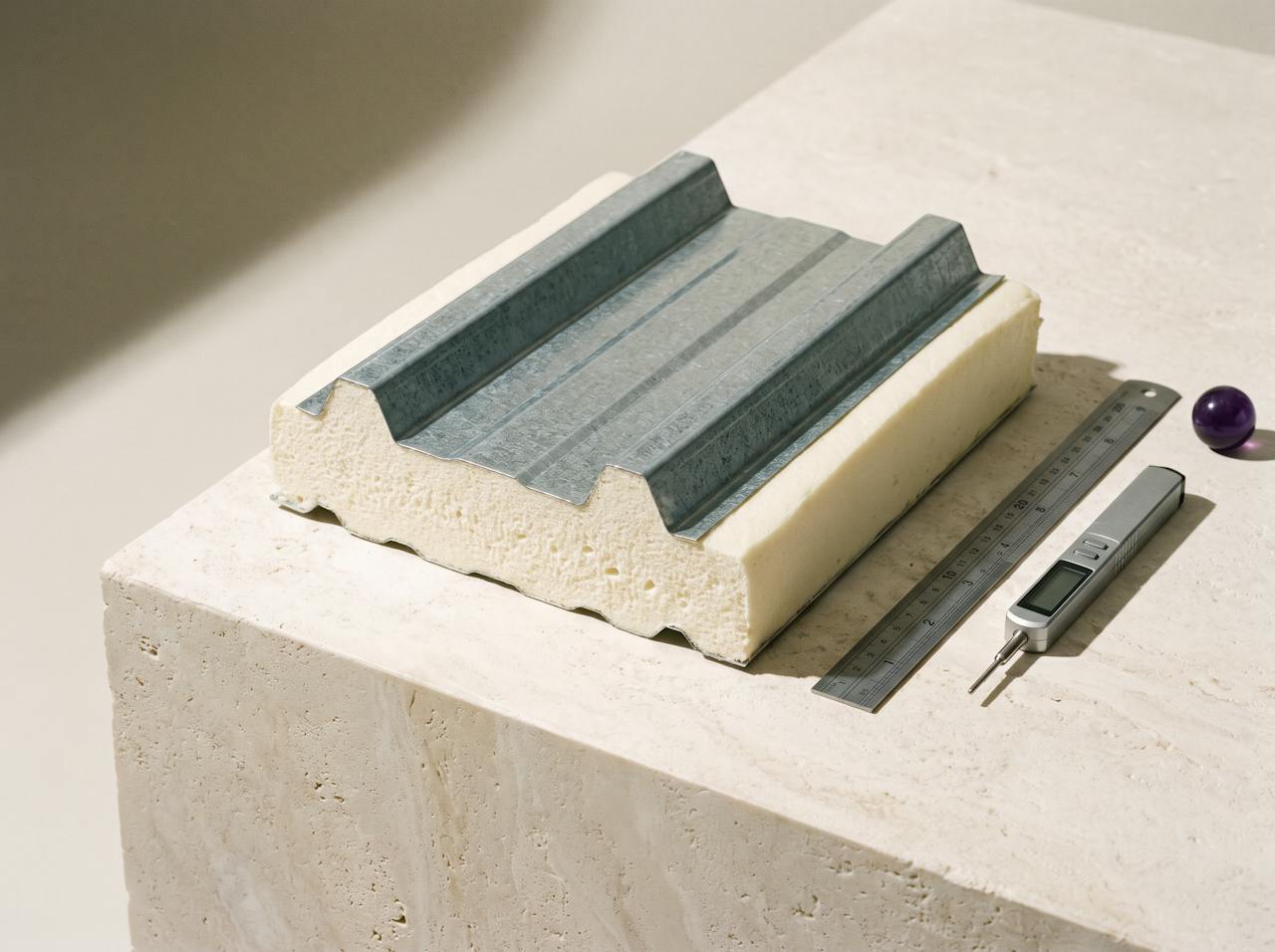
A cut section of closed-cell spray foam on a stone bench under raking light: the pale foam body follows the profile of the sheet it is bonded to, with a steel rule and a probe laid beside it.

What closed-cell looks like in section. A rigid, fine-celled body that follows the profile of the sheet it is sprayed onto, rather than bridging it. At 75 mm it is three times the condensation-control depth.
03How the work ran

Bay by bay, under a working roof.

The building did not close. The work moved along the roof in bays, with the floor beneath each one cleared or sheeted and the rest of the warehouse carrying on.

  1. Survey

    The roof read from inside.

    Sheet profile, purlin spacing, laps and fixings, and the places water was already landing. The depth was set against the objective and this build-up.

  2. Protection and access

    Stock sheeted, towers in.

    Pallets beneath each bay wrapped or moved aside, lighting and services masked, access from mobile towers moving along the building.

  3. Application

    Sprayed in passes to 75 mm.

    Enverge NexSeal applied directly to the sheet in passes, building to depth, wrapping purlins and closing every lap. Re-entry follows ventilation; the floor returns to use bay by bay.

  4. Completion

    Recorded and handed over.

    What was applied, where and at what depth, with the photographs on this page taken as the work ran.

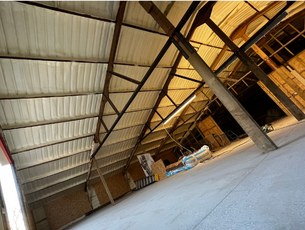
Looking along the eaves of the warehouse towards an open door: the sprayed cream underside of the corrugated roof meeting the steel columns, daylight across the floor.
Project recordAlong the eaves

The eaves line. The layer runs down to the wall head, so the junction that leaks most on a steel building is closed too.

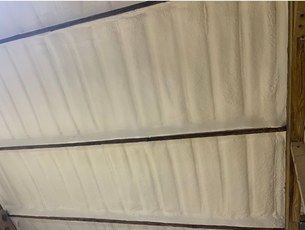
Close to the roof after the work: the corrugated sheet between two timber purlins covered in a continuous cream closed-cell layer that follows every rib, the purlins left exposed and a lamp fitting below.
Project recordBetween the purlins

Between the purlins. Every rib and trough of the sheet covered; the purlins pass through the layer and are wrapped where they meet it.

04The outcome

A dry roof, a steadier building, a quieter floor. As the client reported it.

We publish what the client told us afterwards, in their terms. We do not publish a percentage saving: what a warehouse uses depends on how it is run, and a figure measured in one building says nothing about yours.

Condensation on the sheet

Stoppedas reported

The underside is no longer the surface the warm air meets, so nothing forms on it.

Energy use

Loweras reported

The client reported a substantial fall in energy consumption and cost after the work.

Internal temperature

Steadieras reported

Less swing between day and night, and between the weather outside and the floor inside.

Rain on the roof

Quieteras reported

The drumming a bare sheet makes under rain is damped by the bonded layer.

Where this record comes from

Reported, not metered by us. The client's own figures are theirs; we have not audited them and we do not publish them as a percentage.

Yours will differ. A different sheet, depth, objective or operation gives a different result. How we run a condensation risk analysis.

Your next step

Your building.
Your brief.
A specialist.

If you already know the U-value or thickness you need, tell us and we price to it. If you do not, tell us what you know about the building and the problem, and we work it out with you. Someone who does this every day reads it and comes back to you.

Start a project brief About five minutes. Photographs help; nothing else is needed.

Or pick up the phone

Telephone . Before 3pm on a working day, you are contacted the same day. After 3pm, the next working day. A commitment to contact, not a quotation.

Want a figure before you talk to anyone? What it costs: the cost guide