
The short answer
Asbestos roof repair starts with the fault, the survey and the roof’s condition. HSE includes some asbestos-cement maintenance as non-licensed work, subject to its conditions. A roofer repairs leaks and damaged sheets; closed-cell insulation beneath a suitable roof stops confirmed condensation. Each job needs the right assessment and controls.
HSE publishes specific task guidance for repairing damaged asbestos-cement material. Read Asbestos essentials A13.
Global House records an external treatment system on about 1575 m², including preparation and a silicone finish. Read Global House.
The retained 2340 m² roof was sealed from below; the customer reported underside condensation mitigation. Read the roof project.
HOLVEM has treated more than a dozen asbestos-cement and fibre-cement roofs this year.
01Survey and dutyholder
Begin with the survey and the dutyholder
Before any treatment is discussed
- 01Survey and registerThe building's survey, register and competent asbestos advice establish what the proposed repair needs.
- 02DutyholderThe person responsible for asbestos in the building stays involved throughout; tell the surveyor if the repair changes from what was surveyed.
- 03Roofing repairAsk the appropriate roofer to repair leaks and damaged sheets, with the asbestos requirements and access controls in place.
- 04TreatmentOnce the roof is ready, we carry out the agreed insulation, sealing or refurbishment within our scope.
Before discussing the repair, check the survey and register with a competent asbestos adviser. A roof profile or photograph cannot identify the asbestos content. The information needs to cover the work you intend.
Keep the dutyholder involved as the work develops. The material stays in the building, so its records and arrangements for future work still matter. If the repair changes from the assessed job, tell the surveyor before the contractor starts.
We assess the insulation, sealing and refurbishment treatment. HOLVEM does not test for asbestos or replace roof sheets, and never removes asbestos sheets. If the roof is safe to keep, we encapsulate it; if not, removal is a job for asbestos removal professionals, licensed where HSE requires it.
Start with the building paperwork and photographs from safe positions. HSE’s duty-to-manage guidance explains the management responsibilities. You can make an enquiry with that information; you do not need to diagnose the roof yourself.
02Rain entry or condensation?
Is the water rain entry or condensation?
Next, follow the water. Does a local patch appear during rain, or do droplets spread across the underside in cold conditions? Tell us when it happens and where. Those observations help the survey establish the cause.
Path one
Rain entry
Local to a lap, fixing or rooflight, after rain.
- Investigate
- The actual water path and the condition of the detail
- Arrange first
- A specified roofing repair with the relevant controls
Path two
Condensation
Across the underside on cold mornings.
- Investigate
- Condensation versus rain entry and internal moisture conditions
- Arrange first
- Condition and moisture assessment
If rain is getting in, the roofer traces the failed sheet, fixing, lap or junction and defines the repair. The asbestos requirements and access controls form part of that job. Different faults need different repairs.
For confirmed condensation, the insulation depth follows the construction and operating conditions. Correctly diagnosed and specified, closed-cell spray foam stops roof condensation. Zero call-backs for condensation. The depth is typically 25 mm or 50 mm closed-cell, depending on the roof make-up, confirmed before we spray.
Finish those leak repairs before insulation starts. HOLVEM is not a roofing contractor; spray foam is not waterproofing. Agree the handover between the roofer and insulation team. Read Roof leak or condensation for the diagnosis.
Leak-or-condensation checklist
- Note whether drips appear during rain or on cold mornings.
- Show whether water is local to a fixing, lap or rooflight, or spread across the underside.
- Record heating, door-opening patterns and moisture-generating activities.
- Include previous repairs and whether the same area has become wet again.
- Take photographs from safe accessible positions and arrange the condition and moisture assessment.
03What to establish
Common observations and what to establish
Once you have recorded what you can see safely, use this table to choose the assessment to arrange.
| Observation | What needs investigating | Work to arrange first | Where HOLVEM's treatment may fit |
|---|---|---|---|
| Cracked, broken, slipped or missing sheet | Material condition, weathering and supporting detail | Appropriate roofing and asbestos assessment, then the required repair | Repair the sheet first, then assess insulation on the suitable roof |
| Local rain entry near a lap or fixing | The actual water path and condition of the detail | Ask the roofer to specify the repair and its controls | Quote any later treatment as a separate job |
| Water near a rooflight or penetration | The adjoining weathering details and opening | Appropriate specialist roofing work | Define the insulation junction and exclusion afterwards |
| Widespread underside droplets | Condensation versus rain entry and internal moisture conditions | Condition and moisture assessment | Specify suitable closed-cell treatment and depth for confirmed condensation |
| Repeated wetting after earlier work | Whether the original cause or a different fault remains | Check the diagnosis and what the earlier work covered | Do not cover the symptom without a diagnosis |
After the observations, ask what will be finished. Sealing can describe a local repair, a complete external system or underside insulation, but each treats a different part of the roof. Have the contractor name the result and scope.
Ask the contractor to identify the finished result, not just a material to apply.
04Who may do the work?
Who may do the work?
With the repair identified, the contractor establishes the asbestos work category. HSE distinguishes licensed, non-licensed and notifiable non-licensed work. The actual material, condition and task decide it, rather than the roof’s name.
HSE includes some asbestos-cement maintenance and encapsulation as non-licensed work, subject to its conditions. That still requires assessment, controls and trained people. Ask the competent contractor to explain how those requirements apply to your job.
HOLVEM never removes asbestos sheets. If the roof is safe to keep, we encapsulate it; if not, removal is a job for asbestos removal professionals, licensed where HSE requires it.
Keep asbestos assessment, roofing repairs and insulation responsibilities explicit when more than one contractor is involved.
HSE’s Asbestos essentials A13 covers damaged asbestos-cement material and identifies these roofs as fragile. The competent contractor uses that guidance to plan the work and access. Read HSE’s work-category guidance when discussing the proposal.
05Sealing from above
What sealing from above means
If the weather-facing surface needs treatment, we assess a complete system from above. Its preparation, finish, junctions and access all belong in the specification, together with the roof’s suitability and asbestos information. Roof washing is only preparation before coating; we never sell it as a standalone service.
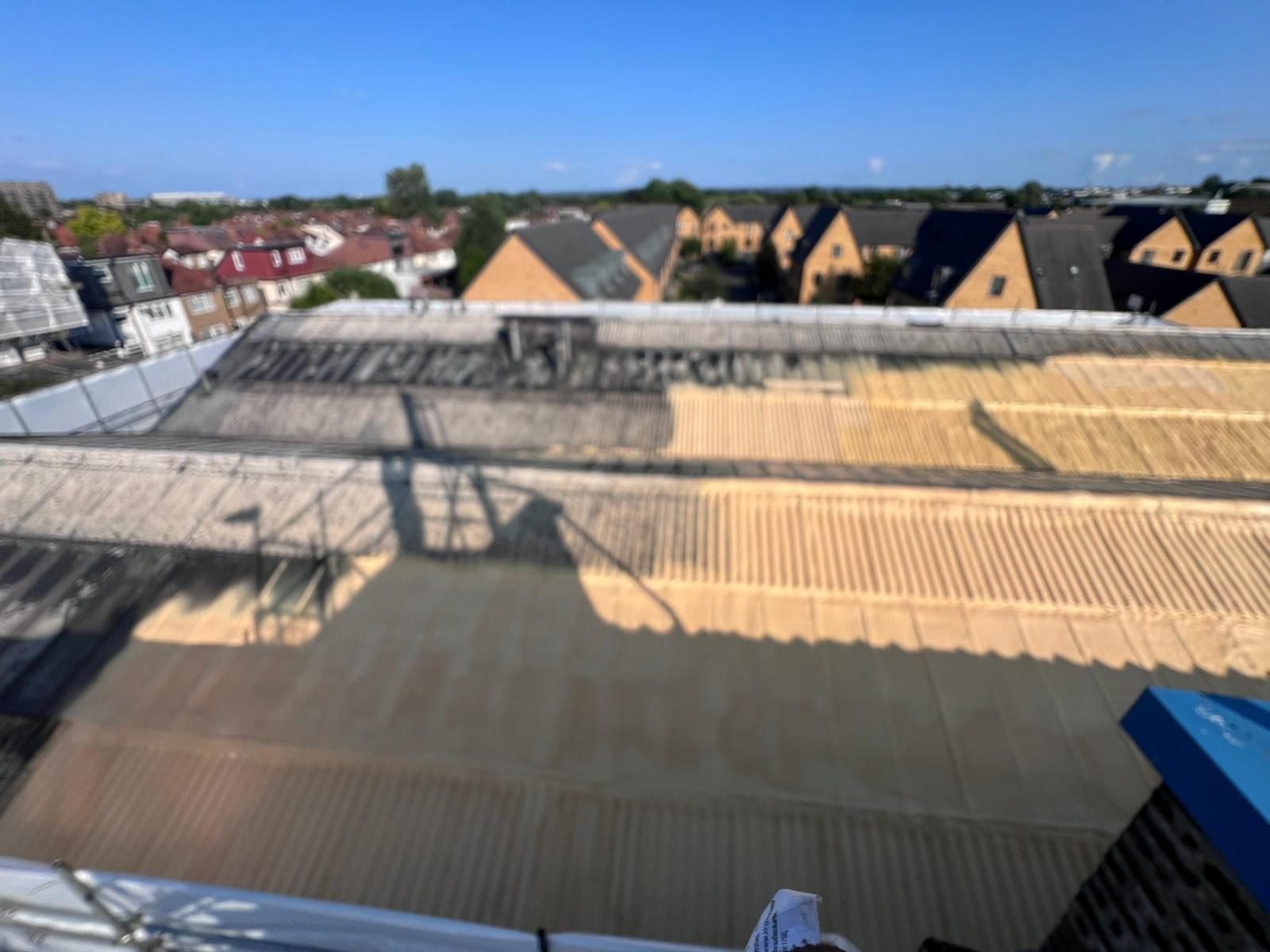
Global House illustrates a complete external system: biocidal wash, 25 mm closed-cell roofing foam and an airless silicone finish. The preparation, insulation and finish form one external system.
Before the external treatment, agree which repairs must be finished. Where another contractor does them, list the work and handover in the quote. The new finish goes onto a roof that has been made ready.
 Project recordGlobal House, Surbiton
06Sealing from below
What sealing from below means
For condensation, we look underneath instead. On a suitable roof, specified insulation stops condensation forming on the treated underside. The existing sheets remain in place, and the weather side keeps its own repair and maintenance requirements.
From above
An external system on the weather side
- Silicone finish: the weathering layer.
- Roofing foam. 25 mm closed-cell roofing foam on the prepared, washed surface.
- The sheet. Retained; prerequisite roof repairs come first.
From below
Insulation beneath the retained sheet
- The sheet. Retained in place, with the asbestos records and management plan kept up to date.
- Closed-cell insulation. Bonded beneath the sheet for confirmed condensation; the depth is confirmed before we spray.
Guaranteed to stop condensation when we confirm it is condensation at survey, set the depth, and the roof has no existing leaks.
Complete repairs to damaged sheets and existing leaks first. Keeping the roof also means keeping its asbestos records and management arrangements active after the treatment.
Check the quote for the build-up, depth, area treated, exclusions and access plan. Read Asbestos roof encapsulation to see how that underside application is specified.
07When replacement is right
When the roof needs replacing
If the roof cannot support the planned repair or retained-roof treatment, move to another route. The competent material, condition and structural assessments, together with your future plans, establish whether replacement is needed.
Price the removal and new roof together. Include access, waste arrangements, replacement construction, junctions and handover so you can see what will be finished. A removal-only quote leaves the replacement roof to be budgeted separately.
For the wider decision, read replacing an asbestos cement roof, which compares retention, encapsulation, overcladding and replacement.
08Observe from safe positions
Observe from safe positions
Whatever the route, take enquiry photographs from safe positions. Do not walk onto the roof. HSE’s fragile-surface guidance covers managing the risks of roof work, and a treatment does not make fragile sheets safe to walk on.
From the floor or another safe accessible position, show the whole underside and the wet area. Note the weather and operating pattern. The roofing and asbestos professionals then establish what inspections and access the job needs.
09The project records
What the project records show
Global House, Surbiton
At Global House, we worked from above on about 1575 m² of pitched asbestos-cement roofs and an office roof. A biocidal wash prepared the surface for 25 mm roofing foam and an airless silicone finish, as one system. Removal had been ruled out with homes and businesses close by. We wash only to prepare for coating, never as a standalone service.
The retained commercial roof
An unnamed commercial roof: 2340 m² of asbestos-cement kept in place and sealed from below with 50 mm closed-cell.
The customer reported underside condensation mitigation.
Black Hangar Studios, Alton
From the project record
4000 m² hangar under a corrugated asbestos-cement roof sealed from below.
The sheet stayed in place and was treated entirely from underneath. Read Black Hangar Studios.
Backed by our 25 year HOLVEM workmanship warranty, plus the manufacturer's 25 year product warranty issued directly to you.

