
The short answer
Asbestos roof removal cost on a commercial building starts with what you are buying: removal alone or a new roof as well. Straightforward large-roof removal is typically £20 to £40/m² + VAT; removal and an insulated replacement are typically £100 to £160/m² + VAT. If the sheets are safe to retain, we can quote encapsulation from below.
Start with the person responsible for asbestos in your building and the survey information they hold. A qualified asbestos surveyor checks what the planned work needs. We then assess the retained-roof treatment. HOLVEM never removes asbestos sheets. If the roof is safe to keep, we encapsulate it; if not, removal is a job for asbestos removal professionals, licensed where HSE requires it.
01What does a published removal figure tell you?
What does a published removal figure tell you?
With that information, the figures become useful. Check the date, roof type and work behind each rate, then ask for a quote for your building. Removal alone and a complete replacement roof belong in separate rows of the comparison.
Put the measured area, access, disposal, new roof and VAT beside the total. Our encapsulation quote shows the treatment we will carry out. That gives you a clear comparison with the removal contractor's complete proposal.
02Asbestos roof removal and encapsulation: the figures side by side
Asbestos roof removal and encapsulation: the figures side by side
Typical UK industry figures, 2026. Send photographs or drawings for a free estimate.
| Route | Typical cost per m², plus VAT | What the figure covers |
|---|---|---|
| Removal and disposal only: straightforward commercial roof, about 500 m² or more | £20 to £40 | Good access and sheets in good condition; a new roof is extra |
| Removal and disposal: small, damaged, fragile or hard-to-reach roof | £60 to £100 or more | More demanding removal; confirm the particular job in writing |
| Remove and replace with a new insulated roof | £100 to £160 | A complete roof-replacement route; check the quoted access and exclusions |
| HOLVEM encapsulation from below, 50 mm closed-cell | £22 to £35 | Foam only on a roof that is safe to keep, using our cost-guide band |
Scaffold, edge protection and powered access are usually extra on removal-only work. So a £20 removal figure is not a £20 new roof. Ask for removal, disposal, replacement, access and any closures to be itemised.
If your roof is safe to retain, encapsulation keeps the sheets in place and lets us plan the work from below around the building. If it needs to come off, use a complete removal-and-replacement quote. Our cost guide remains the source for HOLVEM's foam prices.
03Does removing an asbestos-cement roof need a licensed contractor?
Does removing an asbestos-cement roof need a licensed contractor?
Often it is non-licensed work, where the sheets can be handled carefully without breaking them up. HSE lists substantially damaged or broken-up asbestos-cement removal among notifiable non-licensed work. A qualified risk assessment checks the material and planned task before confirming the category. Read HSE's non-licensed work guidance.
04What are you buying when the roof is removed?
What are you buying when the roof is removed?
If the survey points to removal, your next question is what replaces the sheets. Price the removal and new roof together, including the details that will keep the building dry when the work is finished.
Work through the whole route from the roof you have to the roof you need. Several contractors may be involved, so include every stage in the budget and name who takes responsibility for each handover.
Survey and planning
Give the surveyor your asbestos information and explain the work you are planning. They decide whether the existing survey covers it or whether a refurbishment and demolition survey is needed. Make sure that information reaches the contractors pricing the job.
Once the material is identified, the roof still needs its own plan: what stays, what comes off, what replaces it and when the building can operate. Keep those decisions alongside the survey so everyone prices the same job.
Access and working area
Ask which access measures are included and which need another quotation. The proposed working area should be defined, including restrictions affecting staff, stock, vehicles and neighbouring activities. A building in use needs an occupation plan that matches the work.
An access allowance for one method may not cover another. External removal and internal treatment can require different equipment, protection and exclusion arrangements. Comparing both proposals under the heading “access included” is not enough; ask what is included and where.
Removal, disposal and who is responsible
Ask the removal professionals to spell out the sheets covered, the work category, controls and waste route. The risk assessment sets those requirements for your job. HOLVEM never removes asbestos sheets.
The removal professionals check whether the task is licensed, non-licensed or notifiable non-licensed work under HSE rules. Where removal is licensable, use a licensed asbestos-removal contractor. The task and risk assessment decide the category.
Replacement and roofing details
A replacement quotation should state the new roof construction and the details included. Ask what happens at rooflights, drainage, edges and penetrations, and whether any work to the supporting structure is included or excluded.
Then join the roofing stages up. If the frame needs investigation or repair, a structural engineer checks it before the new roof goes on. Agree who is responsible between removal and replacement, including weather protection and the condition of the supports.
Operations and handover
Include the effect of the works on the building's use. Ask about temporary restrictions, protection, phased working and the point at which an area can be handed back. These can matter to the business even where they are not line items in the roofing price.
Ask what completion documents will be provided and who retains them. A clear handover should describe what was removed, retained or treated and the limits of the work. It should not leave the next maintenance team guessing about the roof assembly.
What moves a removal quotation
| Cost driver | Ask the quote to state |
|---|---|
| Asbestos survey or register | Which survey the price is based on |
| Work category | Non-licensed, notifiable non-licensed or licensed, and who checked it |
| Area and sheet profile | Measured area and any profile allowance |
| Access and fall protection | Scaffold, edge protection and fragile-roof measures |
| State of the sheets | How damaged or weathered sheets will be handled |
| Waste | Wrapping, registered waste carrier, hazardous waste consignment and disposal site |
| Replacement roof | New sheet and insulation specification, supporting-structure work, or excluded |
| Operations | Working hours, closed areas and duration |
| VAT and exclusions | Stated in writing |
05What are you buying when the roof is retained?
What are you buying when the roof is retained?
If the sheets are safe to keep, the choice changes. We can encapsulate them in place, with the preparation, treatment and access set out in your quote. Leaks and structural repairs come first, and the retained asbestos stays in the management plan.
Next, choose the face that needs treatment. Foam beneath the sheet tackles the underside; a complete external system includes its weathering finish. Ask the quote to show that difference, from preparation through to handover.
We check whether keeping the roof makes sense for the building and your future plans. That decision comes before the price comparison. You can then weigh up the routes that actually suit your roof.
If the condition survey shows the sheets are safe to keep, we encapsulate the roof from beneath: closed-cell spray foam bonds to the underside, enclosing the sheet, its laps and its fixings, and the sheet is not walked on, cut, drilled or removed. It doesn't make the roof watertight; leaks go to a roofer first. If the roof fails the survey, we say so before you spend anything and refer you to asbestos removal professionals, licensed where HSE requires it. See how fibre-cement and asbestos-cement encapsulation works.
06Global House: an external system with the roof retained
Global House: an external system with the roof retained
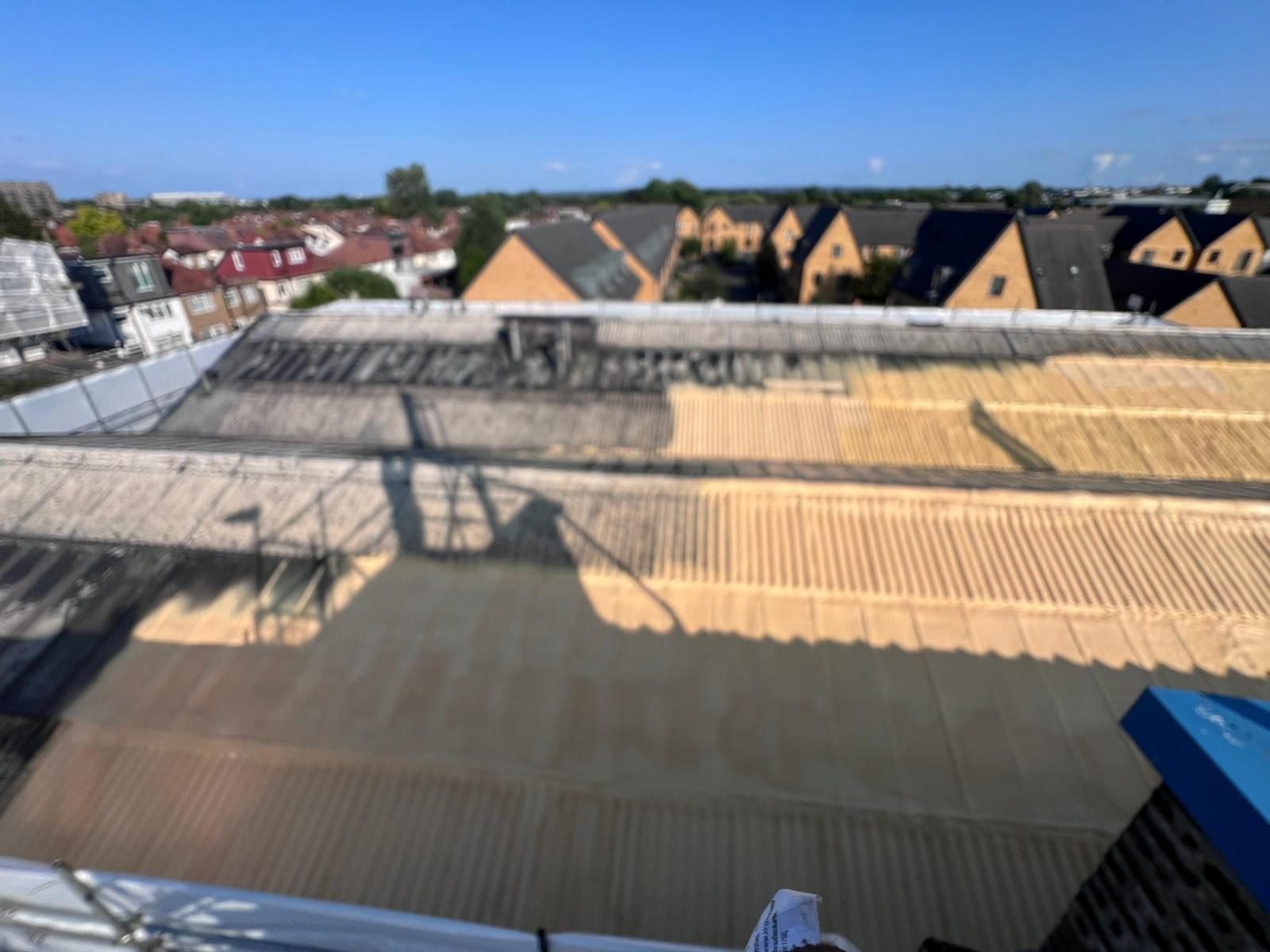
Global House in Surbiton shows the external route:
 Project recordGlobal House, Surbiton
From the project record
At Global House, we treated about 1575 m² of pitched asbestos-cement roofs and an office roof from above. A biocidal wash prepared the surface, followed by 25 mm roofing foam and an airless silicone finish as one system. Removal had been ruled out with homes and businesses close by. We wash only before coating, never as a standalone service.
Read Global House, Surbiton.
There, preparation, roofing foam and silicone finish formed one continuous system. So we price the external job together, including access and details. The foam-only underside rate buys different work.
07Retaining and sealing a commercial roof from beneath
Retaining and sealing a commercial roof from beneath
On a separate commercial roof, we treated the underside:
 Project recordA 2340 m² asbestos-cement roof
From the project record
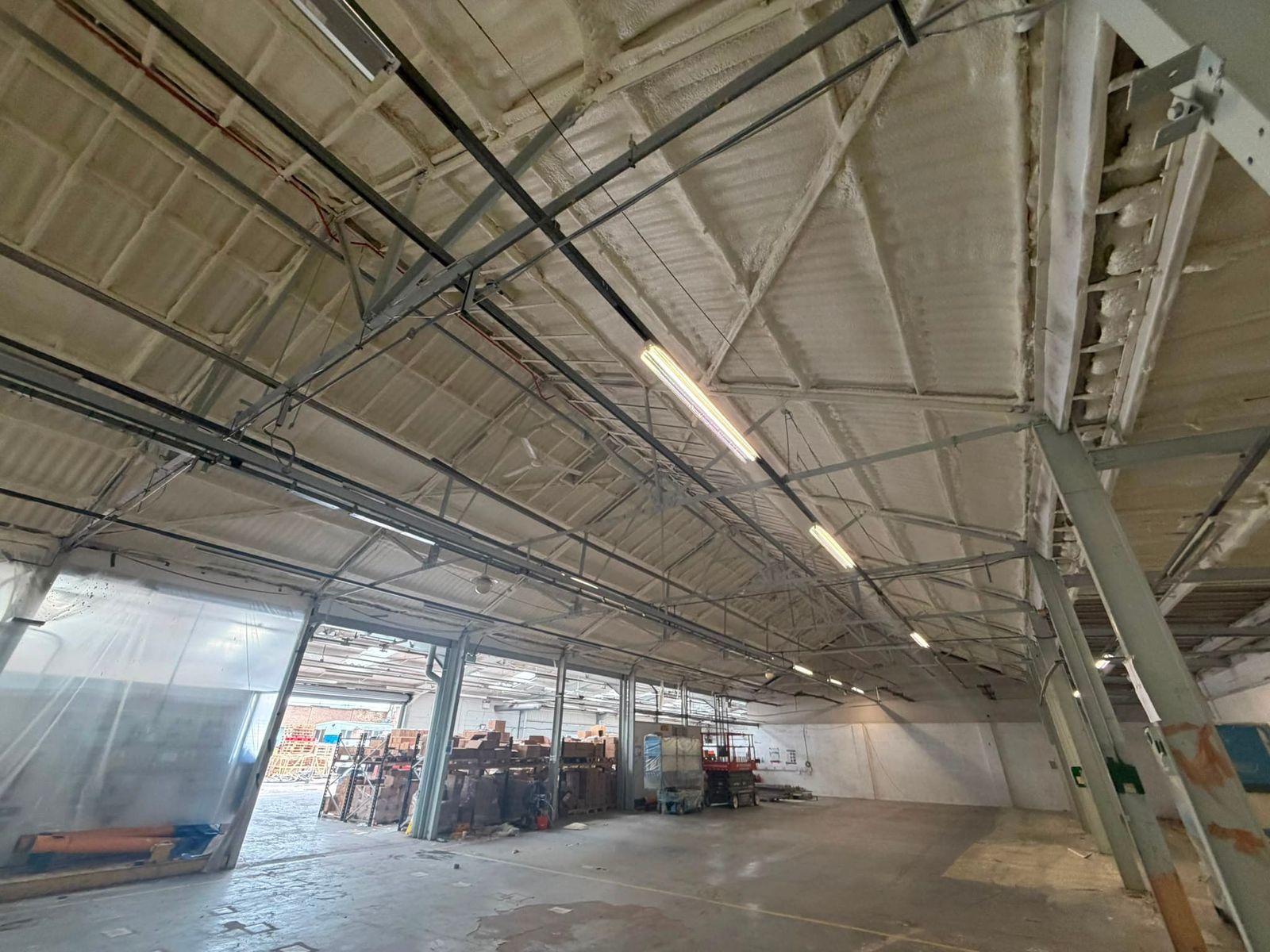
an unnamed commercial roof: 2340 m² of asbestos-cement kept in place and sealed from below with 50 mm closed-cell.
the customer reported underside condensation mitigation.
The customer reported underside condensation mitigation. Those sheets stayed in place, sealed from below. Compare that finished treatment with what a removal-and-replacement quote delivers for your building.
At Black Hangar Studios in Alton, the roof also stayed on:
 Project recordBlack Hangar Studios, Alton
From the project record
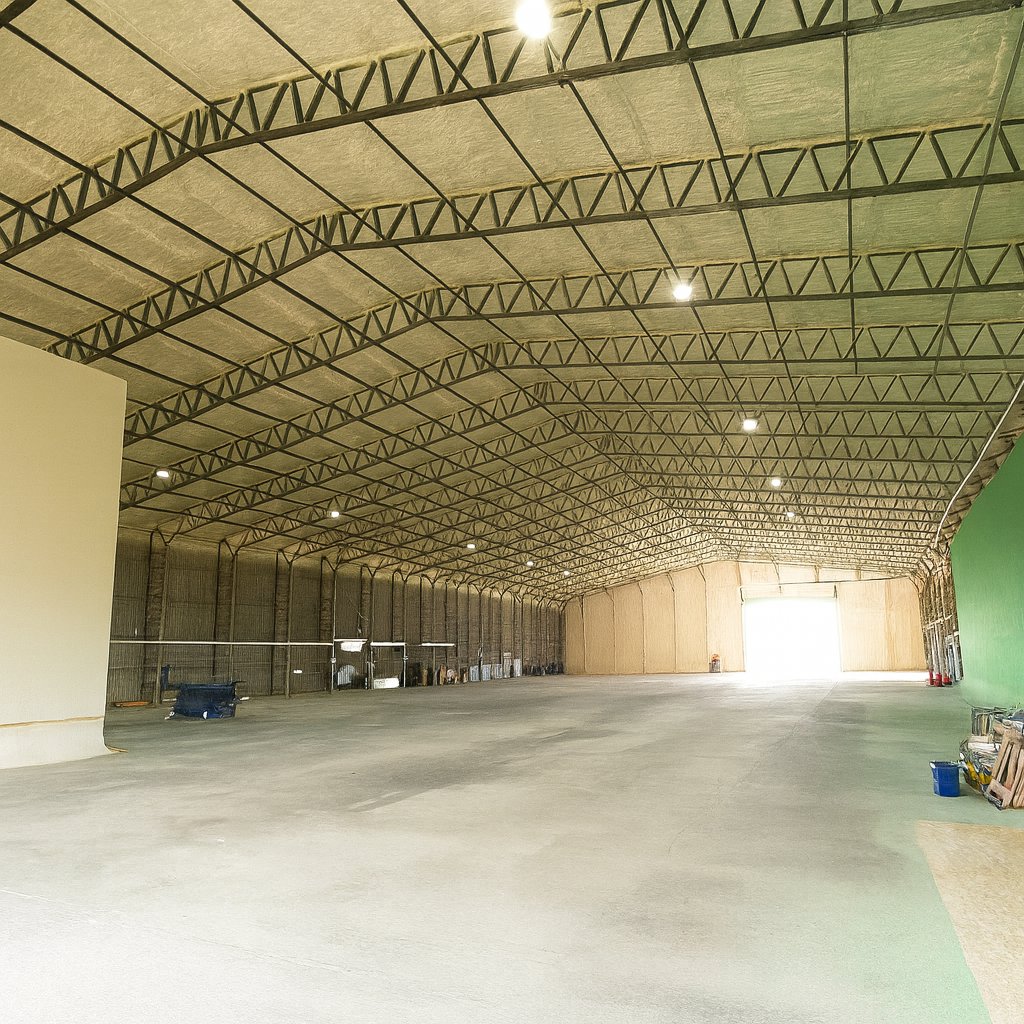
4000 m² hangar under a corrugated asbestos-cement roof sealed from below.
That job shows how we worked beneath a retained roof. Use the photographs and treatment details to understand the method, then let your own survey and written quote settle the choice and price.
At Black Hangar Studios in Alton, the corrugated asbestos-cement roof over a 4,000 m² hangar was kept in place with nothing cut or removed and sealed from below on a 25 mm closed-cell base; the studio reported that drumming and resonance from rain and wind were virtually eliminated. Read the project record.
08Build a comparison that uses the same boundaries
Build a comparison that uses the same boundaries
Now give each contractor the same brief. Include the use, roof area, material information, defects and what you want to change. Mention future alterations too, because they can affect whether retaining the sheets is the right long-term choice.
Ask for the same headings in each quote: preparation, access, finish, closures and handover. The methods remain different, but you can see what the difference in price buys.
| Comparison heading | Removal and replacement proposal | Retained-roof treatment proposal |
|---|---|---|
| Existing roof | What is removed and what remains? | Which retained areas are suitable for treatment? |
| Assessment | Which survey and condition information is required? | Which survey and substrate checks support retention? |
| Access | What access and work-zone measures are included? | What internal or external access is included? |
| Roofing defects | Which repairs and new details are included? | Which repairs must another contractor complete first? |
| The finished job | What new roof and handover are supplied? | What preparation, treatment and finish are supplied? |
| Occupation | What closure or phased programme is proposed? | What protection and restrictions are proposed? |
| Exclusions | What requires another quotation? | Which repairs, surfaces or finishes are priced separately? |
Leave unanswered items visible. If a quote excludes access, weathering repairs or disposal, request the missing proposal rather than treating the exclusion as a saving. The comparison is ready when you can describe what each finished option will provide.
Leave unanswered items visible. An exclusion is not a saving.
Our commercial cost guide gives HOLVEM's foam bands and typical method costs. Use the removal comparison here for the removal route, and get a project quote for a complete external coated system.
09Questions worth asking before choosing a route
Questions worth asking before choosing a route
Before you choose, ask each contractor to answer these questions about your roof:
- Who is the dutyholder for the premises and who holds the asbestos information?
- Has a competent surveyor considered the intended work?
- What condition information supports retaining or replacing the roof?
- Which contractor handles each part of the work?
- Which asbestos work category and controls apply to any removal?
- What roofing repairs are prerequisites to the retained-roof treatment?
- Who provides access, protects the building and handles the waste?
- Is the replacement roof fully described?
- What restrictions apply to the building's use?
- What exclusions, tax treatment and handover documents are stated?
If something is missing from a quote, ask for it before comparing totals. You want the lower cost of a complete solution, with the access, new roof and working restrictions visible alongside the treatment price.
10Keep the retained material in the management plan
Keep the retained material in the management plan
When the roof stays, keep its information with it. Update the asbestos register and management plan with the treatment and remaining actions. The next maintenance team should know which sheets and layers are still above them.
For the wider roof decision, read replacing an asbestos cement roof. For how we retain and treat suitable sheets, see fibre-cement and asbestos-cement encapsulation. Start with the survey findings, then compare the work.
Start a project brief or Send photographs. Supply existing survey information if you have it, and use images taken from safe positions. Do not disturb suspect material or access the roof to obtain a photograph.


