
The short answer
EPC requirements for commercial property in England and Wales start with the certificate: one is needed when the building is constructed, sold or let, and it lasts 10 years. Relevant privately rented non-domestic property must also meet EPC E unless a valid registered exemption applies. Proposed future standards are separate and not yet law.
An EPC is valid for 10 years. Read GOV.UK's business-premises guidance.
If your commercial property is already let, check the rating too. The E minimum has covered relevant continuing non-domestic lettings since 1 April 2023. The government’s landlord guidance explains the scope and exemptions.
Failing to make an EPC available to a prospective buyer or tenant can bring a fine of £500 to £5,000, based on the building's rateable value. Read GOV.UK's business-premises guidance.
01The first checklist
The owner's first checklist
Start with two separate questions: do you have the right EPC, and can you legally let the property? The certificate records the assessed building’s energy performance. MEES sets the minimum rating for relevant rented premises, unless a valid exemption applies.
| Check | What to establish | Who or what supplies the answer |
|---|---|---|
| Building and transaction | Is an EPC required for the proposed construction, sale, letting or alteration? | Official guidance and your commercial assessor/adviser |
| Certificate | Is the EPC current and for the correct premises? | The certificate and official register |
| Letting | Is the tenancy and building within non-domestic MEES? | Landlord guidance and competent advice |
| Rating | Does the applicable property meet E? | The current EPC |
| Exemption | Does a qualifying exemption apply, with the required evidence and registration? | The PRS Exemptions Register and supporting file |
| Improvements | Which measures and building records does the assessor need? | Your assessor, project designer and the specialists for the work |
| Future rules | Is a change law, or still a proposal awaiting legislation? | Current government publication and legislation |
Keep those jobs with the people responsible for them. We can quote for roof insulation and supply the performance information; the commercial assessor handles the certificate. A letting exemption needs its own evidence and registration.
02When an EPC is needed
When a commercial property needs an EPC
Once you know the purpose, check the trigger. GOV.UK lists selling, letting and completing a new building. An EPC can also be required when parts change for separate occupation and fixed heating, air conditioning or mechanical ventilation is provided or extended.
There are exemptions from needing an EPC for qualifying buildings and circumstances. The question should therefore be answered against the particular premises and proposed transaction, rather than by saying every commercial building always needs a certificate.
The question should therefore be answered against the particular premises and proposed transaction, rather than by saying every commercial building always needs a certificate.
If the property is being marketed or its use and subdivision are changing, speak to a commercial energy assessor early. Confirm the assessed boundary and information required so the certificate relates to the correct premises.
For an owner reviewing several documents, check the building address, unit and areas covered. A certificate for another part of a site should not be treated as evidence for the space now being sold or let.
03Assessment, validity and display
Assessment, validity and display
Next, choose a commercial energy assessor who covers your building’s complexity and features. They assess the premises and produce the EPC. GOV.UK’s guidance explains how to find the right assessor.
An EPC lasts 10 years, but check what building it describes before relying on it for a transaction. If alterations have changed the premises, ask the assessor what assessment is needed. Keep the date, scope and current construction together.
Display is another separate check. GOV.UK says an EPC must be displayed where the total useful floor area is over 500 m², the building is frequently visited by the public and an EPC has already been produced for its sale, rental or construction. All those conditions matter.
Do not confuse an EPC with a Display Energy Certificate or with a Part L calculation. The certificate and calculation routes have different purposes. Ask the project team which documents the premises require.
04The minimum for letting
The current minimum rating for letting
For a relevant privately rented non-domestic property in England and Wales, the current MEES minimum is E. Check your property and tenancy against the Department for Energy Security and Net Zero’s landlord guidance before deciding how to comply.
The dates matter if you are reviewing an existing lease. The standard applied to granting, extending or renewing relevant tenancies from 1 April 2018, then to continuing relevant lettings from 1 April 2023. Establish and register a valid exemption where required before relying on it.
Check the tenancy terms as well as the rating. Qualifying short tenancies and very long tenancies have exclusions, and MEES coverage is linked to the legal requirement for an EPC. A building type or lease label on its own does not settle the scope.
If a property is empty and not being let, the landlord guidance treats the timing of the improvement obligation differently. Check the proposed letting before committing to an interpretation; a plan to let can change the next action.
Read Commercial EPC and MEES for HOLVEM's building-performance context, and use the official landlord guidance or your adviser for the property's obligations.
05Two kinds of exemption
EPC exemptions and MEES exemptions are different
Before gathering exemption evidence, decide which rule you mean. Being exempt from an EPC requirement is different from having a registered MEES exemption. Each route has its own conditions.
GOV.UK lists qualifying certificate exemptions such as certain protected buildings, limited-life temporary buildings and low-energy-use industrial, workshop or agricultural premises. The conditions attached to those descriptions matter; check the qualifying conditions for the premises.
For MEES, work through the route that fits the property. The guidance covers cost effectiveness, all relevant improvements completed, unavailable consent, specified wall-insulation concerns, devaluation and some recently qualifying landlords. Each needs the evidence required for that category.
The evidence differs by exemption. Keep the required reports, quotations, correspondence and calculations together. Registration is part of the route, not a substitute for meeting the qualifying conditions.
Most of the listed MEES exemptions last five years, but some have different expiry rules, including a six-month temporary route for certain new landlords and qualifications where tenant consent is the issue. Check the actual expiry rather than apply one period to every entry.
Keep the payback tests separate too. MEES uses a seven-year test for relevant improvements. England’s Approved Document L has a different feasibility and payback provision for building work. Ask the relevant adviser to apply the test for the duty you are addressing.
06Penalties and enforcement
Penalties and enforcement
If an EPC is not made available to a prospective buyer or tenant, GOV.UK gives a fine of £500 to £5,000 based on rateable value. That range relates to the certificate duty.
MEES breaches are dealt with separately. The landlord guidance covers compliance notices and penalties for letting a sub-standard property and for false or misleading exemption information. Check that scale for a MEES issue; the EPC fine range answers a different question.
Keep the evidence in one property file: EPC, lease details, assessments, completed improvements and any exemption registration. If you receive a notice or face a transaction question, give that file to your adviser and commercial assessor.
07The June 2026 proposals
Proposed changes: the June 2026 position
For future planning, separate the proposal from today’s duty. The Department for Energy Security and Net Zero’s 18 June 2026 interim response proposes EPC B from 2031 for privately rented buildings over 1000 m² in England and Wales, where cost effective. Smaller buildings would remain at E under the proposal.
The response says the previously proposed EPC C milestone for 2027 will not proceed. It also states that the higher standard requires the passage of secondary legislation. These are the government's stated proposals and intentions, not a claim that every landlord already has a B duty.
Read the government's interim response.
For a planned building upgrade, keep that distinction in the brief. The assessor can help prioritise information and measures, while the project team checks the requirements actually applying to the work. Update the advice when the final rules and definitions are published.
08Where the roof fits
Where roof insulation fits in the rating
If you are improving the roof, the assessor needs its thermal performance as one building input. The EPC also considers the rest of the fabric and the services. Roof insulation contributes to the assessment, rather than setting the rating by itself.
We calculate the proposed insulation build-up from your actual construction and supply the U-value with its basis. Your assessor can then use that information in the wider assessment. We do not promise a particular EPC band or fixed uplift.
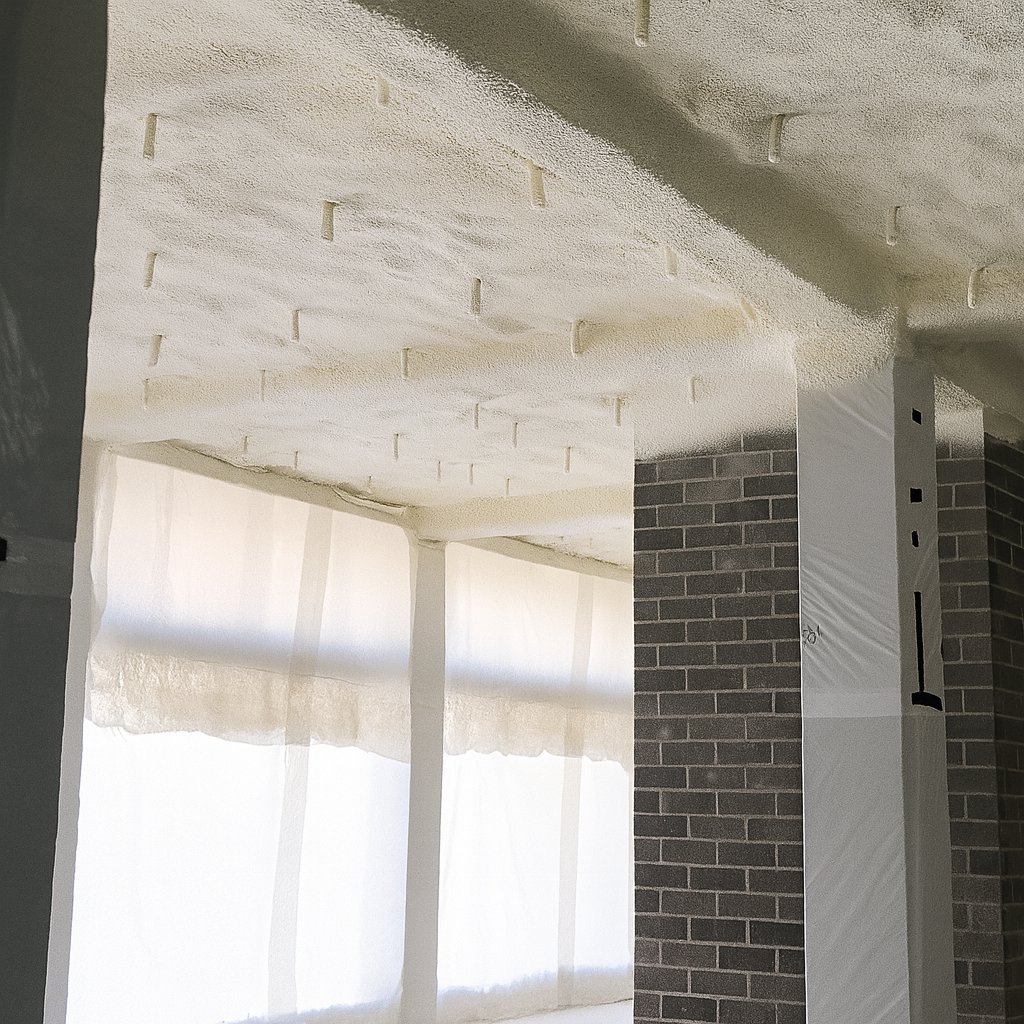
At The Box, Plymouth, the recorded specification was 787 m² of concrete soffit, 120 mm closed-cell and a specified U-value of 0.18 W/m²K.
 Project recordThe Box, Plymouth
From the project record
Read the record787 m² of concrete soffit, 120 mm closed-cell, a specified U-value of 0.18 W/m²K.
A project specification for the treated soffit, not an EPC outcome.
Derriford District Centre, Plymouth, records a design U-value of 0.18 W/m²K, with closed-cell bonded to a metal deck soffit plus open-cell. That design figure also stays attached to its build-up.
Read The Box, Derriford District Centre and U-values and Part L for the distinction between a project specification and a whole-building assessment.
09The information file
A practical information file for the assessor
The handoff, in order
- 01GatherBring together the EPC and recommendations, building use, drawings, known roof and wall layers, previous calculations and planned work.
- 02Set the briefTell us whether you need a project U-value or information for the energy assessment. Say if the target is still to be confirmed.
- 03Keep proposed and completed apartA calculation for a proposed layer is not confirmation that it has been installed.
- 04Hand offWe give you the roof's performance information; your assessor rates the building.
To prepare that handoff, start with the current EPC and recommendations. Add the use and occupation pattern, drawings, known roof and wall layers, previous calculations and proposed work. That gives the assessor and project team the same starting information.
For an insulation enquiry, state whether the objective is a project U-value or information for the wider energy assessment. If the target has not been set, say so. We can assess the construction without inventing a rating requirement for it.
Label what is proposed and what has been completed. A design calculation describes the intended layer; the installation records describe what was actually put in. Keep the final specification and work records with the building file.
We supply the roof-performance information, and your assessor evaluates the premises using the relevant method. Send drawings or Start a project brief so the calculation answers the question your project team needs resolved.
10Which check comes first
Three questions point to the first check.
Answer the three below. The result names the first check to make; the assessor or adviser confirms the obligation.
Commercial property EPC
Your premises, in three answers.
For a sale, letting or newly built premises, check whether an EPC is required and whether an exemption applies. Make sure the certificate covers this property, rather than another unit or part of the site.
GOV.UK's business-premises guidanceYour current EPC shows whether the property meets E. Whether your letting falls under the minimum standard, and whether a registered exemption applies, is for the government's landlord guidance and your adviser.
The government's landlord guidanceThe June 2026 interim response proposes EPC B from 2031 for privately rented buildings over 1000 m², where cost effective, subject to secondary legislation; smaller buildings are intended to remain under E.
Commercial EPC and MEESTell us whether you need a U-value for the project or information for your energy assessor. We calculate it and show how; it helps the assessor but does not promise a rating or a band improvement.
U-values and Part LThe current EPC and recommendations, use and occupation, drawings, the known roof and wall layers, any earlier calculations and the work you are planning. If no target has been set yet, just say so.
Send drawings11HOLVEM
Why choose HOLVEM for the roof information your assessor needs?
You need useful building information before spending on an energy upgrade. We calculate the roof or soffit's U-value and show the layers behind it. Your assessor can use that information alongside the rest of the building.
The Box has a specified 0.18 W/m²K at 120 mm closed-cell; Derriford has a design 0.18 with a different deck and hybrid insulation. Both show why the construction belongs with the figure.
Certified spray foam systems, which we apply as an accredited installer for the manufacturer, are documented in the written specification and QA evidence pack for surveyors, insurers and buyers. Our own team surveys, specifies and installs nationwide across England and Wales from four depots.
Backed by our 25 year HOLVEM workmanship warranty, plus the manufacturer's 25 year product warranty issued directly to you.
12Questions, answered
Questions about commercial property EPCs
When do I need an EPC for commercial property?
Check whether this premises and transaction require an EPC. GOV.UK lists sale, letting, new-building completion and certain alterations, with exemptions for qualifying circumstances. Your commercial assessor or adviser confirms the route for the actual building.
What minimum EPC rating is required to let commercial property?
The current minimum is E for relevant privately rented non-domestic premises in England and Wales, unless a valid exemption applies. It has covered continuing relevant lettings since 1 April 2023. Check that your property and tenancy are within scope.
How long does a commercial EPC last?
GOV.UK states that EPCs are valid for 10 years. Check that the certificate covers the correct premises and discuss significant building changes with the assessor. Validity, display and letting requirements are separate checks.
Are there exemptions?
Yes, but first distinguish an EPC exemption from a MEES exemption. MEES routes need evidence and registration. Many last five years, while some have different expiry rules, so check the particular category and property before relying on one.
What are the penalties?
For failing to make an EPC available to a prospective buyer or tenant, GOV.UK gives £500 to £5,000 based on rateable value. A MEES breach has a separate penalty scale. Use the guidance for the duty involved when reviewing a notice with your adviser.
Does insulating the roof improve the EPC rating?
We can supply the calculated roof build-up for your assessor. The final rating comes from the whole-building assessment, so we do not promise a band improvement. Send the construction, proposed work and assessor’s requirements to give the calculation a clear purpose.
13In five lines
Commercial property EPC requirements, in five lines.
- An EPC is needed when a building is constructed, sold or let, and it lasts 10 years; check that it covers the correct premises.
- Relevant privately rented non-domestic property must meet E unless a valid registered exemption applies; continuing lettings have been covered since 1 April 2023.
- An exemption from needing an EPC is not a MEES exemption; each has its own conditions, evidence and expiry.
- The June 2026 proposal is EPC B from 2031 for rented buildings over 1000 m², subject to secondary legislation. It is not yet law.
- Give the assessor the roof’s calculated U-value and construction details. HOLVEM does not promise an EPC band or fixed uplift.

