Before 3pm on a working day, contacted the same day. After 3pm, the next working day. Contact, not a quotation. Telephone
Start a project brief
Long streams of sea-glass, aqua and violet light crossing pale folded planes cut at 31 degrees, HOLVEM's abstract light plate.

Project record · Schools · Programme

Twenty-nine schools across Hampshire and Berkshire: flat roofs and cavity walls.

A programme of more than 29 primary and junior schools, each with a flat roof losing heat and risking condensation on its cold inner surface. 150 mm of SucraSeal open-cell went to the flat roof at every school, and the cavity walls were filled at several. The aim was lower energy use and a smaller carbon footprint, repeated across the estate.

29+
Schools in the programme
150mm
SucraSeal open-cell, flat roofs
0.20W/m²K
Flat roof U-value, as recorded
Walls
Cavity walls at several schools

01The programme

The same cold flat roof, twenty-nine times over.

Primary and junior schools across two counties share a building type: single-storey blocks under flat roofs, built when energy was cheap and insulation was thin. The roofs lose heat all through the heating season, and on a cold morning their inner surfaces sit close to the dew point of a full classroom. The programme treated them one school at a time, with the same specification.

What the schools had in common. Flat roofs with little insulation, long heating hours, and rooms full of children producing warmth and moisture. The energy bill was the visible cost; the condensation risk on cold surfaces, with the damp and mould that follow, was the hidden one.

What the programme set out to do. Give each school a reliable insulation layer that cut energy use and carbon, and took the surface condensation risk out of the roof for the whole year. Where the walls were cavity construction, fill them too.

Why a programme and not a job. One specification, surveyed and applied school by school, is cheaper to run and easier to check than twenty-nine separate designs. The depth, the product and the method were fixed; the survey confirmed each roof against them.

Schools named on the published record

  • Stoke Park Junior SchoolHampshire
  • Shamblehurst Primary SchoolHampshire
  • Marchwood Junior SchoolHampshire
  • Brockhurst Primary SchoolHampshire
  • And more than twenty-five othersAcross Hampshire and Berkshire
Buildings
Primary and junior schools, single-storey blocks
Location
Hampshire and Berkshire
Roofs
Flat roofs, 150 mm SucraSeal open-cellAt every school in the programme
Walls
Cavity walls insulatedAt some of the schools
U-value
0.20 W/m²K, flat roof build-upAs recorded on the programme
Client
The schools, named above

02What we specified, and why

150 mm of open-cell to the flat roofs, and the cavity walls filled where there were cavities.

A flat roof over a classroom has to meet a thermal target and stay dry on its inner face through a full winter of occupied rooms. Open-cell at 150 mm answers the first; the condensation-risk analysis for the build-up answers the second.

  • The roofs: Enverge SucraSeal open-cell, at 150 mm. A soft, vapour-open foam that expands to fill the roof construction around joists, services and fixings, where boards leave gaps. At 150 mm it took the flat roof build-up to a U-value of 0.20 W/m²K, as recorded on the programme. Open-cell system data.
  • Why open-cell for a flat roof. Depth is what a flat roof needs, and open-cell gives depth economically while staying vapour-open, so the roof construction can dry. The build-up is checked by condensation-risk analysis to BS EN ISO 13788 and designed to BS 5250, so the inner surface stays above the dew point of a full classroom all year. Flat roofs, the application.
  • The walls, where there were cavities. Several of the schools had cavity walls, and these were insulated as part of the same visit, so the roof and the walls stopped leaking heat together. Walls, the application.
  • One specification, many surveys. The depth and the product were fixed for the programme; each roof was surveyed to confirm the build-up, the access and the moisture before the rig arrived.
Roofs
Enverge SucraSeal open-cell, 150 mm
Walls
Cavity walls insulated at some schools
U-value
0.20 W/m²K, flat roof build-up, as recorded
Condensation
Surface risk designed out year-round, as recorded
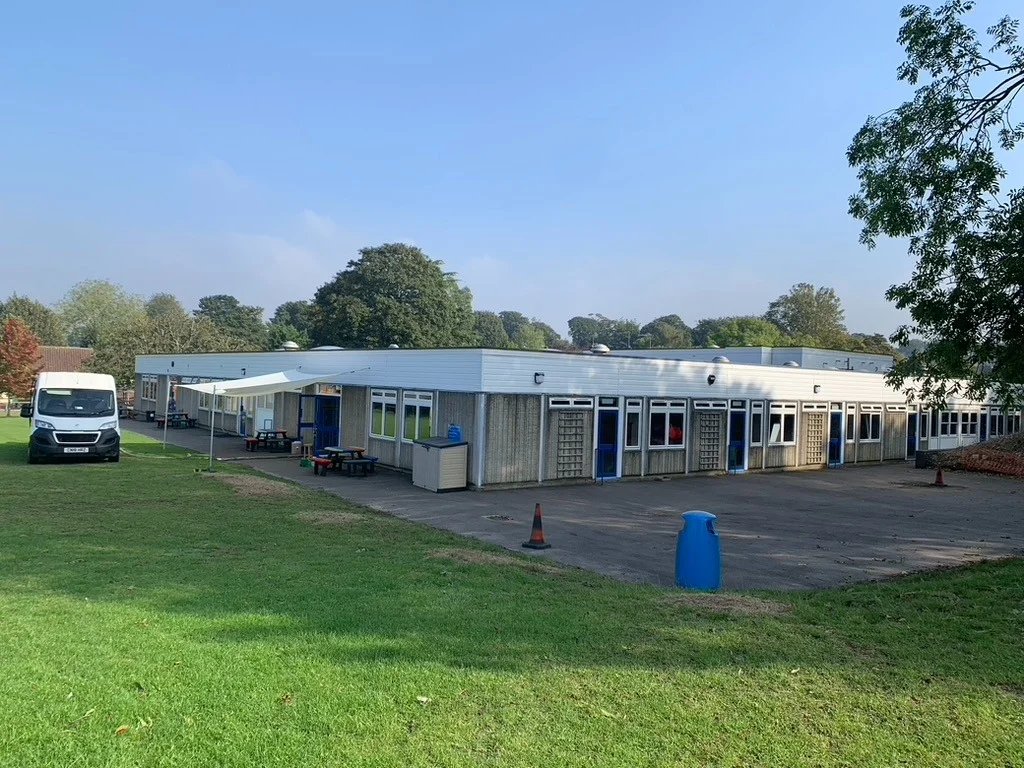
At one of the schools in the programme: the insulation work in progress.
Project recordAt one of the schools

At one of the schools. The one photograph on the published record of the programme. Project record.

03How the programme ran

Survey, book, spray, record. Then the next school.

School work is booked to the school calendar: in the holidays where a whole block is involved, or in a zone segregated from pupils and staff where a term-time visit is unavoidable. The programme ran school by school on that basis, with the same four steps each time.

  1. Survey each school

    The roof and the walls read.

    Flat roof construction, access into it, the state of the deck, and whether the walls had cavities to fill. The 150 mm specification confirmed against the build-up.

  2. Book to the calendar

    Holidays first.

    Each visit placed in a break, or in a segregated zone with its own access where the school year could not wait. Fire strategy and the asbestos register checked before the rig arrived.

  3. Apply

    Roof, then walls.

    SucraSeal sprayed in passes to 150 mm across the flat roof construction, filling around joists, services and fixings. Cavity walls filled at the schools that had them.

  4. Record and move on

    One school signed off, the next booked.

    What was applied, where and at what depth, recorded for the estates file at each school, and the programme moved to the next site.

04The outcome

A U-value of 0.20 on every roof, and the condensation risk taken out of the year.

The record states two things and we repeat them as stated. It does not state a metered energy saving, so neither do we.

Flat roof U-value

0.20W/m²Kas recorded

The flat roof build-up at each school, with 150 mm of SucraSeal open-cell in it.

Surface condensation risk

Removedyear-round, as recorded

The inner surface of each roof designed to stay above the dew point of an occupied classroom through the year.

Schools treated

29+to one specification

The same product, depth and method, surveyed and applied school by school.

Walls

Filledwhere cavities existed

Cavity walls insulated at several of the schools in the same visit.

Where this record comes from

What it does not state. No metered energy or carbon figure was published for the programme, so none appears here.

Your school will differ. Roof construction, occupancy and heating hours change the depth a flat roof needs. U-values and Approved Document L.

Your next step

Your building.
Your brief.
A specialist.

If you already know the U-value or thickness you need, tell us and we price to it. If you do not, tell us what you know about the building and the problem, and we work it out with you. Someone who does this every day reads it and comes back to you.

Start a project brief About five minutes. Photographs help; nothing else is needed.

Or pick up the phone

Telephone . Before 3pm on a working day, you are contacted the same day. After 3pm, the next working day. A commitment to contact, not a quotation.

Want a figure before you talk to anyone? What it costs: the cost guide